Franco Ortega Sara, Ferrocino Ilario, Adams Ian, Silvestri Simone, Spadaro Davide, Gullino Maria Lodovica, Boonham Neil
Centre of Competence for the Innovation in the Agro-Environmental Sector-AGROINNOVA, University of Turin, Via Paolo Braccini 2, I-10095 Grugliasco (TO), Italy.
Department of Agricultural, Forestry and Food Sciences (DiSAFA), University of Torino, Via Paolo Braccini 2, I-10095 Grugliasco (TO), Italy.
J Fungi (Basel). 2020 Dec 17;6(4):372. doi: 10.3390/jof6040372.
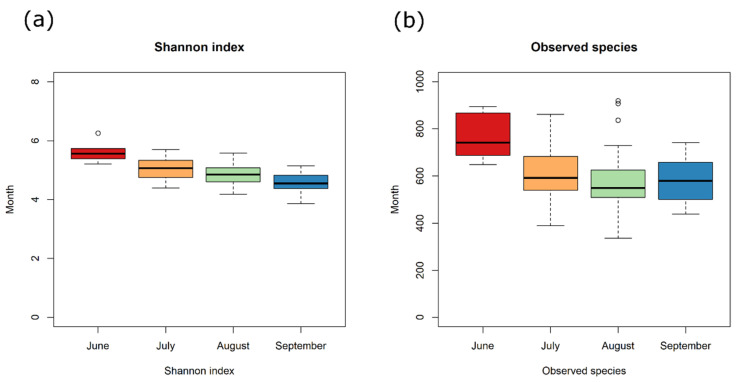
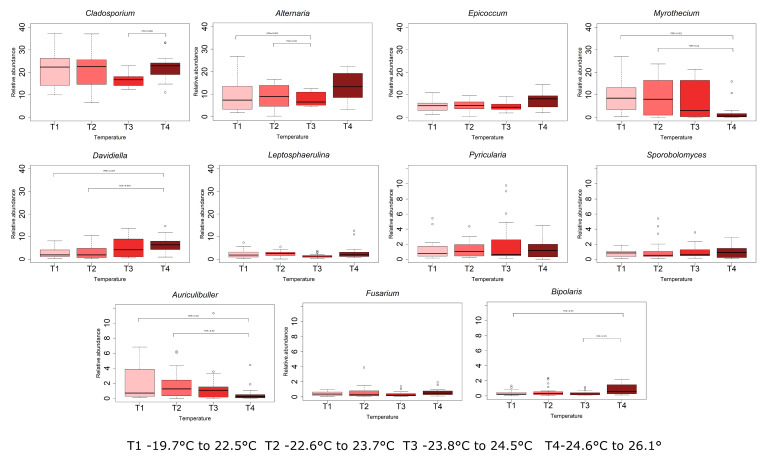
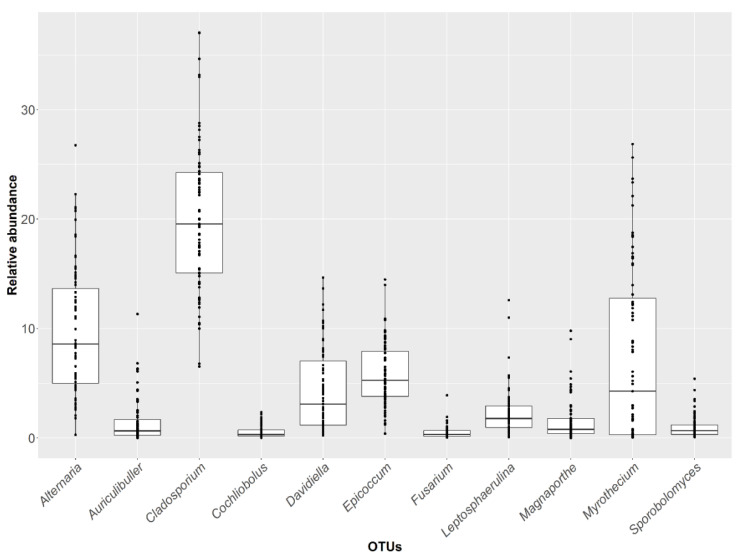
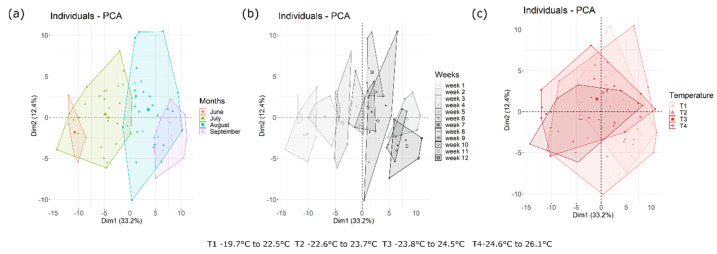
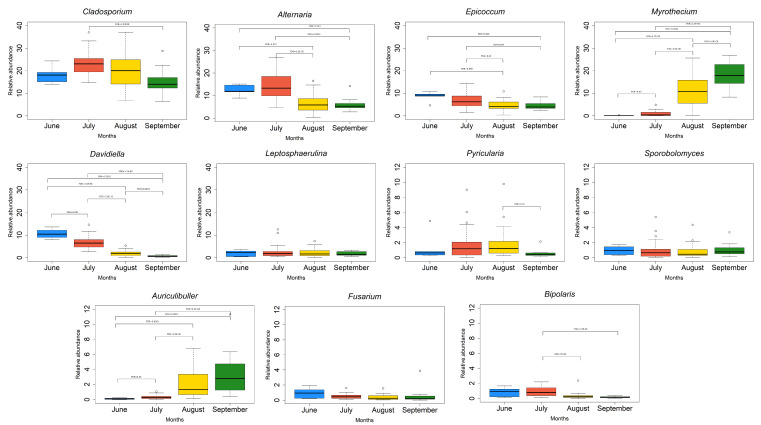
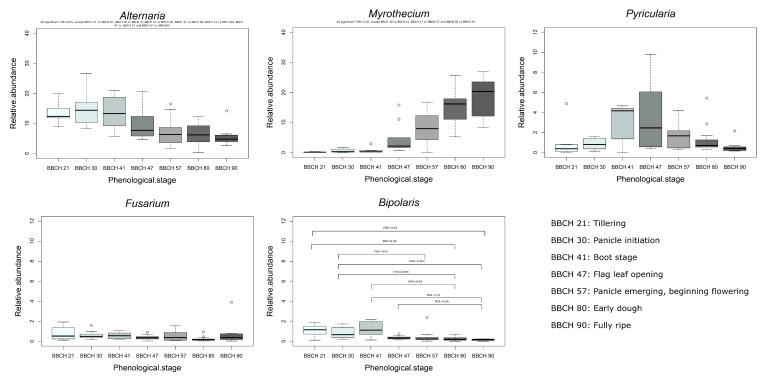
The airborne mycobiota has been understudied in comparison with the mycobiota present in other agricultural environments. Traditional, culture-based methods allow the study of a small fraction of the organisms present in the atmosphere, thus missing important information. In this study, the aerial mycobiota in a rice paddy has been examined during the cropping season (from June to September 2016) using qPCRs for two important rice pathogens ( and ) and by using DNA metabarcoding of the fungal ITS region. The metabarcoding results demonstrated a higher alpha diversity (Shannon-Wiener diversity index H' and total number of observed species) at the beginning of the trial (June), suggesting a higher level of community complexity, compared with the end of the season. The main taxa identified by HTS analysis showed a shift in their relative abundance that drove the cluster separation as a function of time and temperature. The most abundant OTUs corresponded to genera such as , , or . Changes in the mycobiota composition were clearly dependent on the average air temperature with a potential impact on disease development in rice. In parallel, oligotyping analysis was performed to obtain a sub-OTU identification which revealed the presence of several oligotypes of and with relative abundance changing during monitoring.
与其他农业环境中的真菌群落相比,空气传播的真菌群落研究较少。传统的基于培养的方法只能研究大气中一小部分生物,从而遗漏了重要信息。在本研究中,在种植季节(2016年6月至9月),利用针对两种重要水稻病原体的定量PCR以及真菌ITS区域的DNA宏条形码技术,对稻田中的空气传播真菌群落进行了检测。宏条形码分析结果表明,与季节末期相比,试验开始时(6月)的α多样性(香农-维纳多样性指数H'和观察到的物种总数)更高,这表明群落复杂性更高。通过高通量测序分析确定的主要分类群显示,它们的相对丰度发生了变化,这种变化推动了聚类分离,使其成为时间和温度的函数。最丰富的操作分类单元对应于如、、或等属。真菌群落组成的变化明显取决于平均气温,这可能对水稻病害发展产生影响。同时,进行了寡型分析以获得亚操作分类单元识别结果,该结果揭示了和的几种寡型的存在,其相对丰度在监测期间发生了变化。