Department of Physiotherapy, Prince of Wales Hospital, Sydney, NSW 2031, Australia.
Faculty of Medicine, Prince of Wales Clinical School, University of New South Wales, Sydney, NSW 2031, Australia.
Sensors (Basel). 2020 Dec 17;20(24):7238. doi: 10.3390/s20247238.
Objective assessment of shoulder joint active range of motion (AROM) is critical to monitor patient progress after conservative or surgical intervention. Advancements in miniature devices have led researchers to validate inertial sensors to capture human movement. This study investigated the construct validity as well as intra- and inter-rater reliability of active shoulder mobility measurements using a coupled system of inertial sensors and the Microsoft Kinect (HumanTrak).
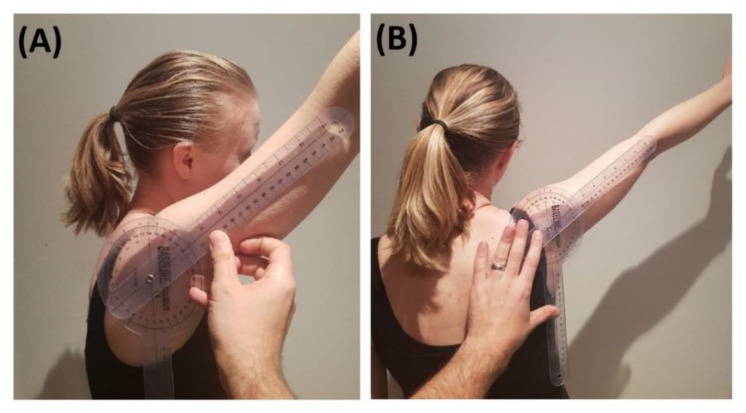
50 healthy participants with no history of shoulder pathology were tested bilaterally for fixed and free ROM: (1) shoulder flexion, and (2) abduction using HumanTrak and goniometry. The repeat testing of the standardised protocol was completed after seven days by two physiotherapists.
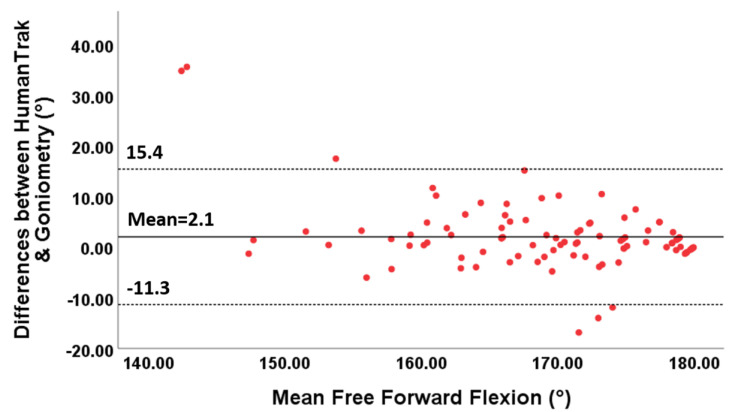
All HumanTrak shoulder movements demonstrated adequate reliability (intra-class correlation (ICC) ≥ 0.70). HumanTrak demonstrated higher intra-rater reliability (ICCs: 0.93 and 0.85) than goniometry (ICCs: 0.75 and 0.53) for measuring free shoulder flexion and abduction AROM, respectively. Similarly, HumanTrak demonstrated higher intra-rater reliability (ICCs: 0.81 and 0.94) than goniometry (ICCs: 0.70 and 0.93) for fixed flexion and abduction AROM, respectively. Construct validity between HumanTrak and goniometry was adequate except for free abduction. The differences between raters were predominately acceptable and below ±10°.
These results indicated that the HumanTrak system is an objective, valid and reliable way to assess and track shoulder ROM.
客观评估肩关节主动活动度(AROM)对于监测保守或手术干预后患者的进展至关重要。微型设备的进步促使研究人员验证惯性传感器以捕捉人体运动。本研究旨在探讨使用惯性传感器和 Microsoft Kinect(HumanTrak)耦合系统测量主动肩部活动度的构效关系以及组内和组间可靠性。
50 名无肩部病史的健康参与者分别使用 HumanTrak 和量角器双侧测试固定和自由 ROM:(1)肩关节前屈,(2)外展。两名物理治疗师在七天后重复测试标准化方案。
所有 HumanTrak 肩部运动均具有足够的可靠性(组内相关系数(ICC)≥0.70)。与量角器(ICC:0.75 和 0.53)相比,HumanTrak 分别测量自由肩关节前屈和外展 AROM 的组内可靠性更高(ICC:0.93 和 0.85)。同样,HumanTrak 分别测量固定前屈和外展 AROM 的组内可靠性也高于量角器(ICC:0.81 和 0.94)。除了自由外展,HumanTrak 和量角器之间的构效关系是适当的。评估者之间的差异主要是可接受的,并且在±10°以内。
这些结果表明,HumanTrak 系统是一种客观、有效且可靠的评估和跟踪肩部活动度的方法。