Tan Y N, Vandekerckhove P J, Verdonk P
Department of Orthopedics and Traumatology, University Hospital Brussels, Laarbeeklaan 101, 1090, Jette, Belgium.
Department of Orthopedics and Traumatology, Sint-Jan Hospital, Ruddershove 10, 8000, Orthoclinic, AZ, Belgium.
J Exp Orthop. 2020 Dec 21;7(1):99. doi: 10.1186/s40634-020-00316-9.
The primary aim of our study was to investigate elective orthopaedic care during the first wave government-imposed COVID-19 lockdown and at four weeks and 21 weeks after resuming elective care. The secondary aim of our study was to evaluate the implementation of the European Society of Sports Traumatology, Knee Surgery and Arthroscopy (ESSKA) COVID-19 Guidelines and Recommendations for Resuming Elective Surgery in the clinical practice of Belgian knee surgeons.
We sent three anonymous online surveys to 102 Belgian Knee Society members (BKS) at times mentioned above. Addressed topics were: (1) participant demographics, (2) elective surgeries, (3) outpatient visits, (4) ESSKA Guidelines, (5) patient and surgeon safety.
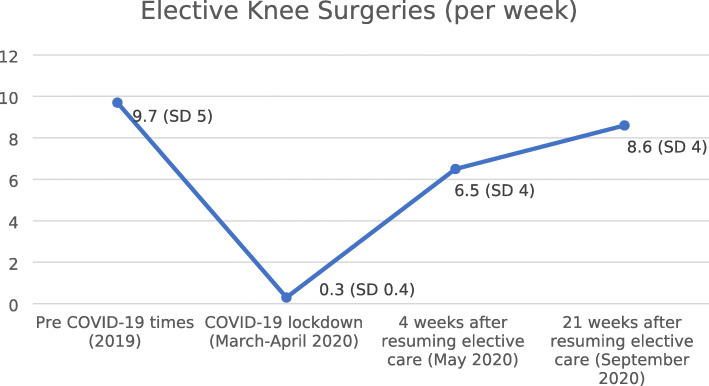
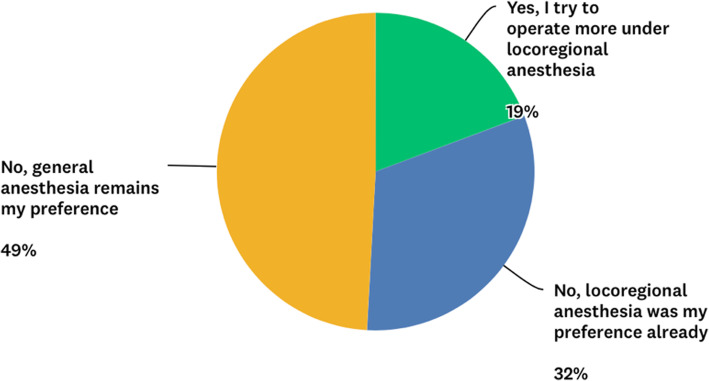
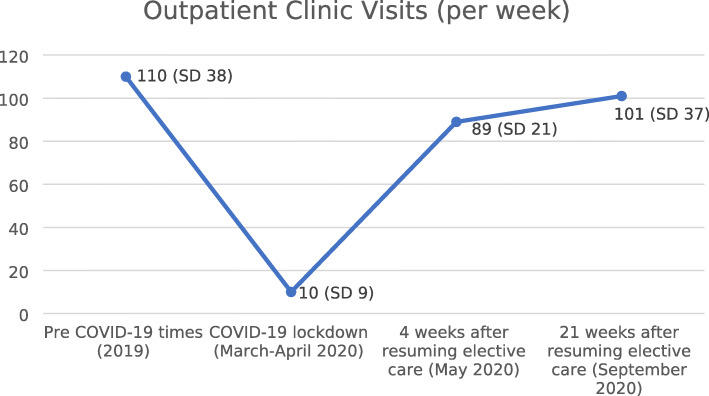
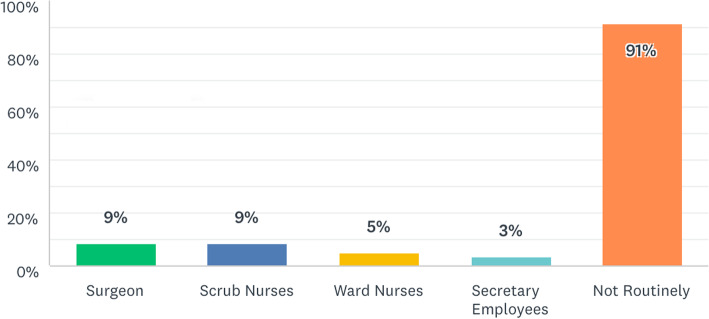
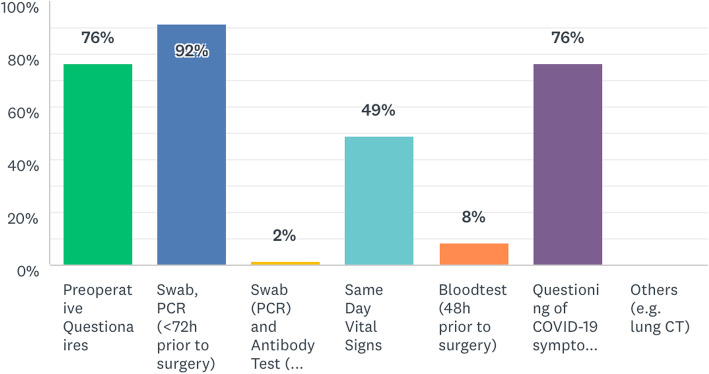
During the COVID-19 lockdown, there was a decrease of 97% in elective knee surgeries and 91% in outpatient visits. At four and 21 weeks after resuming elective care, volumes were respectively 67% and 89% for elective surgeries and 81% and 91% for outpatient visits. Regarding ESSKA guidelines, 91% of surgeons had no COVID-19 testing prior to resuming elective care. Ninety-two per cent reported preoperative (< 72 h) patient PCR testing, and 45% gave preference to young patients without comorbidities. Seventy-two per cent did not use additional personal protective equipment (PPE) if a patient PCR test was negative. Forty-nine per cent continued to give preference to general anaesthesia.
Our study shows that elective surgeries and outpatient visits were almost completely interrupted during the COVID-19 lockdown and were still below normal at four and 21 weeks after resuming elective care. Regarding ESSKA COVID-19 guidelines, our study observes good compliance in preoperative patient COVID-19 testing, but lower compliance for preoperative health care personnel testing, patient selection, use of PPE, and locoregional anaesthesia.
V.
我们研究的主要目的是调查在政府实施的第一波新冠疫情封锁期间以及恢复择期治疗四周和二十一周后的择期骨科护理情况。我们研究的次要目的是评估欧洲运动创伤学、膝关节手术和关节镜学会(ESSKA)新冠疫情期间恢复择期手术的指南和建议在比利时膝关节外科医生临床实践中的实施情况。
我们在上述时间向102名比利时膝关节学会成员(BKS)发送了三项匿名在线调查问卷。涉及的主题包括:(1)参与者人口统计学信息,(2)择期手术,(3)门诊就诊,(4)ESSKA指南,(5)患者和外科医生安全。
在新冠疫情封锁期间,择期膝关节手术减少了97%,门诊就诊减少了91%。恢复择期治疗四周和二十一周后,择期手术量分别为67%和89%,门诊就诊量分别为81%和91%。关于ESSKA指南,91%的外科医生在恢复择期治疗前未进行新冠病毒检测。92%的医生报告进行了术前(<72小时)患者PCR检测,45%的医生更倾向于选择无合并症的年轻患者。如果患者PCR检测呈阴性,72%的医生不使用额外的个人防护装备(PPE)。49%的医生仍然更倾向于全身麻醉。
我们的研究表明,在新冠疫情封锁期间,择期手术和门诊就诊几乎完全中断,恢复择期治疗四周和二十一周后仍低于正常水平。关于ESSKA新冠疫情指南,我们的研究观察到在术前患者新冠病毒检测方面有良好的依从性,但在术前医护人员检测、患者选择、PPE使用和局部麻醉方面依从性较低。
V级