Hong Ji Youn, Shin Eun Young, Herr Yeek, Chung Jong Hyuk, Lim Hyun Chang, Shin Seung Il
Department of Periodontology, Periodontal-Implant Clinical Research Institute, School of Dentistry, Kyung Hee University, Seoul, Korea.
J Periodontal Implant Sci. 2020 Dec;50(6):379-391. doi: 10.5051/jpis.2002140107.
The aims of this study were to evaluate the 5-year cumulative survival rate (CSR) of implants placed with guided bone regeneration (GBR) compared to implants placed in native bone, and to identify factors contributing to implant failure in regenerated bone.
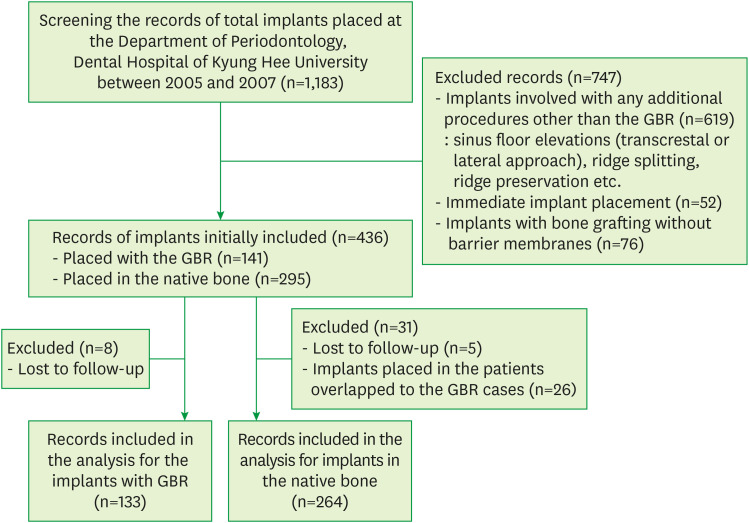
This retrospective cohort study included 240 patients who had implant placement either with a GBR procedure (regenerated bone group) or with pristine bone (native bone group). Data on demographic features (age, sex, smoking, and medical history), location of the implant, implant-specific features, and grafting procedures and materials were collected. The 5-year CSRs in both groups were estimated using Kaplan-Meier analysis. Risk factors for implant failure were analyzed with a Cox proportional hazards model.
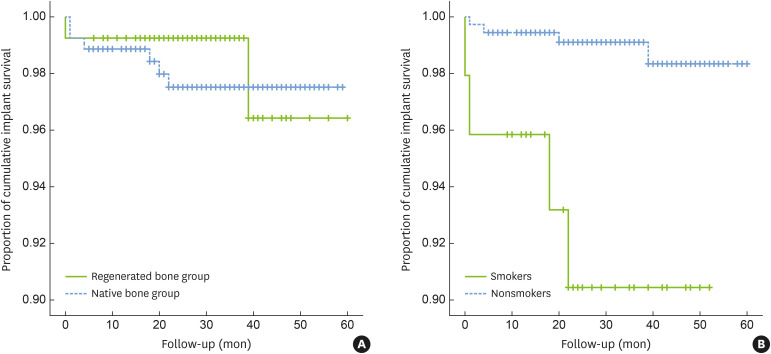
In total, 264 implants in the native bone group and 133 implants in the regenerated bone group were analyzed. The 5-year CSRs were 96.4% in the regenerated bone group and 97.5% in the native bone group, which was not a significant difference. The multivariable analysis confirmed that bone status was not an independent risk factor for implant failure. However, smoking significantly increased the failure rate (hazard ratio, 10.7; =0.002).
The 5-year CSR of implants placed in regenerated bone using GBR was comparable to that of implants placed in native bone. Smoking significantly increased the risk of implant failure in both groups.
本研究旨在评估与植入天然骨中的种植体相比,采用引导骨再生(GBR)技术植入的种植体的5年累积生存率(CSR),并确定导致再生骨中种植体失败的因素。
这项回顾性队列研究纳入了240例接受GBR手术植入种植体(再生骨组)或植入原始骨(天然骨组)的患者。收集了人口统计学特征(年龄、性别、吸烟情况和病史)、种植体位置、种植体特定特征以及植骨手术和材料的数据。两组的5年CSR采用Kaplan-Meier分析进行估计。使用Cox比例风险模型分析种植体失败的危险因素。
总共分析了天然骨组的264颗种植体和再生骨组的133颗种植体。再生骨组的5年CSR为96.4%,天然骨组为97.5%,差异无统计学意义。多变量分析证实骨状态不是种植体失败的独立危险因素。然而,吸烟显著增加了失败率(风险比,10.7;P=0.002)。
采用GBR技术植入再生骨中的种植体的5年CSR与植入天然骨中的种植体相当。吸烟显著增加了两组种植体失败的风险。