Kumar Rajesh, Mehrotra Seema, Michael Rajeev J, Banu Humera, Sudhir Paulomi M, Sharma Manoj K
Department of Clinical Psychology, National Institute of Mental Health and Neurosciences, Bengaluru, Karnataka, India.
Indian J Community Med. 2020 Jul-Sep;45(3):328-332. doi: 10.4103/ijcm.IJCM_357_19. Epub 2020 Sep 1.
Risky riding is one of the major contributing factors in road fatalities. The present study aimed to explore the risky riding behaviors and its correlates in two-wheeler riding young men, as ascertained from pillion riders' perspective.
A survey that captured perspective of pillion riders about two-wheeler riding young men with whom they used to pillion ride most frequently was administered on 115 subjects. The survey consisted of items pertaining to risky riding, perceived impact of negative emotion on riding, expression of negative emotion on roads in response to frustrating situations, road traffic accidents, and pillions' strategies to reduce anger/stress in their two-wheeler riders.
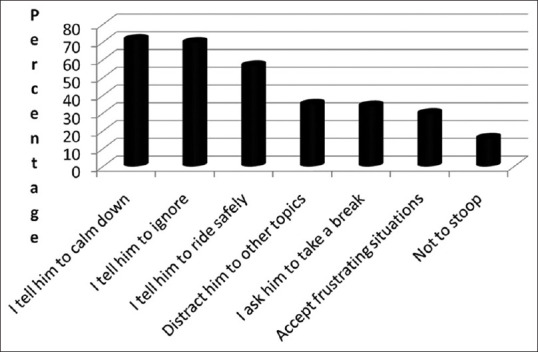
Two-wheeler riders who comprised young men were categorized into two groups: (i) high-risk riding group ( = 54 [48%]) and (ii) low-risk riding group ( = 61 [52%]) based on the subjective report of risky riding behaviors by their pillion riders. The results showed that negative emotions were perceived to have adverse influence on riding in persons with high-risky riding. Pillion riders reported that two-wheeler riding young men with high-risky riding expressed more aggressive behaviors (verbal and nonverbal) while riding in response to frustrating situations and also experienced near misses and minor accidents more frequently than their counterparts. Pillion riders reported utilizing various strategies to regulate emotions and behaviors of two-wheeler riders.
The present study highlights assessing risky riding and their correlates from pillion riders' perspective and strengthening their positive influence on two-wheeler riding. It has significant implications in minimizing risky behaviors on roads and enhancing road safety.
危险骑行是道路死亡事故的主要促成因素之一。本研究旨在从后座乘客的角度探讨两轮车骑行年轻男性的危险骑行行为及其相关因素。
对115名受试者进行了一项调查,该调查收集了后座乘客对他们最常搭载的两轮车骑行年轻男性的看法。该调查包括与危险骑行、负面情绪对骑行的感知影响、在道路上因令人沮丧的情况而产生的负面情绪表达、道路交通事故以及后座乘客减少其两轮车骑行者愤怒/压力的策略等相关的项目。
根据后座乘客对危险骑行行为的主观报告,将包括年轻男性的两轮车骑行者分为两组:(i)高风险骑行组(n = 54 [48%])和(ii)低风险骑行组(n = 61 [52%])。结果表明,负面情绪被认为对高风险骑行者的骑行有不利影响。后座乘客报告说,高风险骑行的两轮车骑行年轻男性在骑行时因令人沮丧的情况会表现出更多的攻击性行为(言语和非言语),并且比低风险骑行者更频繁地经历险些相撞和小事故。后座乘客报告说他们采用了各种策略来调节两轮车骑行者的情绪和行为。
本研究强调从后座乘客的角度评估危险骑行及其相关因素,并加强他们对两轮车骑行的积极影响。这对最大限度减少道路上的危险行为和提高道路安全具有重要意义。