Department of Neurobiology, Neuroscience Institute, Morehouse School of Medicine, Atlanta, Georgia.
Division of Nephrology, Hypertension, and Renal Transplantation, Department of Medicine, University of Florida, Gainesville, Florida.
Am J Physiol Renal Physiol. 2021 Feb 1;320(2):F224-F233. doi: 10.1152/ajprenal.00421.2020. Epub 2020 Dec 28.
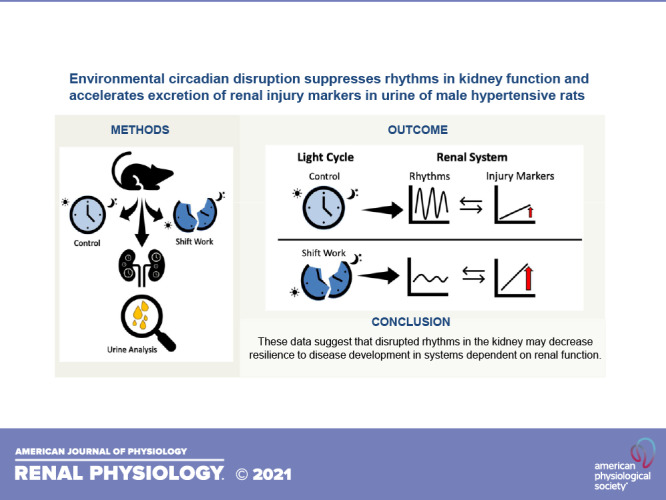
Nontraditional work schedules, such as shift work, have been associated with numerous health issues, including cardiovascular and metabolic disease. These work schedules can chronically misalign environmental timing cues with internal circadian clock systems in the brain and in peripheral organs, leading to dysfunction of those systems and their associated biological processes. Environmental circadian disruption in the kidney may be an important factor in the increased incidence of hypertension and adverse health outcomes in human shift workers. The relationship between renal rhythmicity and injury resilience is not well understood, especially in the context of environmental, rather than genetic, manipulations of the circadian system. We conducted a longitudinal study to determine whether chronic shifting of the light cycle that mimics shift work schedules would disrupt output rhythms of the kidney and accelerate kidney injury in salt-loaded male spontaneously hypertensive, stroke-prone rats. We observed that chronic shifting of the light-dark (LD) cycle misaligned and decreased the amplitude of urinary volume rhythms as the kidney phase-shifted to match each new lighting cycle. This schedule also accelerated glomerular and tubular injury marker excretion, as quantified by nephrin and KIM-1 compared with rats kept in a static LD cycle. These data suggest that disrupted rhythms in the kidney may decrease resilience and contribute to disease development in systems dependent on renal and cardiovascular functions.
非传统的工作时间表,如轮班工作,与许多健康问题有关,包括心血管和代谢疾病。这些工作时间表会使环境时间线索与大脑和外周器官中的内部生物钟长期失准,导致这些系统及其相关生物过程的功能障碍。肾脏环境昼夜节律的破坏可能是人类轮班工作者高血压和不良健康结果发生率增加的一个重要因素。肾脏节律性和损伤弹性之间的关系尚未得到很好的理解,特别是在环境而非遗传操纵生物钟的情况下。我们进行了一项纵向研究,以确定模拟轮班工作时间表的光周期的慢性变化是否会破坏肾脏的输出节律,并加速盐负荷雄性自发性高血压、易卒中型大鼠的肾脏损伤。我们观察到,光-暗(LD)周期的慢性变化使尿体积节律失准并降低了其振幅,因为肾脏相位适应每个新的光照周期。与保持在静态 LD 周期的大鼠相比,这种时间表还加速了肾小球和肾小管损伤标志物的排泄,如肾蛋白尿和 KIM-1 所量化的那样。这些数据表明,肾脏节律的破坏可能会降低弹性,并导致依赖肾脏和心血管功能的系统发生疾病。