State Key Laboratory of Cell Biology, Shanghai Institute of Biochemistry and Cell Biology, Center for Excellence in Molecular Cell Science, Chinese Academy of Sciences, Shanghai 200031, China; University of Chinese Academy of Sciences, Beijing 100049, China.
State Key Laboratory of Cell Biology, Shanghai Institute of Biochemistry and Cell Biology, Center for Excellence in Molecular Cell Science, Chinese Academy of Sciences, Shanghai 200031, China; School of Life Science and Technology, ShanghaiTech University, 100 Haike Road, Shanghai 201210, China.
Stem Cell Reports. 2021 Jan 12;16(1):75-88. doi: 10.1016/j.stemcr.2020.11.015. Epub 2020 Dec 23.
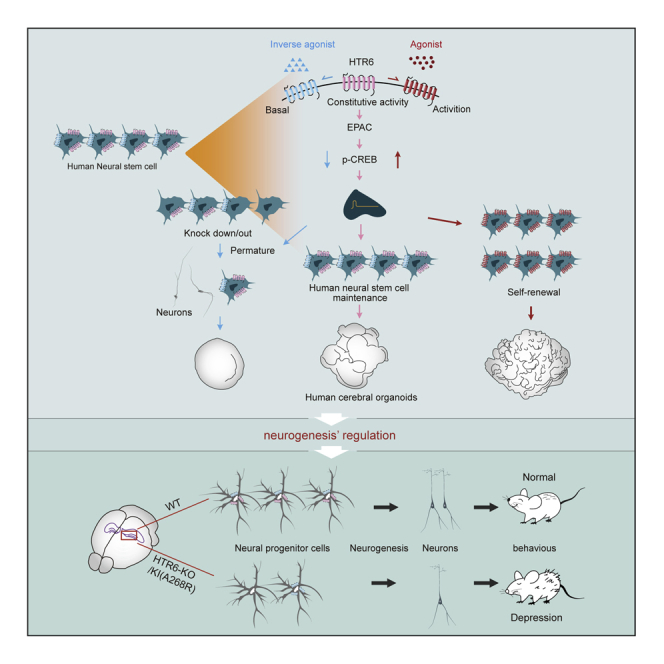
Serotonin receptor 6 (5-HTR), a typical G protein-coupled receptor (GPCR) mainly expressed in the neurogenic area with constitutive activity, is of particular interest as a promising target for emotional impairment. Here, we found that 5-HTR was highly expressed in human NSCs and activation of the receptor promoted self-renewal of human NSCs, and thus induced the expansion and folding of human cerebral organoids; dysfunction of receptor or inhibition of its constitutive activity resulted in the premature differentiation of NSCs, which ultimately depleted the NSC pool. The following mechanistic study revealed that EPAC-CREB signaling was involved in 5-HTR regulation. Furthermore, we showed that mice with genetic deletion of 5-HTR or knockin A268R mutant presented depression-like behaviors and impaired hippocampal neurogenesis for progressive decrease of the NSC pool. Thus, this study indicates that the modulation of 5-HTR and its constitutive activity may provide a therapeutic alternative to alleviate depression.
5-羟色胺受体 6(5-HTR)是一种典型的 G 蛋白偶联受体(GPCR),主要在具有组成性活性的神经发生区域表达,作为情绪障碍的有前途的靶点特别令人关注。在这里,我们发现 5-HTR 在人神经干细胞(NSCs)中高度表达,受体的激活促进了人 NSCs 的自我更新,从而诱导了人类大脑类器官的扩张和折叠;受体功能障碍或其组成性活性的抑制导致 NSCs 的过早分化,最终耗尽 NSC 池。随后的机制研究表明,EPAC-CREB 信号参与了 5-HTR 的调节。此外,我们发现 5-HTR 基因缺失或 A268R 突变嵌合的小鼠表现出抑郁样行为,并伴有海马神经发生受损,导致 NSC 池逐渐减少。因此,本研究表明,5-HTR 及其组成性活性的调节可能提供一种治疗选择,以缓解抑郁。