Department of Mechanical and Aerospace Engineering, University of Missouri, Columbia, MO 65211, United States.
Department of Surgery, University of Missouri, Columbia, Missouri 65211, United States.
Acta Biomater. 2021 Mar 1;122:101-110. doi: 10.1016/j.actbio.2020.12.042. Epub 2020 Dec 21.
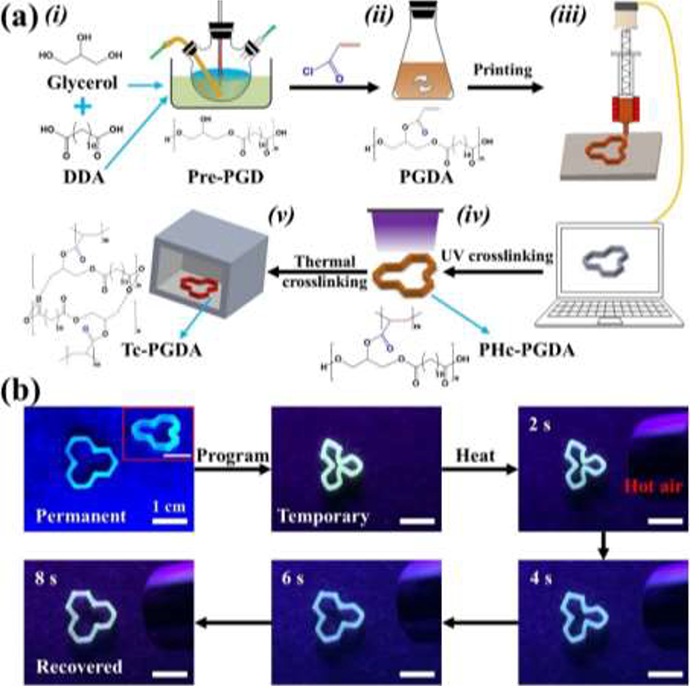
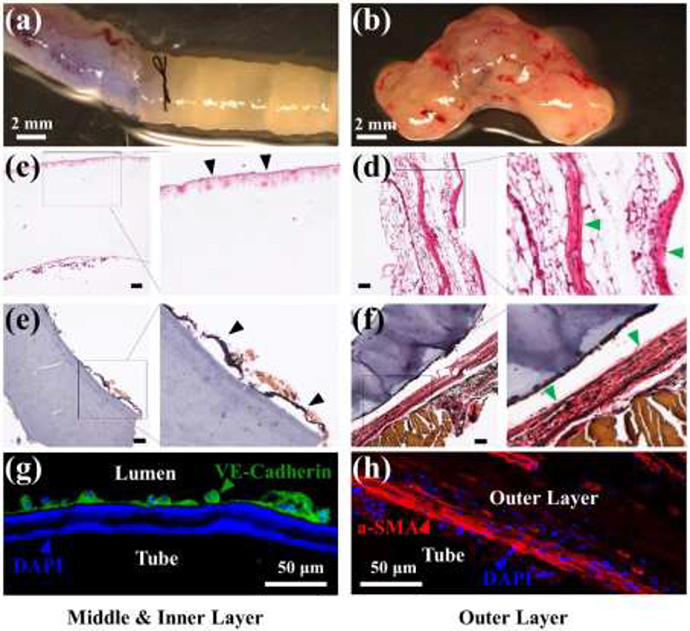
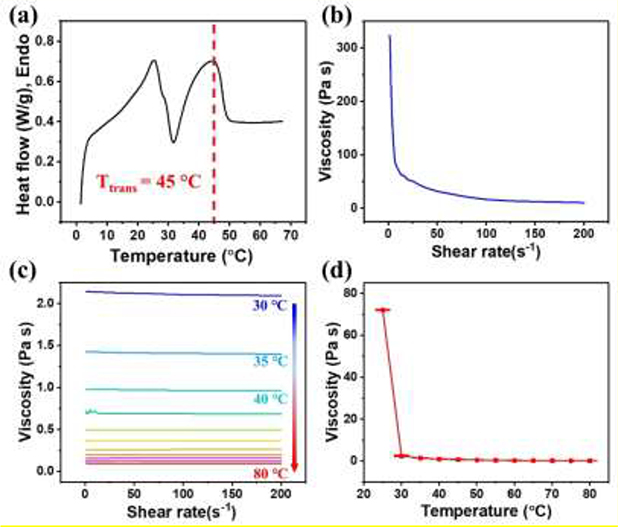
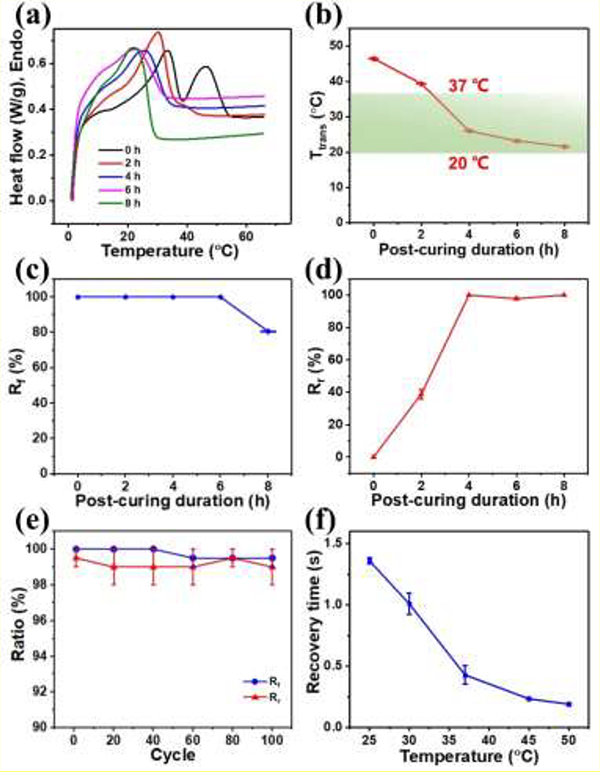
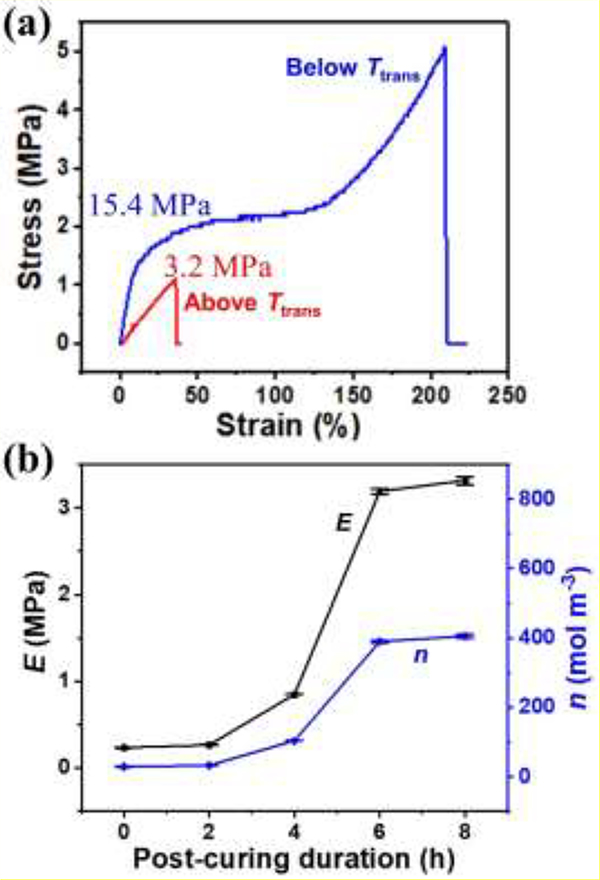
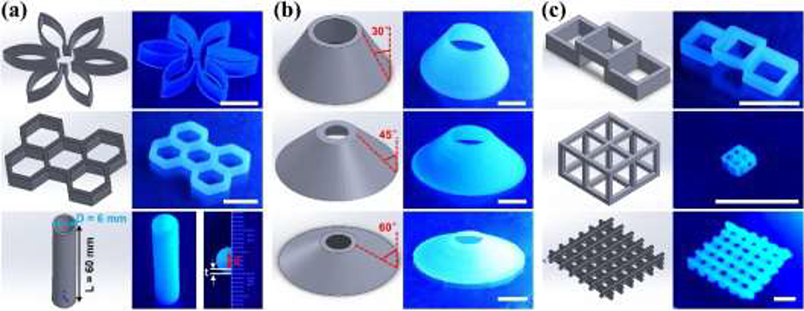
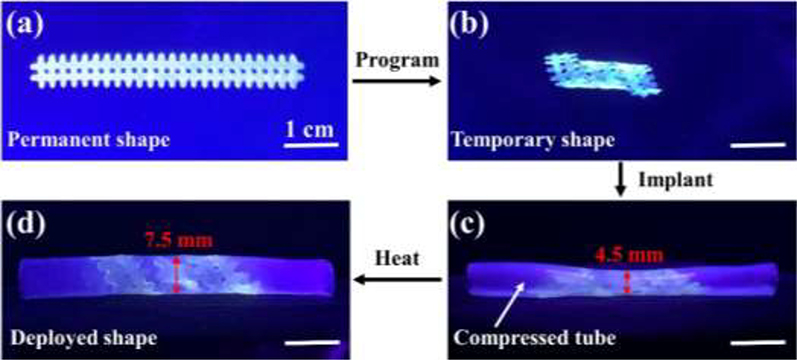
4D printing has shown great potential in a variety of biomedical applications due to the adaptability and minimal invasiveness of fabricated devices. However, commonly employed shape memory polymers (SMPs) possess undesirable transition temperatures (Ts), leading to complications in implantation operations. Herein, we demonstrate 4D printing of a new SMP named poly(glycerol dodecanoate) acrylate (PGDA) with a T in a range of 20 °C - 37 °C making it appropriate for shape programming at room temperature and then shape deployment within the human body. In addition, the material possesses suitable rheological properties to allow for the fabrication of a variety of delicate 3D structures such as "triangular star", "six-petal flower", "honeycomb", "tube", tilted "truncated hollow cones", as well as overhanging "bridge", "cage", and "mesh". The printed 3D structures show shape memory properties including a large fixity ratio of 100% at 20 °C, a large recovery ratio of 98% at 37 °C, a stable cyclability of > 100 times, and a fast recovery speed of 0.4 s at 37 °C. Moreover, the Young's moduli of the printed structures can be decreased by 5 times due to the phase transition of PGDA, which is compatible with biological tissues. Finally, in vitro stenting and in vivo vascular grafting demonstrated the geometrical and mechanical adaptivity of the printed constructs for biomedical implantation. This newly developed PGDA SMP based 4D printing technology has the potential to pave a new route to the fabrication of shape memory scaffolds for personalized biomedical applications.
4D 打印技术由于制造设备的适应性和微创性,在各种生物医学应用中显示出巨大的潜力。然而,常用的形状记忆聚合物(SMPs)具有不理想的转变温度(Ts),这导致在植入操作中出现并发症。在此,我们展示了一种名为聚(十二烷二酸甘油酯)丙烯酸酯(PGDA)的新型 SMP 的 4D 打印,其转变温度在 20°C-37°C 范围内,使其适合在室温下进行形状编程,然后在人体内进行形状部署。此外,该材料具有合适的流变性能,可制造各种精细的 3D 结构,如“三角星”、“六瓣花”、“蜂窝”、“管”、倾斜的“截顶空心锥”,以及悬垂的“桥”、“笼”和“网”。打印的 3D 结构具有形状记忆性能,包括在 20°C 时固定率为 100%,在 37°C 时恢复率为 98%,循环稳定性>100 次,在 37°C 时恢复速度为 0.4s。此外,由于 PGDA 的相转变,打印结构的杨氏模量可降低 5 倍,与生物组织相兼容。最后,体外支架和体内血管移植实验证明了打印结构在生物医学植入物中的几何和机械适应性。这种新开发的基于 PGDA SMP 的 4D 打印技术有可能为个性化生物医学应用的形状记忆支架制造开辟新途径。