Liang Weidong, Zhang Jian, Ren Zhouliang, Maimaiti Maierdan, Mamati Fulati, Abulizi Yakefu, Xu Tao, Cao Rui, Sheng Jun, Sheng Weibin
Department of Spine Surgery, The First Affiliated Hospital of Xinjiang Medical University, Urumqi, Xinjiang, China (mainland).
Med Sci Monit. 2020 Dec 25;26:e926142. doi: 10.12659/MSM.926142.
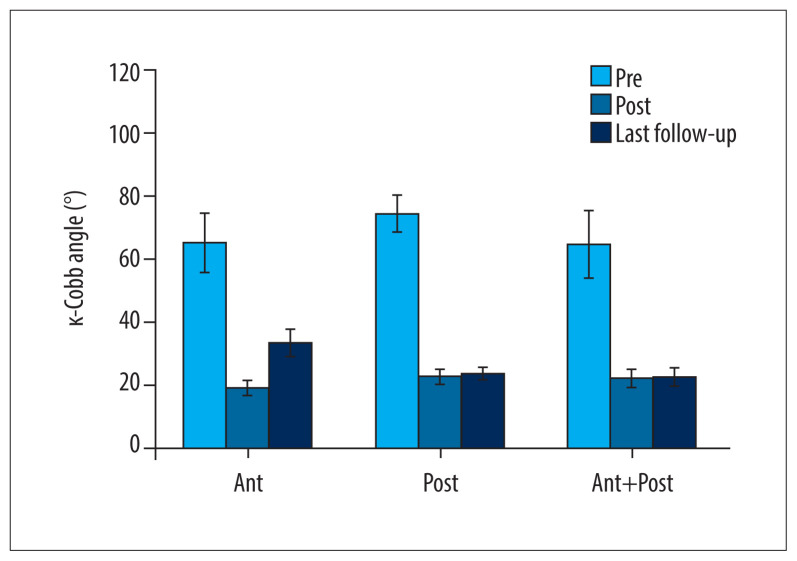
BACKGROUND This study aimed to investigate the safety and clinical efficacy of 3 different surgical methods for treating spinal tuberculosis (ST) in children. MATERIAL AND METHODS We reviewed the cases of 62 children with ST who were treated in our hospital from January 2010 to December 2014. In this study, erythrocyte sedimentation rate (ESR), C-reactive protein (CRP) level, Frankel classification of neurological function, pain visual analog scale (VAS) score, and kyphosis Cobb (k-Cobb) angle were dynamically monitored to evaluate the efficacy of different surgical methods. Complications in the patients were evaluated at 3 time points: before surgery (T1), after surgery (T2), and during final follow-up (T3). The average follow-up was 27.4 months. Twenty-two patients underwent simple anterior debridement alone or combined with internal fixation (Method A), 13 patients underwent posterior debridement alone (Method B), and 27 patients received anteroposterior debridement and bone graft fusion together with internal fixation (Method C). RESULTS In all 3 groups after surgery, ESR, CRP levels, VAS scores, and k-Cobb angles significantly decreased. However, compared with patients who received Methods B and C, patients who received Method A had a significant rebound in k-Cobb angle and a higher incidence of complications at the T3 time point. The overall reoperation rate during follow-up was 37.10%. Fourteen patients (22.58%) had kyphosis, 2 patients (3.23%) had tuberculosis recurrence combined with kyphosis, and other complications were reported in 5 patients (8.06%). CONCLUSIONS Considering the incidence of complications and level of postoperative biochemical indicators, we concluded that caution should be exercised in using an anterior approach to treat pediatric ST.
背景 本研究旨在探讨3种不同手术方法治疗儿童脊柱结核(ST)的安全性和临床疗效。
材料与方法 我们回顾了2010年1月至2014年12月在我院接受治疗的62例儿童ST患者的病例。在本研究中,动态监测红细胞沉降率(ESR)、C反应蛋白(CRP)水平、神经功能Frankel分级、疼痛视觉模拟量表(VAS)评分和后凸畸形Cobb(k-Cobb)角,以评估不同手术方法的疗效。在3个时间点评估患者的并发症:术前(T1)、术后(T2)和末次随访时(T3)。平均随访时间为27.4个月。22例患者单纯行前路清创术或联合内固定(方法A),13例患者单纯行后路清创术(方法B),27例患者接受前后路清创、植骨融合并联合内固定(方法C)。
结果 所有3组术后ESR、CRP水平、VAS评分和k-Cobb角均显著下降。然而,与接受方法B和C的患者相比,接受方法A的患者在T3时间点k-Cobb角有明显反弹,并发症发生率更高。随访期间的总体再手术率为37.10%。14例患者(22.58%)出现后凸畸形,2例患者(3.23%)结核复发合并后凸畸形,5例患者(8.06%)报告有其他并发症。
结论 考虑到并发症发生率和术后生化指标水平,我们得出结论,在采用前路治疗儿童ST时应谨慎。