Centro de Investigación en Complejidad Social (CICS), Facultad de Gobierno, Universidad del Desarrollo, Santiago, Chile.
Centro de Genética y Genómica, Facultad de Medicina, Clínica Alemana Universidad del Desarrollo, Santiago, Chile.
PLoS One. 2020 Dec 23;15(12):e0244189. doi: 10.1371/journal.pone.0244189. eCollection 2020.
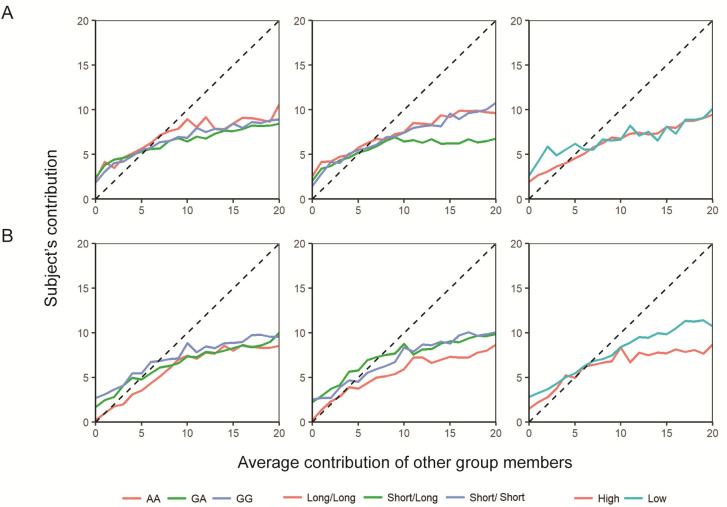
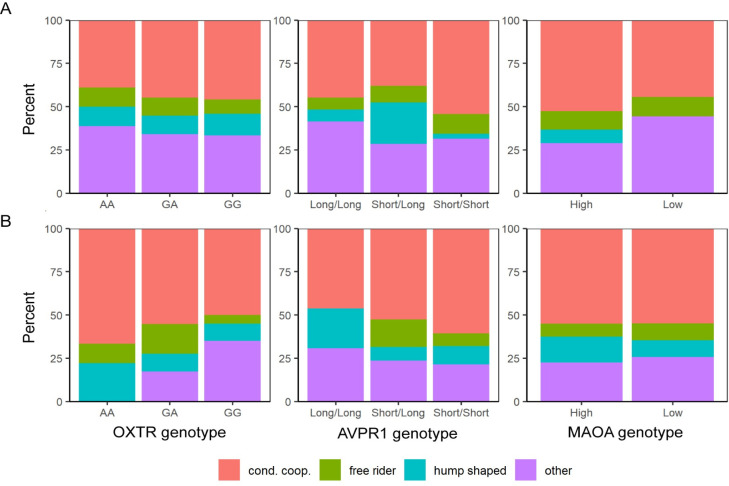
The effort to understand the genetic basis of human sociality has been encouraged by the diversity and heritability of social traits like cooperation. This task has remained elusive largely because most studies of sociality and genetics use sample sizes that are often unable to detect the small effects that single genes may have on complex social behaviors. The lack of robust findings could also be a consequence of a poor characterization of social phenotypes. Here, we explore the latter possibility by testing whether refining measures of cooperative phenotypes can increase the replication of previously reported associations between genetic variants and cooperation in small samples. Unlike most previous studies of sociality and genetics, we characterize cooperative phenotypes based on strategies rather than actions. Measuring strategies help differentiate between similar actions with different underlaying social motivations while controlling for expectations and learning. In an admixed Latino sample (n = 188), we tested whether cooperative strategies were associated with three genetic variants thought to influence sociality in humans-MAOA-uVNTR, OXTR rs53576, and AVPR1 RS3. We found no association between cooperative strategies and any of the candidate genetic variants. Since we were unable to replicate previous observations our results suggest that refining measurements of cooperative phenotypes as strategies is not enough to overcome the inherent statistical power problem of candidate gene studies.
理解人类社会性的遗传基础的努力受到了合作等社会特征的多样性和遗传性的鼓励。这项任务仍然难以实现,主要是因为大多数社会性和遗传学研究使用的样本量通常无法检测到单个基因对复杂社会行为可能产生的微小影响。缺乏强有力的发现也可能是社会表型特征描述不佳的结果。在这里,我们通过测试细化合作表型的测量方法是否可以增加遗传变异与小样本中合作之间先前报道的关联的复制,来探讨后一种可能性。与大多数以前的社会性和遗传学研究不同,我们根据策略而不是行为来描述合作表型。测量策略有助于区分具有不同潜在社会动机的相似行为,同时控制预期和学习。在一个混合拉丁裔样本(n = 188)中,我们测试了合作策略是否与三个被认为会影响人类社会性的遗传变体有关——MAOA-uVNTR、OXTR rs53576 和 AVPR1 RS3。我们没有发现合作策略与任何候选遗传变体之间存在关联。由于我们无法复制以前的观察结果,因此我们的结果表明,细化合作表型作为策略的测量方法不足以克服候选基因研究固有的统计功效问题。