Kaminski Nicole, Köster Christian, Mouloud Yanis, Börger Verena, Felderhoff-Müser Ursula, Bendix Ivo, Giebel Bernd, Herz Josephine
Department of Pediatrics I, Neonatology and Experimental Perinatal Neurosciences, University Hospital Essen, University Duisburg-Essen, Essen, Germany.
Institute for Transfusion Medicine, University Hospital Essen, University Duisburg-Essen, Essen, Germany.
Front Cell Neurosci. 2020 Dec 10;14:601176. doi: 10.3389/fncel.2020.601176. eCollection 2020.
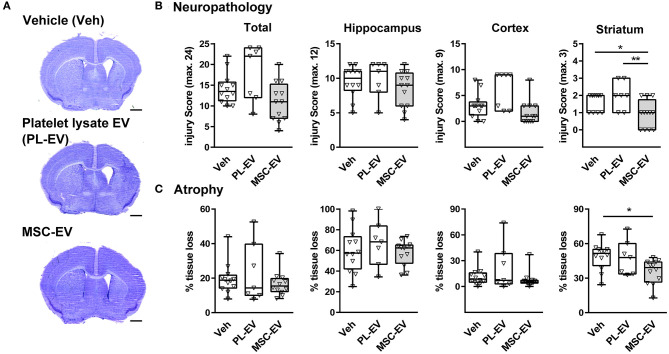
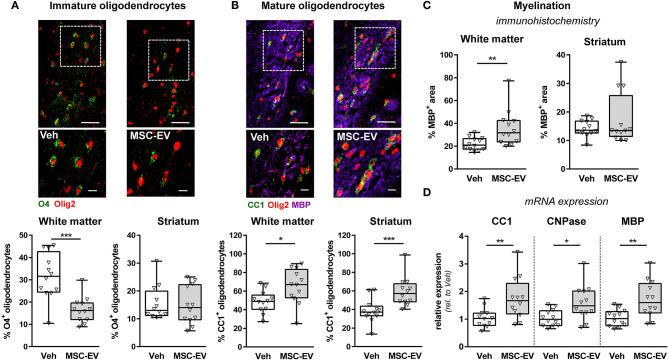
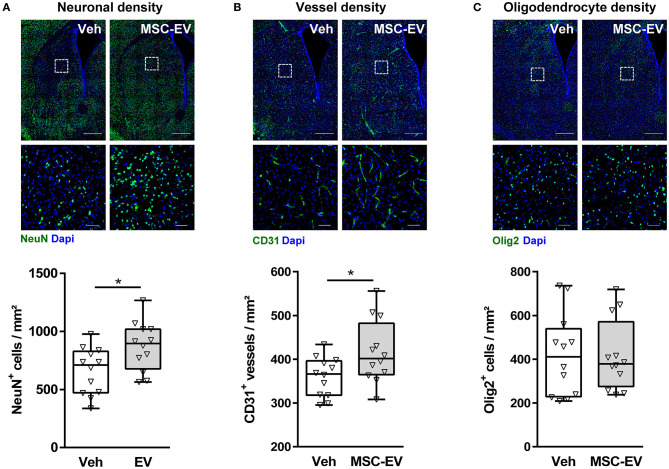
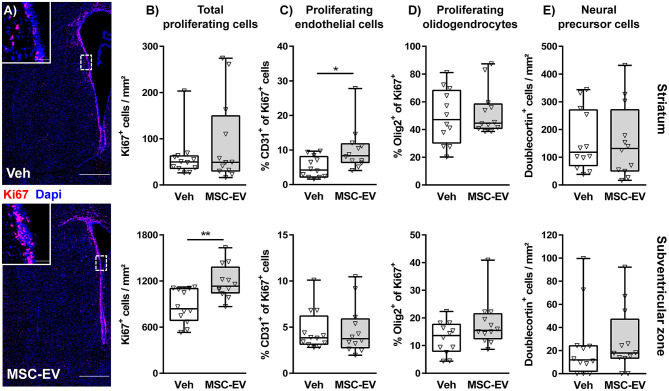
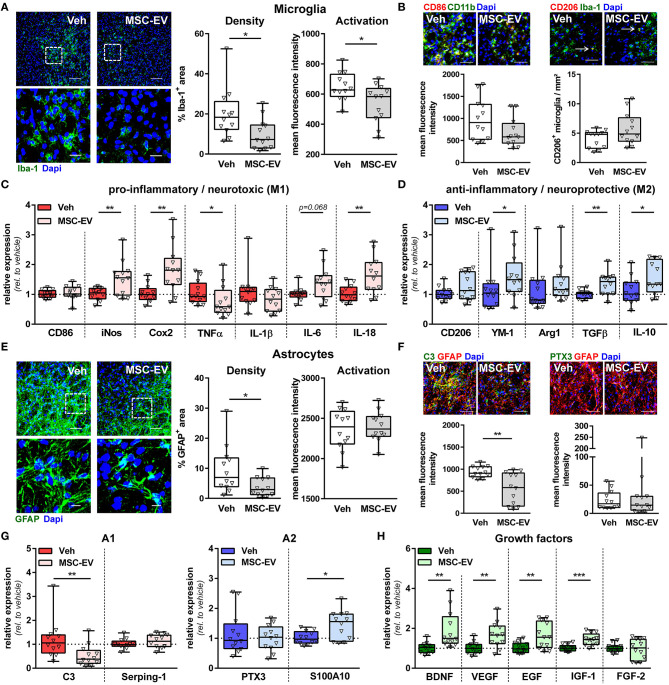
Neonatal encephalopathy caused by hypoxia-ischemia (HI) is a major cause of childhood mortality and disability. Stem cell-based regenerative therapies seem promising to prevent long-term neurological deficits. Our previous work in neonatal HI revealed an unexpected interaction between mesenchymal stem/stromal cells (MSCs) and the brains' microenvironment leading to an altered therapeutic efficiency. MSCs are supposed to mediate most of their therapeutic effects in a paracrine mode via extracellular vesicles (EVs), which might be an alternative to cell therapy. In the present study, we investigated the impact of MSC-EVs on neonatal HI-induced brain injury. Nine-day-old C57BL/6 mice were exposed to HI through ligation of the right common carotid artery followed by 1 h hypoxia (10% oxygen). MSC-EVs were injected intraperitoneally 1, 3, and 5 days after HI. One week after HI, brain injury was evaluated by regional neuropathological scoring, atrophy measurements and immunohistochemistry to assess effects on neuronal, oligodendrocyte and vessel densities, proliferation, oligodendrocyte maturation, myelination, astro-, and microglia activation. Immunohistochemistry analyses were complemented by mRNA expression analyses for a broad set of M1/M2- and A1/A2-associated molecules and neural growth factors. While total neuropathological scores and tissue atrophy were not changed, MSC-EVs significantly protected from HI-induced striatal tissue loss and decreased micro- and astroglia activation. MSC-EVs lead to a significant downregulation of the pro-inflammatory cytokine TNFa, accompanied by a significant upregulation of the M2 marker YM-1 and the anti-inflammatory cytokine TGFb. MSC-EVs significantly decreased astrocytic expression of the A1 marker C3, concomitant with an increased expression of neural growth factors (i.e., BDNF, VEGF, and EGF). These alterations were associated with an increased neuronal and vessel density, coinciding with a significant increase of proliferating cells in the neurogenic sub-ventricular zone juxtaposed to the striatum. MSC-EV-mediated neuroprotection went along with a significant improvement of oligodendrocyte maturation and myelination. The present study demonstrates that MSC-EVs mediate anti-inflammatory effects, promote regenerative responses and improve key developmental processes in the injured neonatal brain. The present results suggest different cellular target mechanisms of MSC-EVs, preventing secondary HI-induced brain injury. MSC-EV treatment may be a promising alternative to risk-associated cell therapies in neonatal brain injury.
缺氧缺血性(HI)新生儿脑病是儿童死亡和残疾的主要原因。基于干细胞的再生疗法似乎有望预防长期神经功能缺损。我们之前在新生儿HI方面的研究揭示了间充质干/基质细胞(MSC)与大脑微环境之间存在意外的相互作用,导致治疗效率改变。MSC被认为主要通过细胞外囊泡(EV)以旁分泌方式介导其治疗作用,这可能是细胞治疗的一种替代方法。在本研究中,我们研究了MSC-EV对新生儿HI诱导的脑损伤的影响。将9日龄的C57BL/6小鼠通过结扎右侧颈总动脉然后1小时缺氧(10%氧气)暴露于HI。在HI后1、3和5天腹腔注射MSC-EV。HI后1周,通过区域神经病理学评分、萎缩测量和免疫组织化学评估脑损伤,以评估对神经元、少突胶质细胞和血管密度、增殖、少突胶质细胞成熟、髓鞘形成、星形胶质细胞和小胶质细胞活化的影响。免疫组织化学分析通过对一系列广泛的M1/M2和A1/A2相关分子以及神经生长因子的mRNA表达分析得到补充。虽然总神经病理学评分和组织萎缩没有变化,但MSC-EV显著保护免受HI诱导的纹状体组织损失,并减少小胶质细胞和星形胶质细胞活化。MSC-EV导致促炎细胞因子TNFα显著下调,同时M2标志物YM-1和抗炎细胞因子TGFβ显著上调。MSC-EV显著降低星形胶质细胞中A1标志物C3的表达,同时神经生长因子(即BDNF、VEGF和EGF)的表达增加。这些改变与神经元和血管密度增加相关,与纹状体相邻的神经源性脑室下区增殖细胞的显著增加一致。MSC-EV介导的神经保护作用伴随着少突胶质细胞成熟和髓鞘形成的显著改善。本研究表明,MSC-EV介导抗炎作用,促进再生反应并改善受损新生儿大脑中的关键发育过程。目前的结果提示了MSC-EV不同的细胞靶向机制,可预防继发性HI诱导的脑损伤。MSC-EV治疗可能是新生儿脑损伤中与风险相关的细胞治疗的一种有前途的替代方法。