Tomás Diana, Coelho Luís Pinto, Rodrigues José Carlos, Viegas Wanda, Silva Manuela
Linking Landscape, Environment, Agriculture and Food, Instituto Superior de Agronomia, Universidade de Lisboa, Lisbon, Portugal.
Centro de Estudos Florestais, Instituto Superior de Agronomia, Universidade de Lisboa, Lisbon, Portugal.
Front Plant Sci. 2020 Dec 9;11:594977. doi: 10.3389/fpls.2020.594977. eCollection 2020.
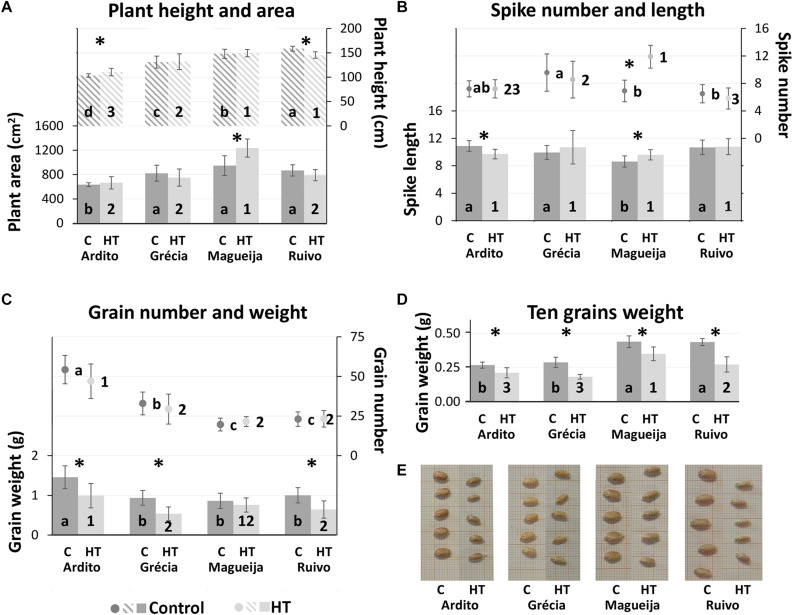
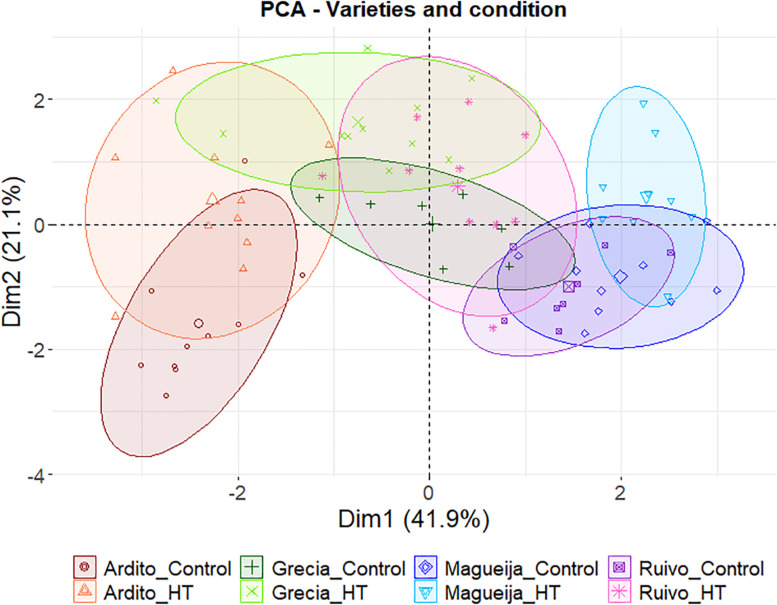
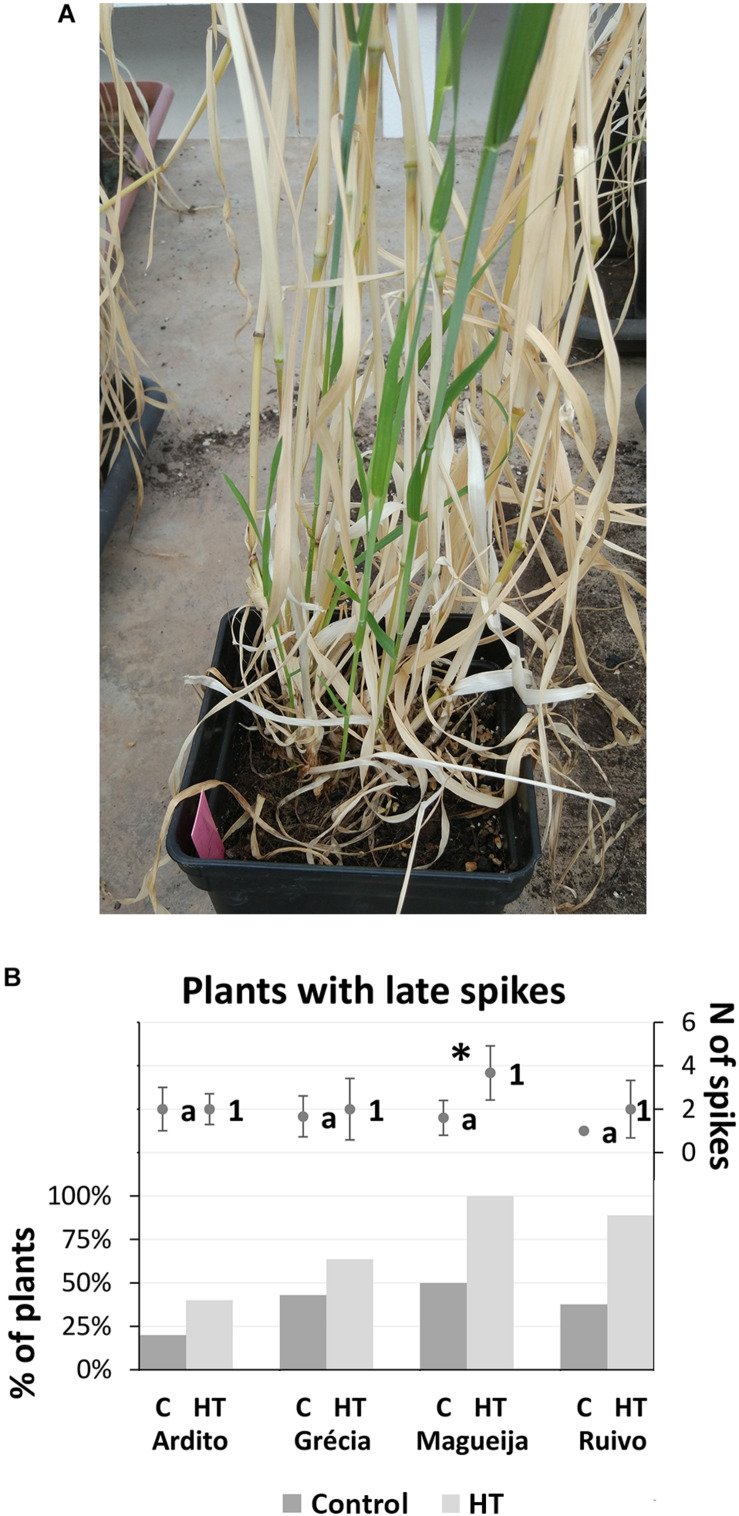
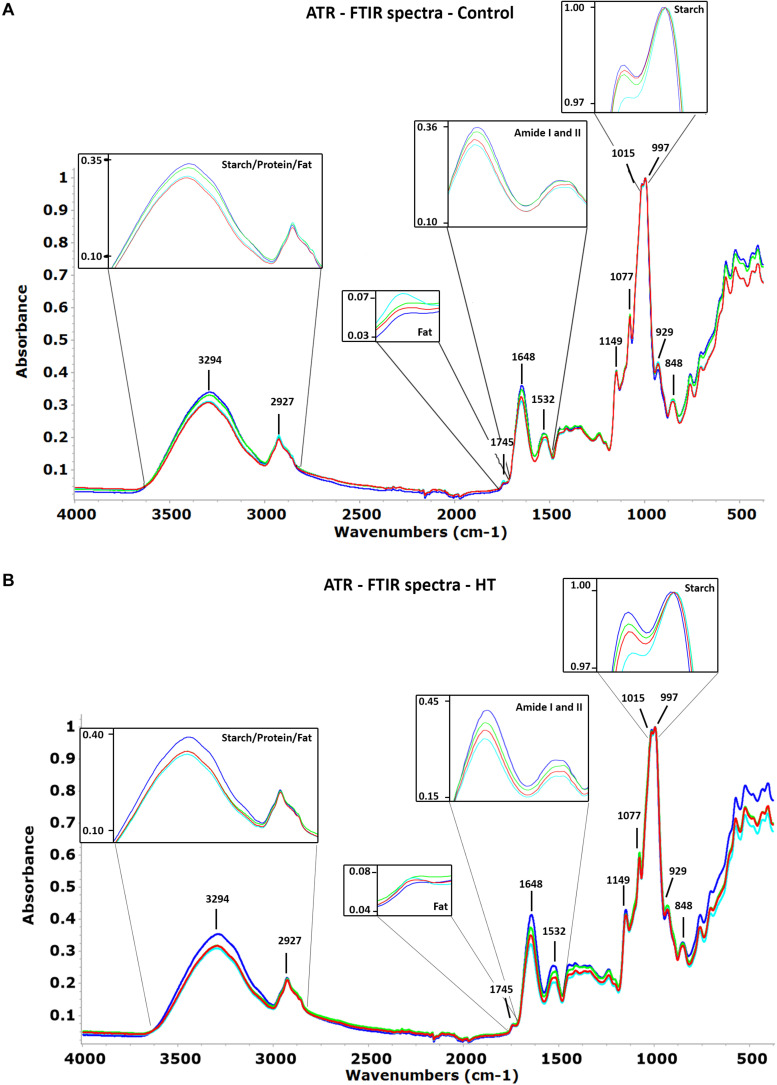
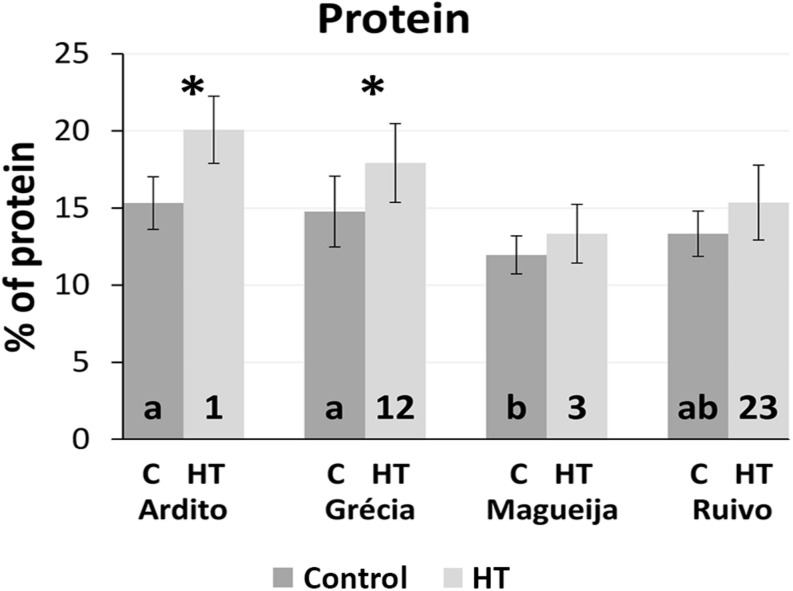
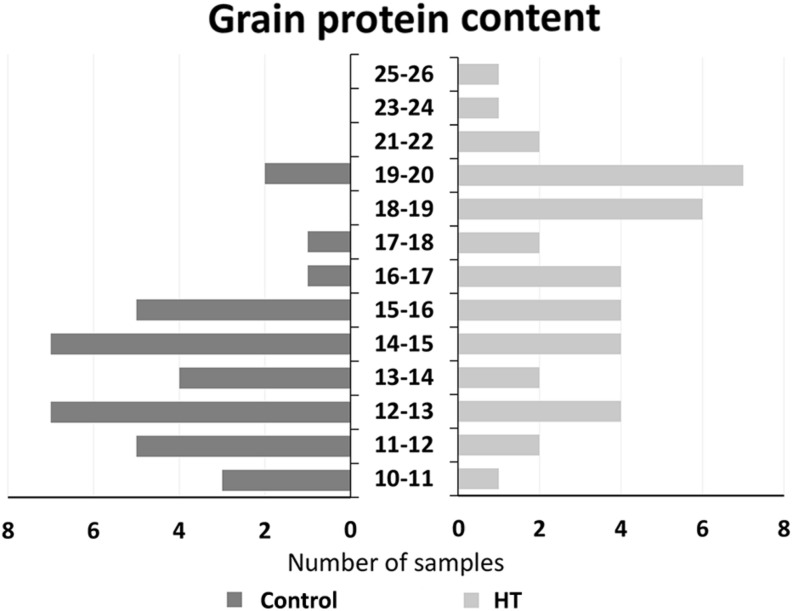
Wheat is a dietary staple consumed worldwide strongly responsible for proteins and carbohydrate population intake. However, wheat production and quality will scarcely fulfill forward demands, which are compounded by high-temperature (HT) events as heatwaves, increasingly common in Portugal. Thus, landraces assume crucial importance as potential reservoirs of useful traits for wheat breeding and may be pre-adapted to extreme environmental conditions. This work evaluates four Portuguese landrace yield and grain composition through attenuated total reflection Fourier transform infrared (ATR-FTIR) spectroscopy, particularly protein content, and their responses to HT treatment mimicking a heatwave. Landraces showed distinct yield traits, especially plant height and first spike grain number, and a similar pattern in FTIR spectra, although revealing differences in grain components' proportions. Comparison between spectra band intensity indicates that Ardito has the highest protein-related peaks, contrary to Magueija, which appears to be the landrace with higher lipid content. In plants submitted to 1 week of HT treatment 10 days after anthesis, the first spike grain size and weight were markedly reduced in all landraces. Additionally, it was observed that a general increase in grain protein content in the four landraces, being the increment observed in Ardito and Grécia, is statistically significant. The comparative assessment of control and HT average FTIR spectra denoted also the occurrence of alterations in grain polysaccharide composition. An integrated assessment of the evaluations performed revealed that Ardito and Magueija landraces presented diverse yield-related characteristics and distinct responses to cope with HT. In fact, the former landrace revealed considerable grain yield diminution along with an increase in grain protein proportion after HT, while the latter showed a significant increase in spikes and grain number, with grain quality detriment. These results reinforce the relevance of scrutinizing old genotype diversity seeking for useful characteristics, particularly considering HT impact on grain production and quality.
小麦是全球范围内的主要膳食主食,对蛋白质和碳水化合物的摄入量起着重要作用。然而,小麦产量和质量几乎无法满足未来需求,而在葡萄牙日益常见的热浪等高温事件更是加剧了这一情况。因此,地方品种作为小麦育种有用性状的潜在储存库具有至关重要的意义,并且可能预先适应极端环境条件。本研究通过衰减全反射傅里叶变换红外光谱(ATR-FTIR),特别是蛋白质含量,评估了四个葡萄牙地方品种的产量和籽粒组成,以及它们对模拟热浪的高温处理的反应。地方品种表现出不同的产量性状,尤其是株高和第一穗粒数,并且在傅里叶变换红外光谱中呈现出相似的模式,尽管籽粒成分比例存在差异。光谱带强度的比较表明,阿尔迪托具有最高的蛋白质相关峰,而马圭亚则似乎是脂质含量较高的地方品种。在开花后10天接受1周高温处理的植株中,所有地方品种的第一穗粒大小和重量均显著降低。此外,观察到四个地方品种的籽粒蛋白质含量普遍增加,其中阿尔迪托和格雷西亚的增加具有统计学意义。对照和高温处理平均傅里叶变换红外光谱的比较评估还表明籽粒多糖组成发生了变化。对所进行评估的综合分析表明,阿尔迪托和马圭亚地方品种呈现出不同的产量相关特征以及应对高温的不同反应。事实上,前一个地方品种在高温处理后籽粒产量大幅下降,同时籽粒蛋白质比例增加,而后一个地方品种则表现出穗数和粒数显著增加,但籽粒品质下降。这些结果强化了仔细研究古老基因型多样性以寻找有用特征的重要性,特别是考虑到高温对籽粒产量和质量的影响。