Lum Zachary C, Holland Christopher Thomas, Meehan John P
Department of Orthopaedic Surgery, Davis Medical Center, University of California, Sacramento, CA 95817, United States.
Department of Orthopaedics, University of California, Davis Medical Center, Sacramento, CA 95817, United States.
World J Orthop. 2020 Dec 18;11(12):559-572. doi: 10.5312/wjo.v11.i12.559.
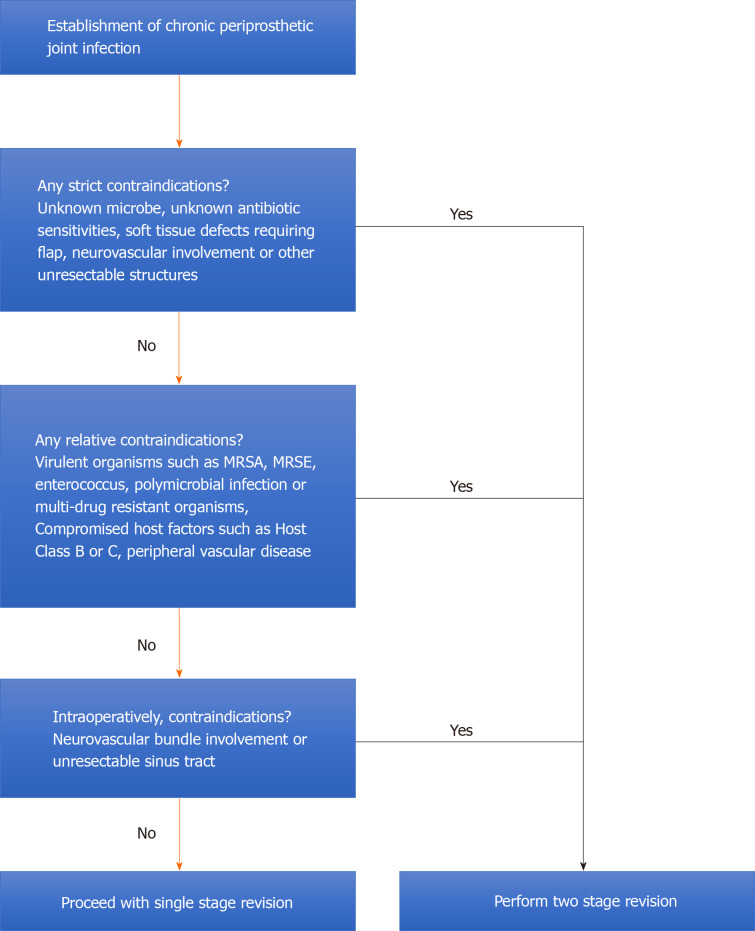
While advanced technology, increased medical knowledge and improved surgical technique has improved patient outcomes in total joint arthroplasty, prosthetic joint infection still remains one of the leading causes of increased healthcare costs, medical resources and societal burdens in orthopaedic care. Two stage arthroplasty revision remains the gold standard for treatment of prosthetic joint infection. Proponents of single stage revision arthroplasty for infection argue that it results in lower healthcare costs while improving patient reported functional outcomes and with equivalent success rates. Here we review the history of single stage revision arthroplasty, discuss the key principles, highlight the indications and contraindications, and review the reported outcomes with a focus on future developments of single stage revision arthroplasty for hip and knee periprosthetic joint infections.
虽然先进的技术、增加的医学知识和改进的手术技术已改善了全关节置换术的患者预后,但假体关节感染仍然是骨科护理中医疗成本增加、医疗资源消耗和社会负担加重的主要原因之一。两阶段关节置换翻修术仍然是治疗假体关节感染的金标准。支持感染性单阶段翻修关节置换术的人认为,它能降低医疗成本,同时改善患者报告的功能预后,且成功率相当。在此,我们回顾单阶段翻修关节置换术的历史,讨论关键原则,强调适应证和禁忌证,并着重于髋膝关节假体周围关节感染单阶段翻修关节置换术的未来发展,回顾已报道的预后情况。