Jie Kong, Feng Wang, Boxiang Zhao, Maofeng Gong, Jianbin Zhang, Zhaoxuan Lu, Yangyi Zhou, Liang Chen, Haobo Su, Wensheng Lou, Guoping Chen, Jianping Gu, Xu He, Jianyan Wen
Department of Interventional Radiology, Nanjing First Hospital, Nanjing Medical University, Nanjing, China.
Graduate School of Peking Union Medical College, Beijing, China.
Front Physiol. 2020 Dec 8;11:565240. doi: 10.3389/fphys.2020.565240. eCollection 2020.
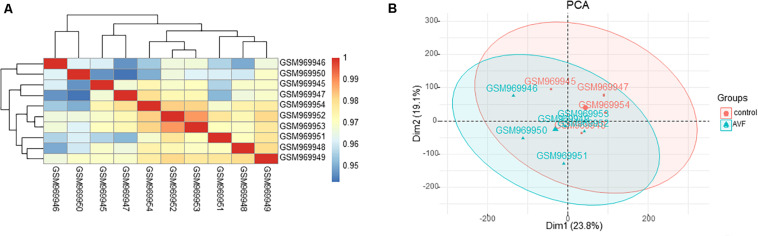
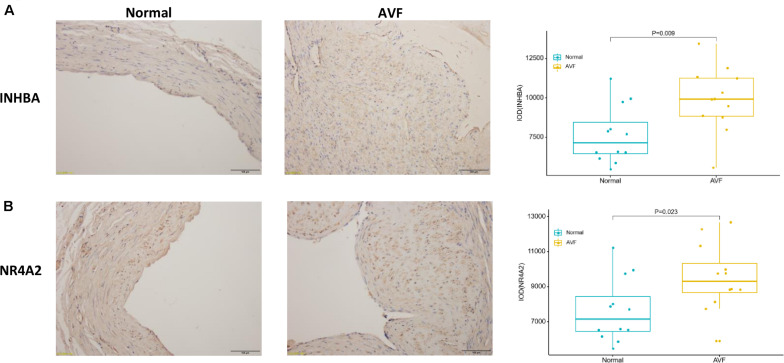
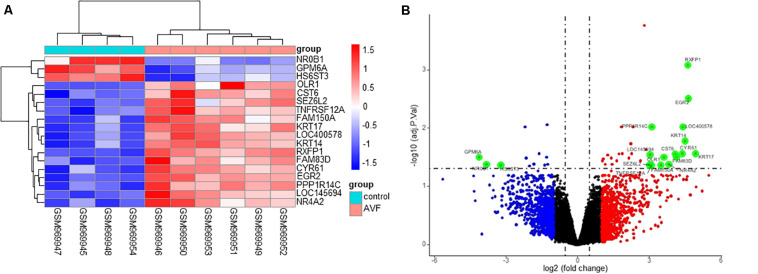
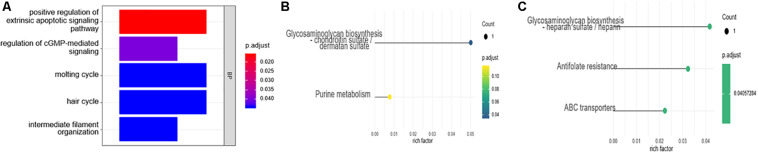
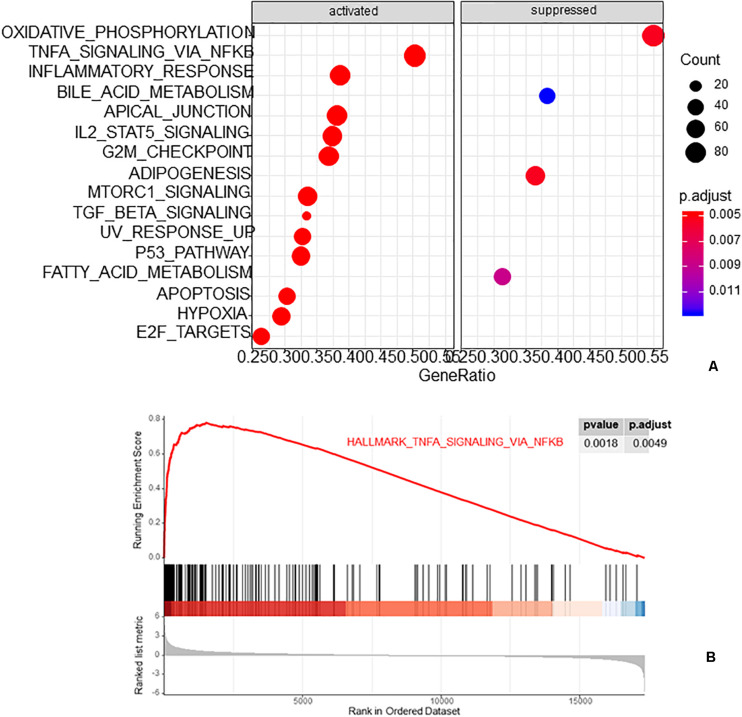
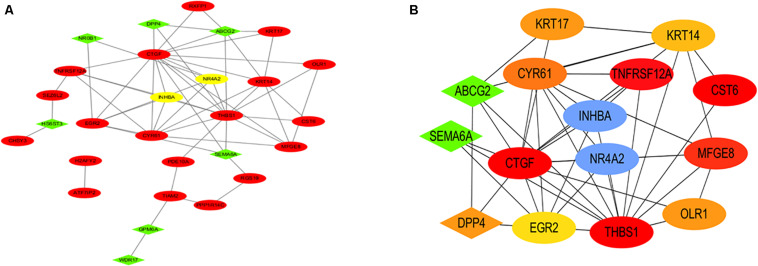
The arteriovenous fistula (AVF) is the first choice for vascular access for hemodialysis of renal failure patients. Venous remodeling after exposure to high fistula flow is important for AVF to mature but the mechanism underlying remodeling is still unknown. The objective of this study is to identify the molecular mechanisms that contribute to venous remodeling after AVF. To screen and identify the differentially expressed genes (DEGs) that may involve venous remodeling after AVF, we used bioinformatics to download the public microarray data (GSE39488) from the Gene Expression Omnibus (GEO) and screen for DEGs. We then performed gene ontology (GO) function analysis, Kyoto Encyclopedia of Genes and Genomes (KEGG) pathway analysis, and gene set enrichment analysis (GSEA) for the functional annotation of DEGs. The protein-protein interaction (PPI) network was constructed and the hub genes were carried out. Finally, we harvested 12 normal vein samples and 12 AVF vein samples which were used to confirm the expressions of the hub genes by immunohistochemistry. A total of 45 DEGs were detected, including 32 upregulated and 13 downregulated DEGs. The biological process (BP) of the GO analysis were enriched in the extrinsic apoptotic signaling pathway, cGMP-mediated pathway signaling, and molting cycle. The KEGG pathway analysis showed that the upregulated DEGs were enriched in glycosaminoglycan biosynthesis and purine metabolism, while the downregulated DEGs were mainly enriched in pathways of glycosaminoglycan biosynthesis, antifolate resistance, and ABC transporters. The GSEA analysis result showed that the top three involved pathways were oxidative phosphorylation, TNFA signaling via NF-K B, and the inflammatory response. The PPI was constructed and the hub genes found through the method of DMNC showed that INHBA and NR4A2 might play an important role in venous remodeling after AVF. The integrated optical density (DOI) examined by immunohistochemistry staining showed that the expression of both INHBA and NR4A2 increased in AVF compared to the control group. Our research contributes to the understanding of the molecular mechanism of venous remodeling after exposure to high fistula flow, which may be useful in treating AVF failure.
动静脉内瘘(AVF)是肾衰竭患者血液透析血管通路的首选。暴露于高血流量后静脉重塑对AVF成熟很重要,但重塑的潜在机制仍不清楚。本研究的目的是确定导致AVF后静脉重塑的分子机制。为了筛选和鉴定可能参与AVF后静脉重塑的差异表达基因(DEG),我们利用生物信息学从基因表达综合数据库(GEO)下载公共微阵列数据(GSE39488)并筛选DEG。然后我们对DEG进行基因本体(GO)功能分析、京都基因与基因组百科全书(KEGG)通路分析和基因集富集分析(GSEA)以进行功能注释。构建了蛋白质-蛋白质相互作用(PPI)网络并确定了枢纽基因。最后,我们采集了12个正常静脉样本和12个AVF静脉样本,用于通过免疫组织化学确认枢纽基因的表达。共检测到45个DEG,包括32个上调和13个下调的DEG。GO分析的生物学过程(BP)富集在外源凋亡信号通路、cGMP介导的信号通路和蜕皮周期中。KEGG通路分析表明,上调的DEG富集在糖胺聚糖生物合成和嘌呤代谢中,而下调的DEG主要富集在糖胺聚糖生物合成、抗叶酸耐药和ABC转运蛋白通路中。GSEA分析结果表明,涉及的前三个通路是氧化磷酸化、通过NF-κB的TNFA信号传导和炎症反应。构建了PPI并通过DMNC方法发现的枢纽基因表明,抑制素βA(INHBA)和核受体亚家族4A成员2(NR4A2)可能在AVF后静脉重塑中起重要作用。免疫组织化学染色检测的积分光密度(DOI)表明,与对照组相比,AVF中INHBA和NR4A2的表达均增加。我们的研究有助于理解暴露于高血流量后静脉重塑的分子机制,这可能对治疗AVF失败有用。