De Zio Elena, Montagnoli Antonio, Karady Michal, Terzaghi Mattia, Sferra Gabriella, Antoniadi Ioanna, Scippa Gabriella S, Ljung Karin, Chiatante Donato, Trupiano Dalila
Department of Biosciences and Territory, University of Molise, Pesche, Italy.
Department of Biotechnology and Life Science, University of Insubria, Varese, Italy.
Front Plant Sci. 2020 Dec 7;11:590985. doi: 10.3389/fpls.2020.590985. eCollection 2020.
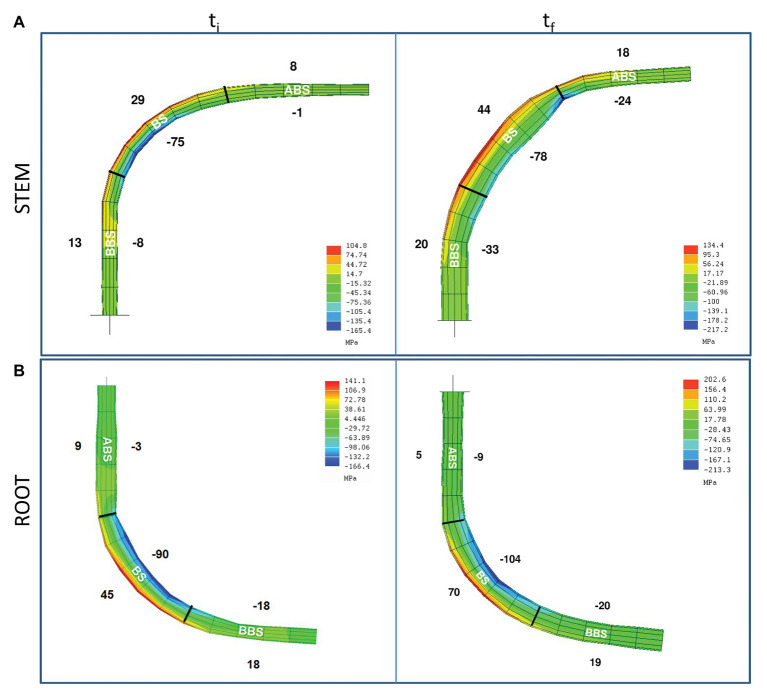
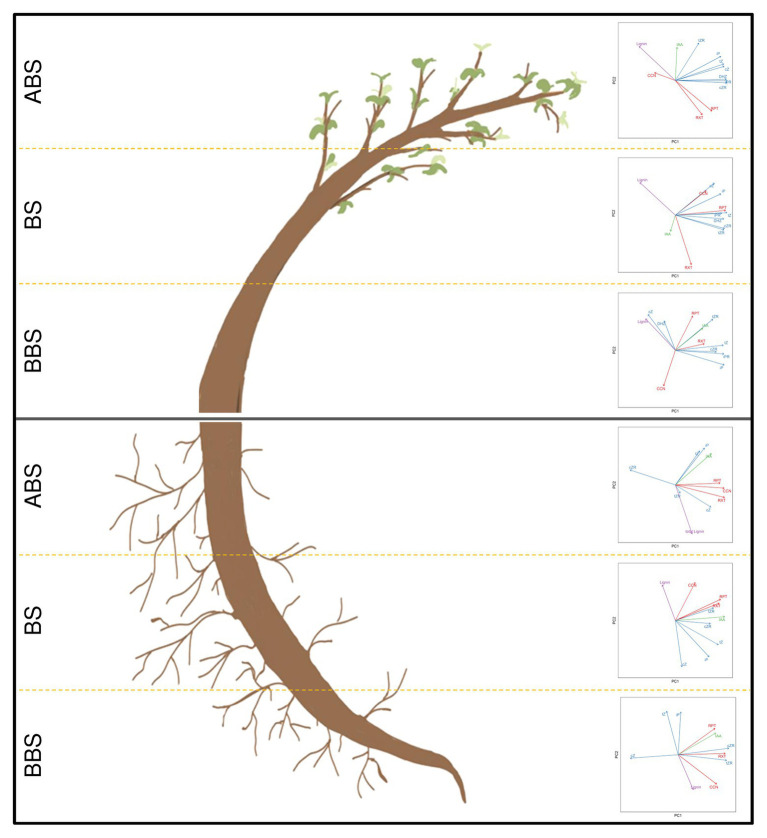
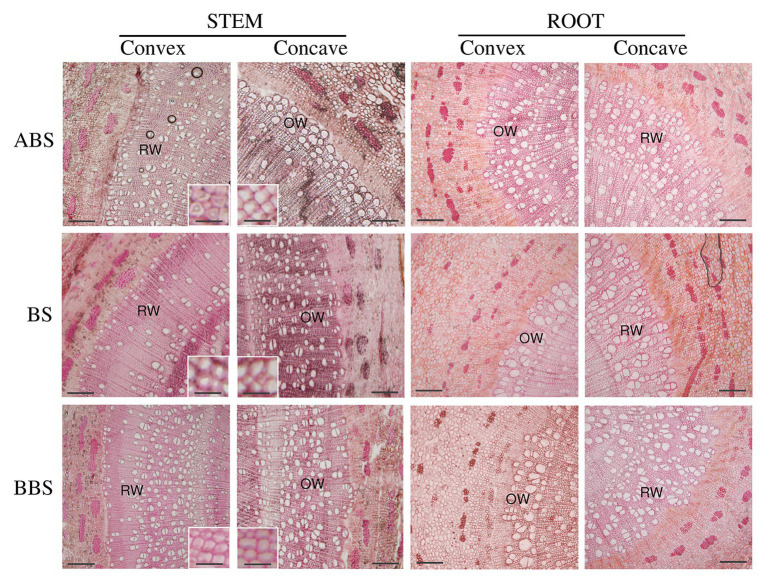
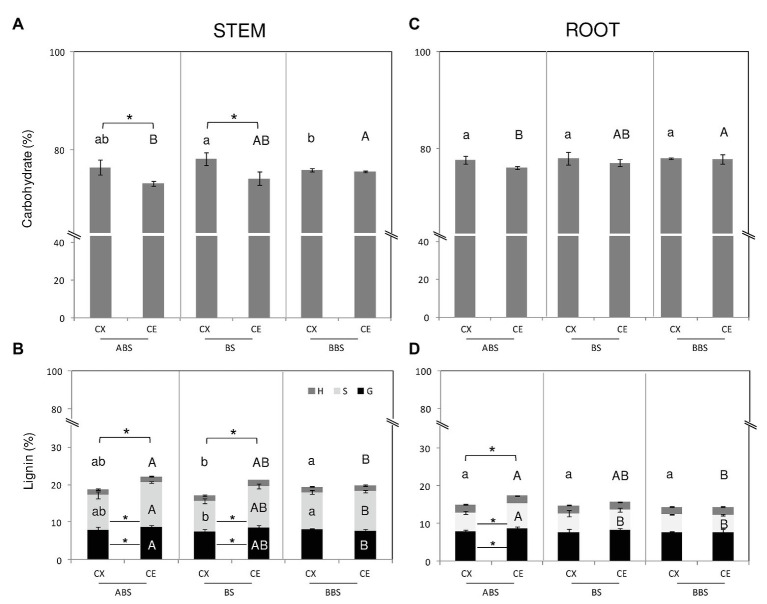
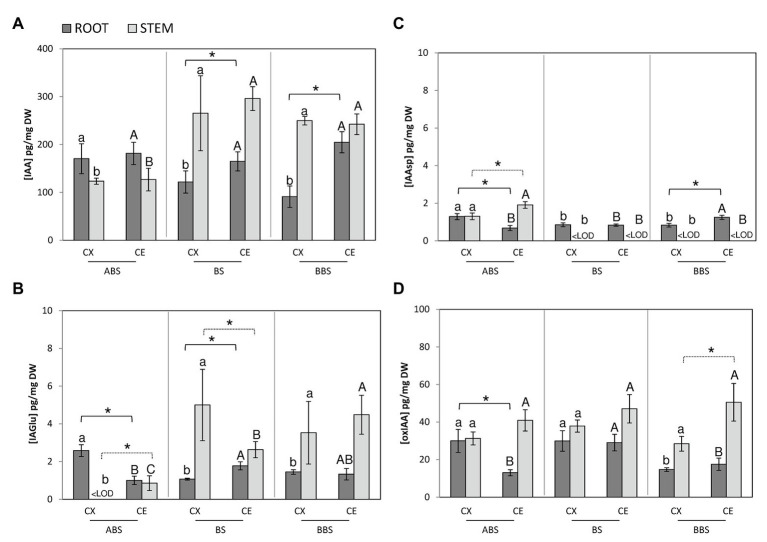
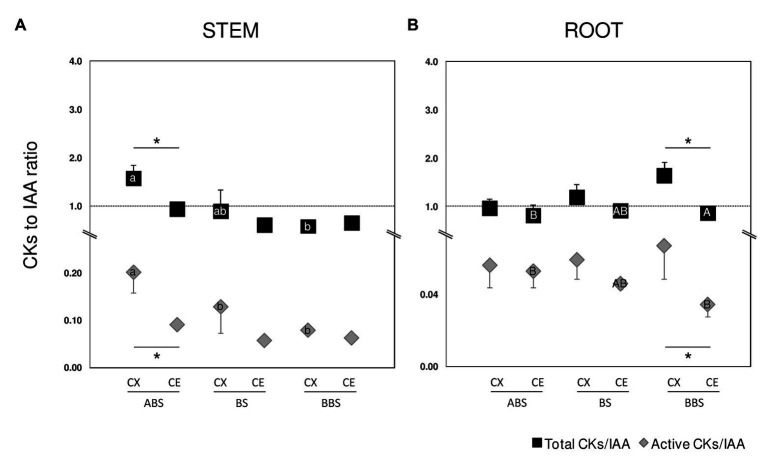
Reaction wood (RW) formation is an innate physiological response of woody plants to counteract mechanical constraints in nature, reinforce structure and redirect growth toward the vertical direction. Differences and/or similarities between stem and root response to mechanical constraints remain almost unknown especially in relation to phytohormones distribution and RW characteristics. Thus, stem and root subjected to static non-destructive mid-term bending treatment were analyzed. The distribution of tension and compression forces was firstly modeled along the main bent stem and root axis; then, anatomical features, chemical composition, and a complete auxin and cytokinin metabolite profiles of the stretched convex and compressed concave side of three different bent stem and root sectors were analyzed. The results showed that in bent stems RW was produced on the upper stretched convex side whereas in bent roots it was produced on the lower compressed concave side. Anatomical features and chemical analysis showed that bent stem RW was characterized by a low number of vessel, poor lignification, and high carbohydrate, and thus gelatinous layer in fiber cell wall. Conversely, in bent root, RW was characterized by high vessel number and area, without any significant variation in carbohydrate and lignin content. An antagonistic interaction of auxins and different cytokinin forms/conjugates seems to regulate critical aspects of RW formation/development in stem and root to facilitate upward/downward organ bending. The observed differences between the response stem and root to bending highlight how hormonal signaling is highly organ-dependent.
反应木(RW)的形成是木本植物的一种固有生理反应,以抵消自然界中的机械约束,加强结构并使生长重新朝向垂直方向。茎和根对机械约束的反应之间的差异和/或相似性几乎仍然未知,特别是在植物激素分布和RW特征方面。因此,对经过静态非破坏性中期弯曲处理的茎和根进行了分析。首先沿弯曲的茎和根的主轴模拟拉力和压力的分布;然后,分析了三个不同弯曲茎和根区段的拉伸凸面和压缩凹面的解剖特征、化学成分以及完整的生长素和细胞分裂素代谢物谱。结果表明,在弯曲的茎中,RW产生于上部拉伸凸面,而在弯曲的根中,RW产生于下部压缩凹面。解剖特征和化学分析表明,弯曲茎RW的特征是导管数量少、木质化程度低、碳水化合物含量高,因此纤维细胞壁中有凝胶层。相反,在弯曲根中,RW的特征是导管数量和面积高,碳水化合物和木质素含量没有任何显著变化。生长素和不同形式/共轭体的细胞分裂素之间的拮抗相互作用似乎调节了茎和根中RW形成/发育的关键方面,以促进器官向上/向下弯曲。观察到的茎和根对弯曲反应的差异突出了激素信号传导高度依赖器官的程度。