Ernst Mareike, Brähler Elmar, Wild Philipp S, Faber Jörg, Merzenich Hiltrud, Beutel Manfred E
Department of Psychosomatic Medicine and Psychotherapy, University Medical Center Mainz, Germany.
Preventive Cardiology and Preventive Medicine-Department of Cardiology, University Medical Center Mainz, Germany.
Int J Clin Health Psychol. 2021 Jan-Apr;21(1):100201. doi: 10.1016/j.ijchp.2020.10.001. Epub 2020 Nov 26.
Long-term childhood cancer survivors (CCS) are at risk for adverse late effects. However, not all of them are well understood. The present study addressed loneliness, a previously under-researched mental health risk in cancer survivor populations. We assessed the prevalence of loneliness and its impact on psychological symptoms over time.
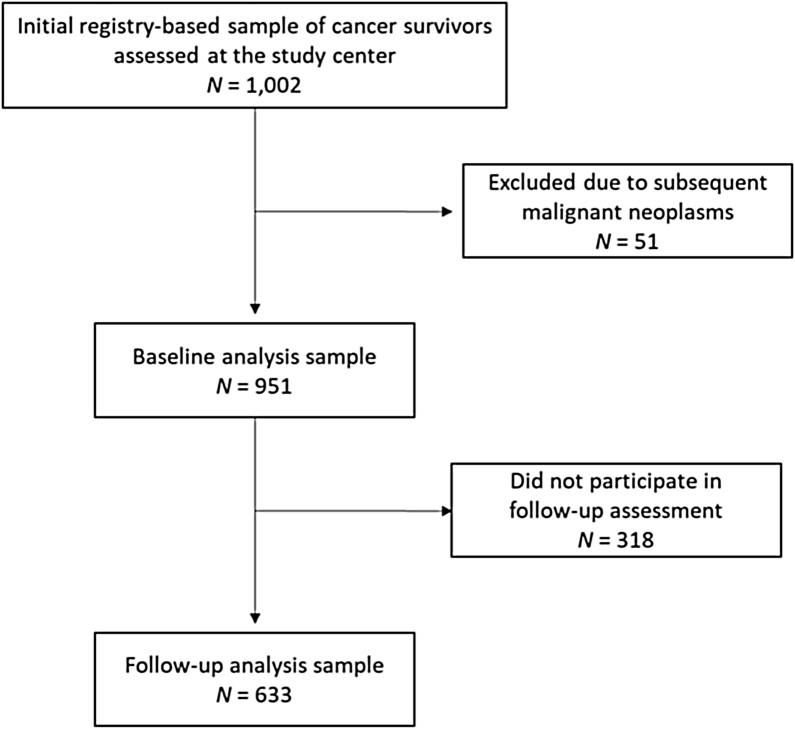
A registry-based sample of = 633 adult long-term CCS underwent medical and psychological assessments and took part in a follow-up survey 2.5 years later. Psychological symptoms (somatic, anxiety, depression symptoms, and suicidal ideation) were measured using the Patient Health Questionnaire. We calculated linear regression models of symptoms at follow-up to investigate the impact of loneliness over time (controlling for symptoms at baseline and relevant confounders).
Loneliness was reported by 17.70% of CCS. In multivariate linear regression analyses, loneliness was still predictive of more severe anxiety symptoms and suicidal ideation over two years later. Loneliness did not predict somatic and depression symptoms at follow-up (which increased with age).
Loneliness affected a significant number of CCS and was a risk factor for persistent anxiety symptoms and suicidal ideation. The extent to which young cancer patients' re-integration into society is successful could thus have important implications for well-being in adulthood.
长期儿童癌症幸存者(CCS)面临不良晚期效应的风险。然而,并非所有这些效应都得到了充分理解。本研究探讨了孤独感,这是癌症幸存者群体中此前研究较少的一种心理健康风险。我们评估了孤独感的患病率及其随时间对心理症状的影响。
基于登记处选取了633名成年长期CCS样本,对其进行医学和心理评估,并在2.5年后参加随访调查。使用患者健康问卷测量心理症状(躯体症状、焦虑、抑郁症状和自杀意念)。我们计算了随访时症状的线性回归模型,以研究孤独感随时间的影响(控制基线症状和相关混杂因素)。
17.70%的CCS报告有孤独感。在多变量线性回归分析中,两年多后孤独感仍可预测更严重的焦虑症状和自杀意念。孤独感在随访时并不能预测躯体症状和抑郁症状(这些症状随年龄增加)。
孤独感影响了相当数量的CCS,是持续性焦虑症状和自杀意念的一个风险因素。因此,年轻癌症患者重新融入社会的成功程度可能对成年后的幸福感有重要影响。