Villacorta-Atienza José Antonio, Calvo Tapia Carlos, Díez-Hermano Sergio, Sánchez-Jiménez Abel, Lobov Sergey, Krilova Nadia, Murciano Antonio, López-Tolsa Gabriela E, Pellón Ricardo, Makarov Valeri A
B.E.E. Department, Faculty of Biology, Complutense University of Madrid, Spain.
Institute of Interdisciplinary Mathematics, Complutense University of Madrid, Spain.
J Adv Res. 2020 Aug 14;28:111-125. doi: 10.1016/j.jare.2020.08.008. eCollection 2021 Feb.
The human brain has evolved under the constraint of survival in complex dynamic situations. It makes fast and reliable decisions based on internal representations of the environment. Whereas neural mechanisms involved in the internal representation of space are becoming known, entire spatiotemporal cognition remains a challenge. Growing experimental evidence suggests that brain mechanisms devoted to spatial cognition may also participate in spatiotemporal information processing.
The time compaction hypothesis postulates that the brain represents both static and dynamic situations as purely static maps. Such an internal reduction of the external complexity allows humans to process time-changing situations in real-time efficiently. According to time compaction, there may be a deep inner similarity between the representation of conventional static and dynamic visual stimuli. Here, we test the hypothesis and report the first experimental evidence of time compaction in humans.
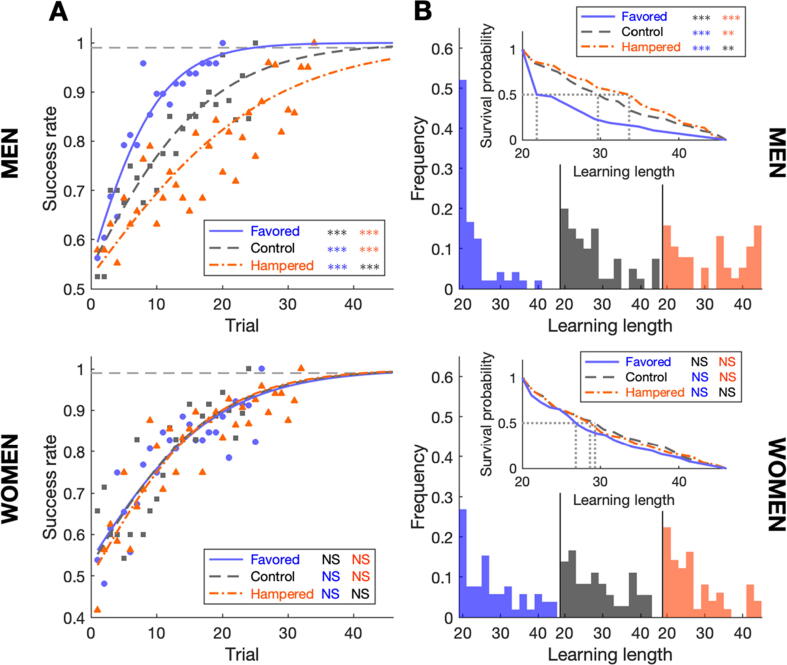
We engaged human subjects in a discrimination-learning task consisting in the classification of static and dynamic visual stimuli. When there was a hidden correspondence between static and dynamic stimuli due to time compaction, the learning performance was expected to be modulated. We studied such a modulation experimentally and by a computational model.
The collected data validated the predicted learning modulation and confirmed that time compaction is a salient cognitive strategy adopted by the human brain to process time-changing situations. Mathematical modelling supported the finding. We also revealed that men are more prone to exploit time compaction in accordance with the context of the hypothesis as a cognitive basis for survival.
The static internal representation of dynamic situations is a human cognitive mechanism involved in decision-making and strategy planning to cope with time-changing environments. The finding opens a new venue to understand how humans efficiently interact with our dynamic world and thrive in nature.
人类大脑是在复杂动态环境中的生存约束下进化而来的。它基于对环境的内部表征做出快速且可靠的决策。虽然参与空间内部表征的神经机制已为人所知,但完整的时空认知仍然是一个挑战。越来越多的实验证据表明,致力于空间认知的大脑机制也可能参与时空信息处理。
时间压缩假说假定大脑将静态和动态情境都表征为纯粹的静态地图。这种对外部复杂性的内部简化使人类能够有效地实时处理随时间变化的情境。根据时间压缩理论,传统静态和动态视觉刺激的表征之间可能存在深层次的内在相似性。在此,我们对这一假说进行检验,并报告人类时间压缩的首个实验证据。
我们让人类受试者参与一项辨别学习任务,该任务包括对静态和动态视觉刺激进行分类。当由于时间压缩导致静态和动态刺激之间存在隐藏对应关系时,预期学习表现会受到调节。我们通过实验和计算模型研究了这种调节。
收集到的数据验证了预测的学习调节,并证实时间压缩是人类大脑采用的一种显著认知策略,用于处理随时间变化的情境。数学建模支持了这一发现。我们还发现,根据该假说的背景,男性更倾向于利用时间压缩作为生存的认知基础。
动态情境的静态内部表征是一种人类认知机制,参与决策和策略规划以应对不断变化的环境。这一发现为理解人类如何有效地与动态世界互动并在自然中蓬勃发展开辟了新途径。