Department of Psychology, University of Pennsylvania, Philadelphia, Pennsylvania, USA.
Institute of Behavioural Neuroscience, Department of Experimental Psychology, Division of Psychology and Language Sciences, University College London, London, UK.
Nat Neurosci. 2017 Oct 26;20(11):1504-1513. doi: 10.1038/nn.4656.
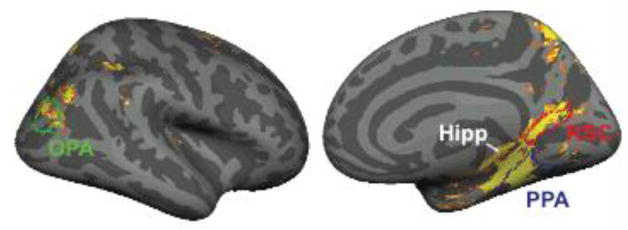
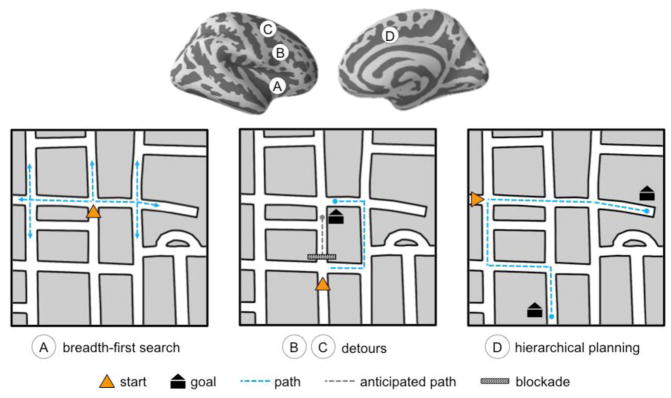
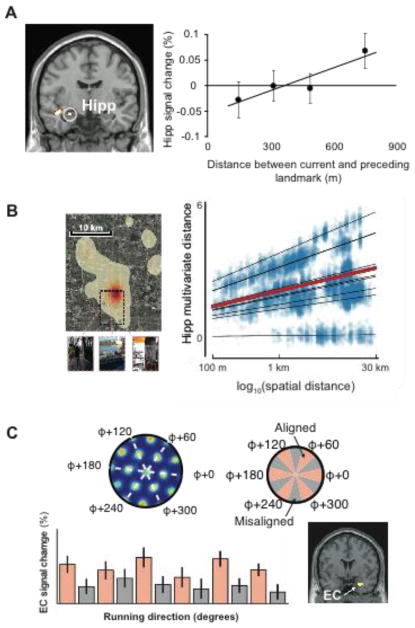
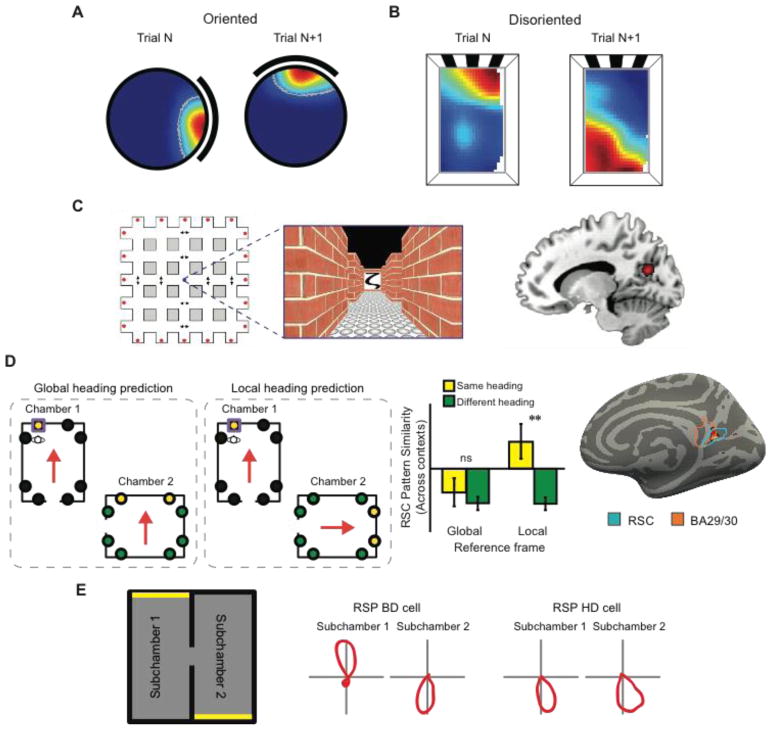
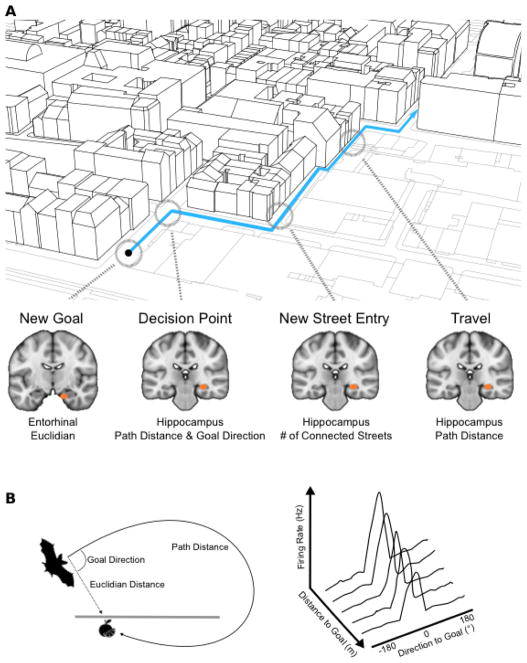
The 'cognitive map' hypothesis proposes that brain builds a unified representation of the spatial environment to support memory and guide future action. Forty years of electrophysiological research in rodents suggest that cognitive maps are neurally instantiated by place, grid, border and head direction cells in the hippocampal formation and related structures. Here we review recent work that suggests a similar functional organization in the human brain and yields insights into how cognitive maps are used during spatial navigation. Specifically, these studies indicate that (i) the human hippocampus and entorhinal cortex support map-like spatial codes, (ii) posterior brain regions such as parahippocampal and retrosplenial cortices provide critical inputs that allow cognitive maps to be anchored to fixed environmental landmarks, and (iii) hippocampal and entorhinal spatial codes are used in conjunction with frontal lobe mechanisms to plan routes during navigation. We also discuss how these three basic elements of cognitive map based navigation-spatial coding, landmark anchoring and route planning-might be applied to nonspatial domains to provide the building blocks for many core elements of human thought.
“认知地图”假说提出,大脑构建了一个统一的空间环境表示,以支持记忆并指导未来的行动。啮齿动物 40 年的电生理学研究表明,认知地图是由海马体及其相关结构中的位置、网格、边界和头部方向细胞神经实现的。在这里,我们回顾了最近的研究工作,这些工作表明人类大脑中存在类似的功能组织,并深入了解了认知地图在空间导航过程中的使用方式。具体来说,这些研究表明:(i)人类海马体和内嗅皮层支持类似地图的空间编码;(ii)后颅区域,如旁海马和后扣带回皮层,提供了关键的输入,使认知地图能够锚定到固定的环境地标上;(iii)海马体和内嗅体的空间编码与额叶机制一起用于导航过程中的路线规划。我们还讨论了基于认知地图的导航的这三个基本要素——空间编码、地标锚定和路线规划——如何应用于非空间领域,为人类思维的许多核心要素提供构建块。