Naunheim Matthew R, Zhou Allen S, Puka Elefteria, Franco Ramon A, Carroll Thomas L, Teng Stephanie E, Mallur Pavan S, Song Phillip C
Department of Otolaryngology-Head and Neck Surgery Massachusetts Eye and Ear Infirmary Boston Massachusetts USA.
Department of Otolaryngology-Head and Neck Surgery Harvard Medical School Boston Massachusetts USA.
Laryngoscope Investig Otolaryngol. 2020 Oct 30;5(6):1117-1124. doi: 10.1002/lio2.484. eCollection 2020 Dec.
To describe and visually depict laryngeal complications in patients recovering from coronavirus disease 2019 (COVID-19) infection along with associated patient characteristics.
Prospective patient series.
Tertiary laryngology care centers.
Twenty consecutive patients aged 18 years or older presenting with laryngological complaints following recent COVID-19 infection were included. Patient demographics, comorbid medical conditions, COVID-19 diagnosis dates, symptoms, intubation, and tracheostomy status, along with subsequent laryngological symptoms related to voice, airway, and swallowing were collected. Findings on laryngoscopy and stroboscopy were included, if performed.
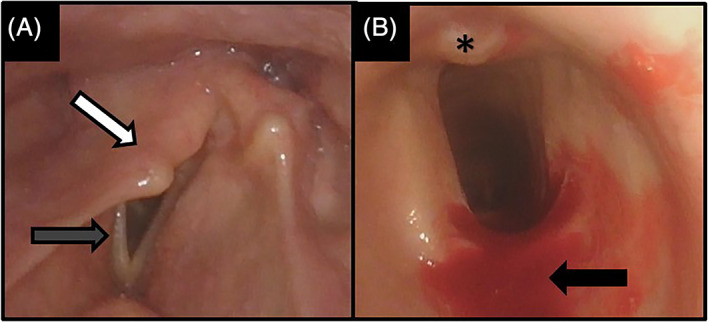
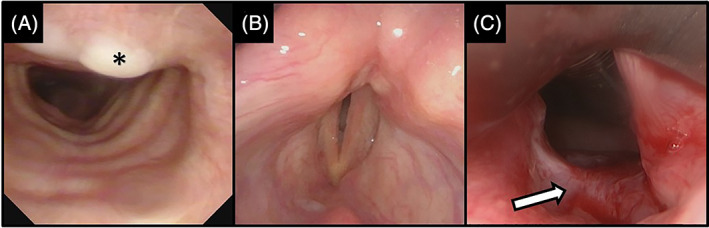
Of the 20 patients enrolled, 65% had been intubated for an average duration of 21.8 days and 69.2% requiring prone-position mechanical ventilation. Voice-related complaints were the most common presenting symptom, followed by those related to swallowing and breathing. All patients who underwent flexible laryngoscopy demonstrated laryngeal abnormalities, most frequently in the glottis (93.8%), and those who underwent stroboscopy had abnormalities in mucosal wave (87.5%), periodicity (75%), closure (50%), and symmetry (50%). Unilateral vocal fold immobility was the most common diagnosis (40%), along with posterior glottic (15%) and subglottic (10%) stenoses. 45% of patients underwent further procedural intervention in the operating room or office. Many findings were suggestive of intubation-related injury.
Prolonged intubation with prone-positioning commonly employed in COVID-19 respiratory failure can lead to significant laryngeal complications with associated difficulties in voice, airway, and swallowing. The high percentage of glottic injuries underscores the importance of stroboscopic examination. Otolaryngologists must be prepared to manage these complications in patients recovering from COVID-19.
IV.
描述并直观呈现2019冠状病毒病(COVID-19)感染康复患者的喉部并发症以及相关患者特征。
前瞻性患者系列研究。
三级喉科学护理中心。
纳入20例年龄在18岁及以上、近期感染COVID-19后出现喉部症状的连续患者。收集患者人口统计学资料、合并症、COVID-19诊断日期、症状、插管及气管切开状态,以及随后与声音、气道和吞咽相关的喉部症状。若进行了喉镜检查和频闪喉镜检查,则纳入其结果。
在纳入的20例患者中,65%曾接受插管,平均插管时间为21.8天,69.2%需要俯卧位机械通气。与声音相关的症状是最常见的首发症状,其次是与吞咽和呼吸相关的症状。所有接受柔性喉镜检查的患者均表现出喉部异常,最常见于声门(93.8%),接受频闪喉镜检查的患者在黏膜波(87.5%)、周期性(75%)、闭合(50%)和对称性(50%)方面存在异常。单侧声带麻痹是最常见的诊断(40%),其次是声门后狭窄(15%)和声门下狭窄(10%)。45%的患者在手术室或诊室接受了进一步的手术干预。许多检查结果提示与插管相关的损伤。
COVID-19呼吸衰竭患者常用的长时间俯卧位插管可导致严重的喉部并发症,并伴有声音、气道和吞咽方面的相关困难。声门损伤的高比例凸显了频闪喉镜检查的重要性。耳鼻喉科医生必须做好管理COVID-19康复患者这些并发症的准备。
IV级。