Spohn Simon K B, Kramer Maria, Kiefer Selina, Bronsert Peter, Sigle August, Schultze-Seemann Wolfgang, Jilg Cordula A, Sprave Tanja, Ceci Lara, Fassbender Thomas F, Nicolay Nils H, Ruf Juri, Grosu Anca L, Zamboglou Constantinos
Department of Radiation Oncology, Medical Center-University of Freiburg, Faculty of Medicine, University of Freiburg, Freiburg, Germany.
German Cancer Consortium (DKTK), Partner Site Freiburg, Freiburg, Germany.
Front Oncol. 2020 Dec 7;10:600690. doi: 10.3389/fonc.2020.600690. eCollection 2020.
Accurate contouring of intraprostatic gross tumor volume (GTV) is pivotal for successful delivery of focal therapies and for biopsy guidance in patients with primary prostate cancer (PCa). Contouring of GTVs, using 18-Fluor labeled tracer prostate specific membrane antigen positron emission tomography ([F]PSMA-1007/PET) has not been examined yet.
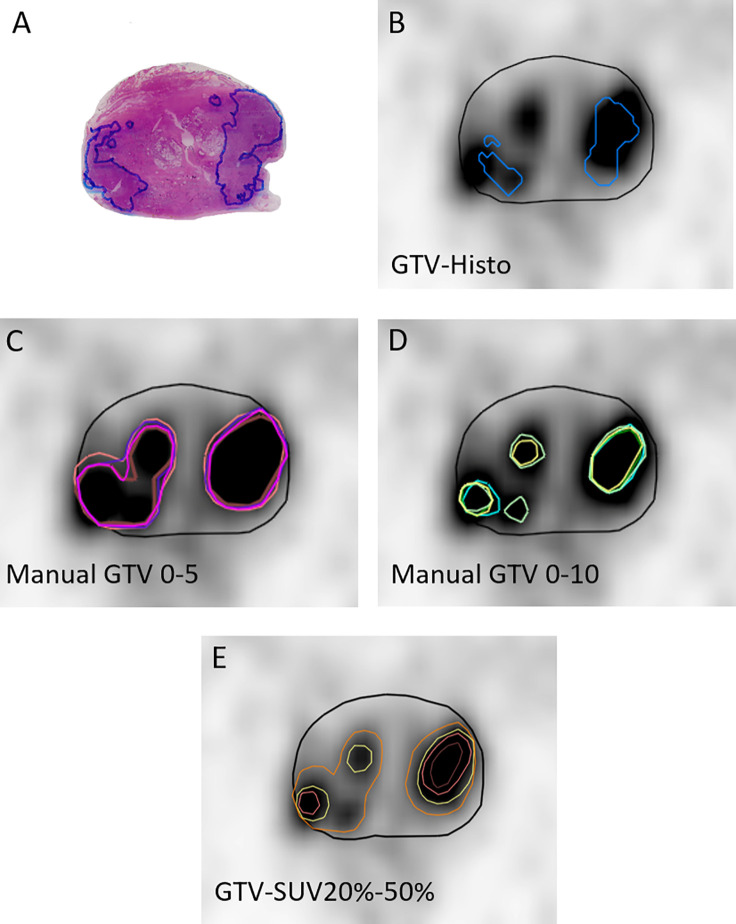
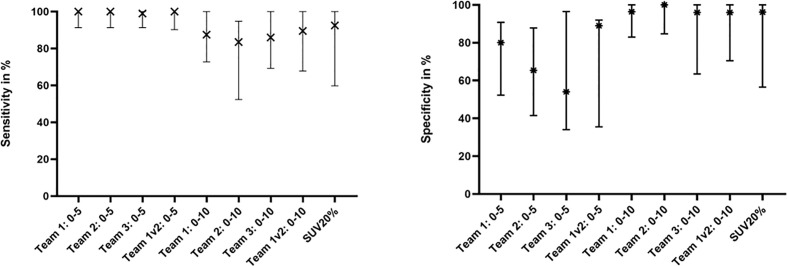
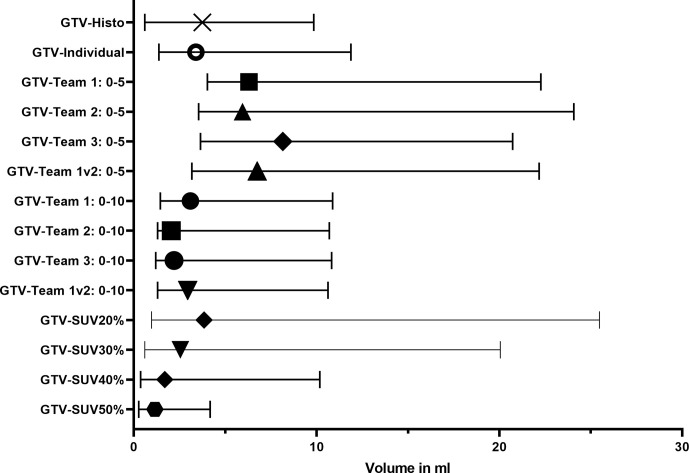
Ten Patients with primary PCa who underwent [F]PSMA-1007 PET followed by radical prostatectomy were prospectively enrolled. Coregistered histopathological gross tumor volume (GTV-Histo) was used as standard of reference. PSMA-PET images were contoured on two ways: (1) manual contouring with PET scaling SUVmin-max: 0-10 was performed by three teams with different levels of experience. Team 1 repeated contouring at a different time point, resulting in n = 4 manual contours. (2) Semi-automatic contouring approaches using SUVmax thresholds of 20-50% were performed. Interobserver agreement was assessed for manual contouring by calculating the Dice Similarity Coefficient (DSC) and for all approaches sensitivity, specificity were calculated by dividing the prostate in each CT slice into four equal quadrants under consideration of histopathology as standard of reference.
Manual contouring yielded an excellent interobserver agreement with a median DSC of 0.90 (range 0.87-0.94). Volumes derived from scaling SUVmin-max 0-10 showed no statistically significant difference from GTV-Histo and high sensitivities (median 87%, range 84-90%) and specificities (median 96%, range 96-100%). GTVs using semi-automatic segmentation applying a threshold of 20-40% of SUVmax showed no significant difference in absolute volumes to GTV-Histo, GTV-SUV50% was significantly smaller. Best performing semi-automatic contour (GTV-SUV20%) achieved high sensitivity (median 93%) and specificity (median 96%). There was no statistically significant difference to SUVmin-max 0-10.
Manual contouring with PET scaling SUVmin-max 0-10 and semi-automatic contouring applying a threshold of 20% of SUVmax achieved high sensitivities and very high specificities and are recommended for [F]PSMA-1007 PET based focal therapy approaches. Providing high specificities, semi-automatic approaches applying thresholds of 30-40% of SUVmax are recommend for biopsy guidance.
准确勾勒前列腺内大体肿瘤体积(GTV)对于成功实施聚焦治疗以及原发性前列腺癌(PCa)患者的活检引导至关重要。尚未对使用18F标记示踪剂前列腺特异性膜抗原正电子发射断层扫描([F]PSMA - 1007/PET)勾勒GTV进行研究。
前瞻性纳入10例接受[F]PSMA - 1007 PET检查后行根治性前列腺切除术的原发性PCa患者。将配准的组织病理学大体肿瘤体积(GTV - Histo)用作参考标准。PSMA - PET图像通过两种方式勾勒:(1)由三个经验水平不同的团队进行PET缩放SUVmin - max:0 - 10的手动勾勒。团队1在不同时间点重复勾勒,得到n = 4个手动轮廓。(2)使用SUVmax阈值为20% - 50%的半自动勾勒方法。通过计算骰子相似系数(DSC)评估手动勾勒的观察者间一致性,对于所有方法,以组织病理学为参考标准,将每个CT切片中的前列腺分为四个相等象限来计算敏感性和特异性。
手动勾勒显示观察者间一致性极佳,DSC中位数为0.90(范围0.87 - 0.94)。缩放SUVmin - max 0 - 10得出的体积与GTV - Histo无统计学显著差异,敏感性高(中位数87%,范围84% - 90%),特异性高(中位数96%,范围96% - 100%)。使用SUVmax阈值为20% - 40%的半自动分割得出的GTV在绝对体积上与GTV - Histo无显著差异,GTV - SUV50%显著更小。表现最佳的半自动轮廓(GTV - SUV20%)实现了高敏感性(中位数93%)和特异性(中位数96%)。与SUVmin - max 0 - 10无统计学显著差异。
PET缩放SUVmin - max 0 - 10的手动勾勒和应用SUVmax 20%阈值的半自动勾勒具有高敏感性和非常高的特异性,推荐用于基于[F]PSMA - 1007 PET的聚焦治疗方法。对于活检引导,推荐应用SUVmax 30% - 40%阈值的半自动方法,其具有高特异性。