Li Shu-Xiang, Zhang Xiao-Feng, Wang Hong-Xin, Zhu Zhi-Xin, Wang Hua-Feng
Hainan Key Laboratory for Sustainable Utilization of Tropical Bioresources, School of Life and Pharmaceutical Sciences, Hainan University, Haikou, China.
Mitochondrial DNA B Resour. 2019 Sep 19;4(2):3114-3115. doi: 10.1080/23802359.2019.1667915.
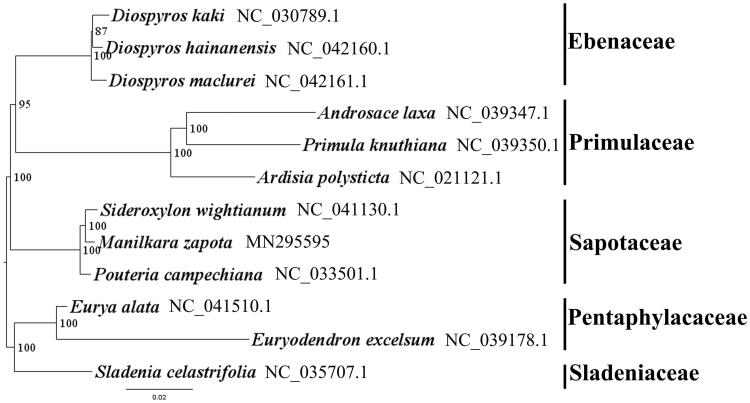
iThe plastome of is found to be 158,386 bp long with the typical quadripartite structure of angiosperms, contains two inverted repeats (IRs) of 26,099 bp each, a large single-copy (LSC) region of 87,745 bp, and a small single-copy (SSC) region of 18,443 bp. The plastome contains 114 genes, consisting of 80 unique protein-coding genes, 30 unique tRNA genes, and 4 unique rRNA genes. The overall A/T content in the plastome of M. zapota is 63.00%. The phylogenetic analysis indicated that is close to within Sapotaceae in this study.
发现[物种名称]的质体基因组长度为158,386 bp,具有被子植物典型的四分体结构,包含两个各为26,099 bp的反向重复序列(IRs)、一个87,745 bp的大单拷贝(LSC)区域和一个18,443 bp的小单拷贝(SSC)区域。该质体基因组包含114个基因,由80个独特的蛋白质编码基因、30个独特的tRNA基因和4个独特的rRNA基因组成。人心果质体基因组中的总体A/T含量为63.00%。系统发育分析表明,在本研究中[物种名称]在山榄科内与[另一物种名称]关系密切。 (注:原文中“iThe”应为“The”,“ is found to be”等多处缺少具体物种名称,翻译时根据一般情况补充了相关表述以使译文完整通顺。)