Department of Surgical Sciences, Orthopaedics, Uppsala University, Uppsala, Sweden.
Department of Medical Sciences, Molecular Epidemiology, Uppsala University, Uppsala, Sweden.
Int J Epidemiol. 2021 Mar 3;50(1):234-244. doi: 10.1093/ije/dyaa239.
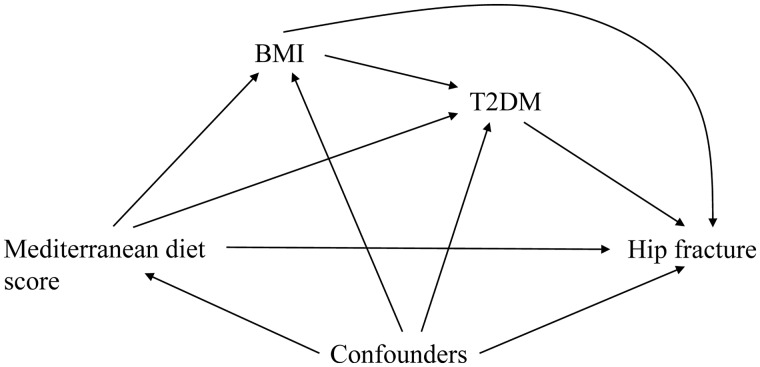
We examined whether the inverse association between adherence to a Mediterranean diet and hip fracture risk is mediated by incident type 2 diabetes mellitus (T2DM) and body mass index (BMI).
We included 50 755 men and women from the Cohort of Swedish Men and the Swedish Mammography Cohort who answered lifestyle and medical questionnaires in 1997 and 2008 (used for calculation of the Mediterranean diet score 9mMED; low, medium, high) and BMI in 1997, and incident T2DM in 1997-2008). The cumulative incidence of hip fracture from the National Patient Register (2009-14) was considered as outcome.
We present conditional odds ratios (OR) 9[95% confidence interval, CI) of hip fracture for medium and high adherence to mMED, compared with low adherence. The total effect ORs were 0.82 (0.71, 0.95) and 0.75 (0.62, 0.91), respectively. The controlled direct effect of mMED on hip fracture (not mediated by T2DM, considering BMI as an exposure-induced confounder), calculated using inverse probability weighting of marginal structural models, rendered ORs of 0.82 (0.72, 0.95) and 0.73 (0.60, 0.88), respectively. The natural direct effect ORs (not mediated by BMI or T2DM, calculated using flexible mediation analysis) were 0.82 (0.71, 0.95) and 0.74(0.61, 0.89), respectively. The path-specific indirect and partial indirect natural effects ORs (through BMI or T2DM) were close to 1.
Mediterranean diet has a direct effect on hip fracture risk via pathways other than through T2DM and BMI. We cannot exclude mediating effects of T2DM or BMI, or that their effects cancel each other out.
我们研究了地中海饮食与髋部骨折风险之间的负相关关系是否通过 2 型糖尿病(T2DM)和体重指数(BMI)的发生来介导。
我们纳入了 50755 名来自瑞典男性队列和瑞典乳腺摄影队列的男性和女性,他们在 1997 年和 2008 年(用于计算地中海饮食评分 9mMED;低、中、高)和 BMI(1997 年)回答了生活方式和医学问卷,并在 1997-2008 年期间发生了 T2DM。国家患者登记处(2009-14 年)的髋部骨折累积发病率被视为结局。
我们提出了与低依从性相比,中、高依从性与 mmed 的髋部骨折的条件比值比(OR)9[95%置信区间,CI]。总效应 OR 分别为 0.82(0.71,0.95)和 0.75(0.62,0.91)。使用边际结构模型的逆概率加权计算 mmed 对髋部骨折的直接控制效应(不考虑 BMI 作为暴露引起的混杂因素),得出的 OR 分别为 0.82(0.72,0.95)和 0.73(0.60,0.88)。使用灵活的中介分析计算的非 BMI 或 T2DM 介导的自然直接效应 OR 分别为 0.82(0.71,0.95)和 0.74(0.60,0.88)。路径特异性间接和部分间接自然效应 ORs(通过 BMI 或 T2DM)接近 1。
地中海饮食通过 T2DM 和 BMI 以外的途径对髋部骨折风险有直接影响。我们不能排除 T2DM 或 BMI 的中介作用,或它们的作用相互抵消。