Faculty of Health and Life Sciences, University of the West of England, Coldharbour Lane, Bristol, BS16 1QY, UK.
Department of Pathology, Faculty of Medicine, Umm Al-Qura University, Makkah, 24382, Saudi Arabia.
Breast Cancer. 2021 May;28(3):592-607. doi: 10.1007/s12282-020-01197-7. Epub 2020 Dec 24.
Biological characterisation of breast cancer subtypes is essential as it informs treatment regimens especially as different subtypes have distinct locoregional patterns. This is related to metabolic phenotype, where altered cellular metabolism is a fundamental adaptation of cancer cells during rapid proliferation. In this context, the metabolism of the essential branched-chain amino acids (BCAAs), catalysed by the human branched-chain aminotransferase proteins (hBCAT), offers multiple benefits for tumour growth. Upregulation of the cytosolic isoform of hBCAT (hBCATc), regulated by c-Myc, has been demonstrated to increase cell migration, tumour aggressiveness and proliferation in gliomas, ovarian and colorectal cancer but the importance of the mitochondrial isoform, hBCATm has not been fully investigated.
Using immunohistochemistry, the expression profile of metabolic proteins (hBCAT, IDH) was assessed between breast cancer subtypes, HER2 + , luminal A, luminal B and TNBC. Correlations between the percentage and the intensity of protein expression/co-expression with clinical parameters, such as hormone receptor status, tumour stage, lymph-node metastasis and survival, were determined.
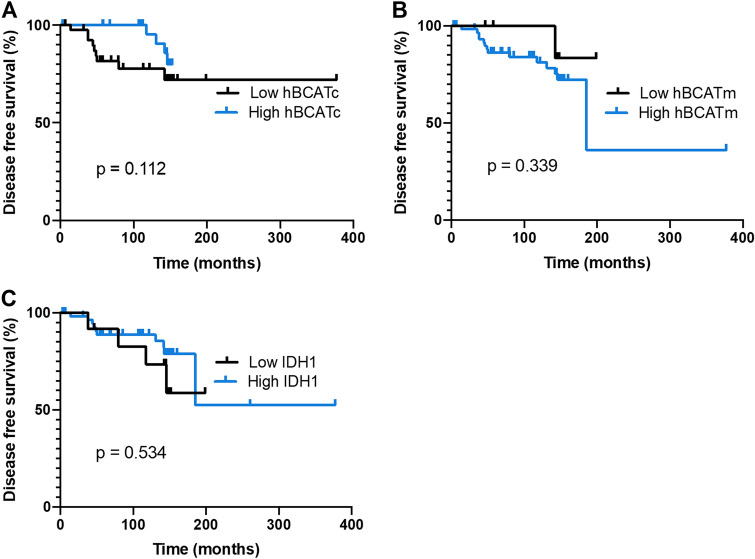
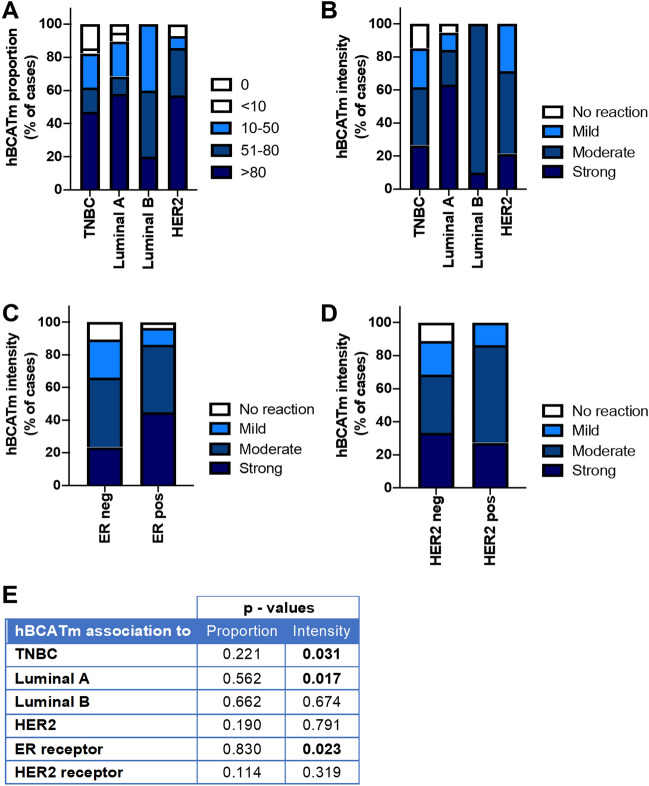
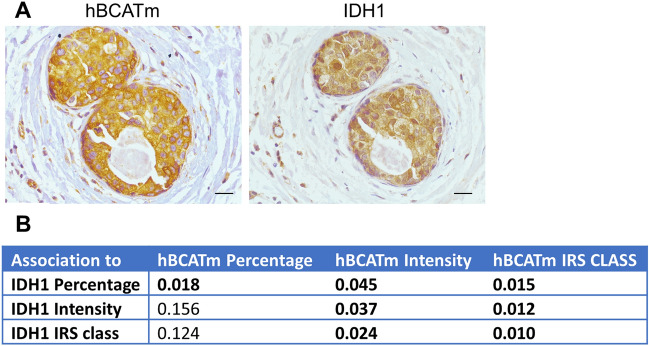
We show that hBCATc expression was found to be significantly associated with the more aggressive HER2 + and luminal B subtypes, whilst hBCATm and IDH1 associated with luminal A subtype. This was concomitant with better prognosis indicating a differential metabolic reliance between these two subtypes, in which enhanced expression of IDH1 may replenish the α-ketoglutarate pool in cells with increased hBCATm expression.
The cytosolic isoform of BCAT is associated with tumours that express HER2 receptors, whereas the mitochondrial isoform is highly expressed in tumours that are ER + , indicating that the BCAT proteins are regulated through different signalling pathways, which may lead to the identification of novel targets for therapeutic applications targeting dysregulated cancer metabolism.
乳腺癌亚型的生物学特征至关重要,因为它可以为治疗方案提供信息,特别是因为不同的亚型具有不同的局部区域模式。这与代谢表型有关,其中癌细胞在快速增殖过程中发生的细胞代谢改变是基本的适应。在这种情况下,必需支链氨基酸(BCAA)的代谢,由人支链氨基转移酶蛋白(hBCAT)催化,为肿瘤生长提供了多种益处。已经证明,细胞溶质同工型 hBCAT(hBCATc)的上调,由 c-Myc 调节,可增加神经胶质瘤、卵巢和结直肠癌中的细胞迁移、肿瘤侵袭性和增殖,但线粒体同工型 hBCATm 的重要性尚未得到充分研究。
使用免疫组织化学方法,评估代谢蛋白(hBCAT、IDH)在乳腺癌亚型、HER2+、luminal A、luminal B 和 TNBC 之间的表达谱。确定蛋白表达/共表达的百分比和强度与临床参数(如激素受体状态、肿瘤分期、淋巴结转移和生存)之间的相关性。
我们发现 hBCATc 的表达与更具侵袭性的 HER2+和 luminal B 亚型显著相关,而 hBCATm 和 IDH1 与 luminal A 亚型相关。这与更好的预后相关,表明这两种亚型之间存在不同的代谢依赖性,其中增强的 IDH1 表达可能补充具有增加的 hBCATm 表达的细胞中的α-酮戊二酸池。
BCAT 的细胞质同工型与表达 HER2 受体的肿瘤相关,而线粒体同工型在 ER+的肿瘤中高度表达,表明 BCAT 蛋白通过不同的信号通路进行调节,这可能导致鉴定出针对失调的癌症代谢的治疗应用的新靶点。