Division of Nephrology, Department of Medicine, University of Texas Southwestern Medical Center, Dallas, TX, USA.
Perelman School of Medicine, University of Pennsylvania, Philadelphia, PA, USA.
Adv Ther. 2021 Feb;38(2):949-968. doi: 10.1007/s12325-020-01587-5. Epub 2020 Dec 26.
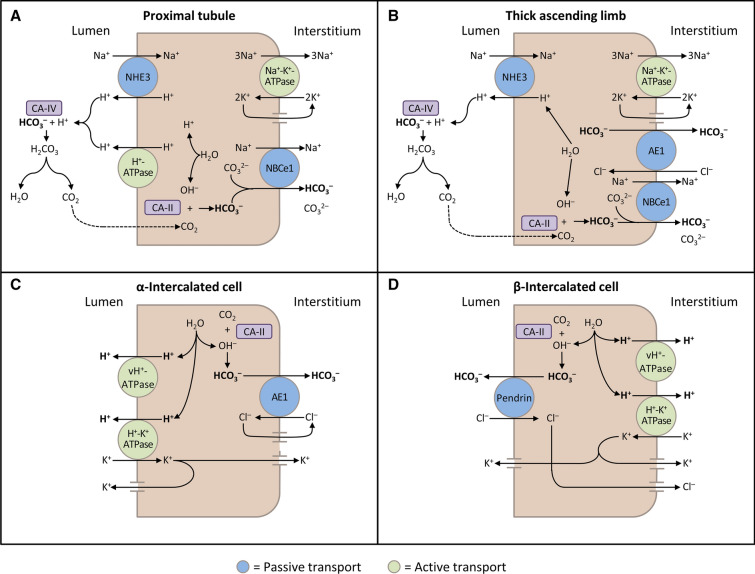
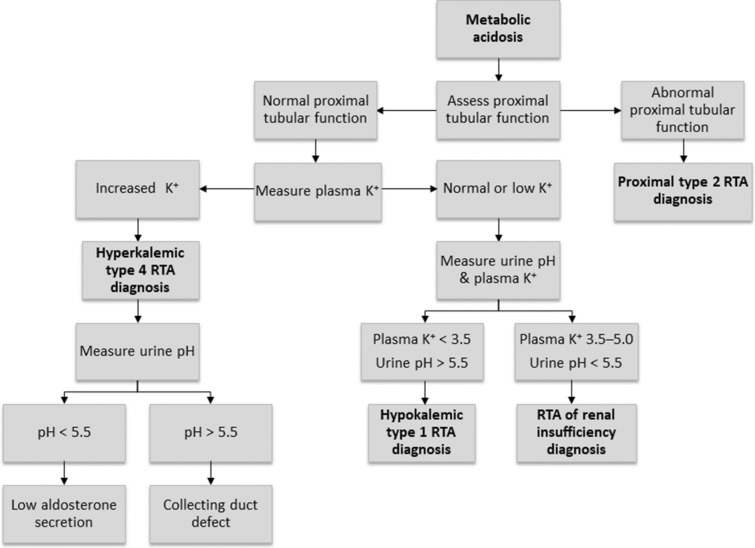
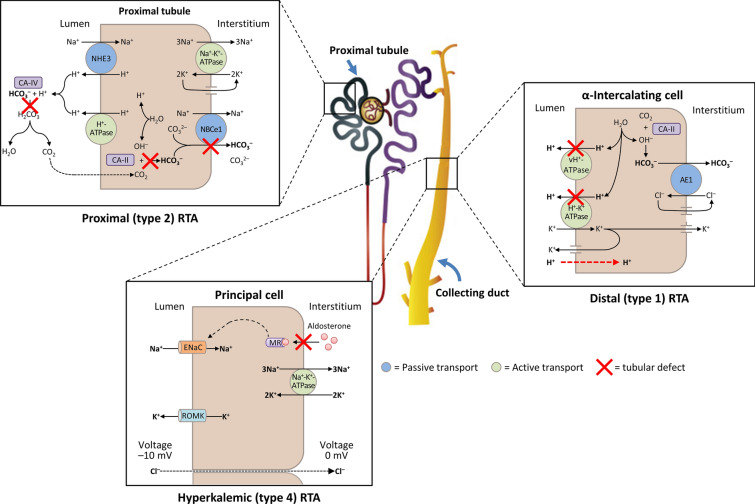
Renal tubular acidosis (RTA) occurs when the kidneys are unable to maintain normal acid-base homeostasis because of tubular defects in acid excretion or bicarbonate ion reabsorption. Using illustrative clinical cases, this review describes the main types of RTA observed in clinical practice and provides an overview of their diagnosis and treatment. The three major forms of RTA are distal RTA (type 1; characterized by impaired acid excretion), proximal RTA (type 2; caused by defects in reabsorption of filtered bicarbonate), and hyperkalemic RTA (type 4; caused by abnormal excretion of acid and potassium in the collecting duct). Type 3 RTA is a rare form of the disease with features of both distal and proximal RTA. Accurate diagnosis of RTA plays an important role in optimal patient management. The diagnosis of distal versus proximal RTA involves assessment of urinary acid and bicarbonate secretion, while in hyperkalemic RTA, selective aldosterone deficiency or resistance to its effects is confirmed after exclusion of other causes of hyperkalemia. Treatment options include alkali therapy in patients with distal or proximal RTA and lowering of serum potassium concentrations through dietary modification and potential new pharmacotherapies in patients with hyperkalemic RTA including newer potassium binders.
当肾脏由于肾小管排酸或重吸收碳酸氢根离子缺陷而无法维持正常酸碱平衡时,就会发生肾小管酸中毒 (RTA)。本文通过列举临床病例,描述了在临床实践中观察到的主要类型的 RTA,并对其诊断和治疗进行了概述。RTA 的三种主要类型为远端肾小管酸中毒 (RTA; 1 型,特征为排酸功能障碍)、近端肾小管酸中毒 (RTA; 2 型,由滤过的碳酸氢盐重吸收缺陷引起) 和高钾血症型 RTA (RTA; 4 型,由集合管排酸和排钾异常引起)。RTA 型 3 是一种罕见的疾病形式,具有远端和近端 RTA 的特征。准确诊断 RTA 对患者的最佳管理起着重要作用。RTA 的诊断包括远端和近端 RTA 的尿酸和碳酸氢盐分泌评估,而在高钾血症型 RTA 中,在排除其他高钾血症原因后,通过选择性醛固酮缺乏或对其作用的抵抗来确认。治疗选择包括远端或近端 RTA 患者的碱治疗以及通过饮食调整和高钾血症型 RTA 患者的潜在新药物治疗(包括新型钾结合剂)来降低血清钾浓度。