Br J Dermatol. 2021 Jul;185(1):80-90. doi: 10.1111/bjd.19755. Epub 2021 Mar 9.
Registry data suggest that people with immune-mediated inflammatory diseases (IMIDs) receiving targeted systemic therapies have fewer adverse coronavirus disease 2019 (COVID-19) outcomes compared with patients receiving no systemic treatments.
We used international patient survey data to explore the hypothesis that greater risk-mitigating behaviour in those receiving targeted therapies may account, at least in part, for this observation.
Online surveys were completed by individuals with psoriasis (globally) or rheumatic and musculoskeletal diseases (RMDs) (UK only) between 4 May and 7 September 2020. We used multiple logistic regression to assess the association between treatment type and risk-mitigating behaviour, adjusting for clinical and demographic characteristics. We characterized international variation in a mixed-effects model.
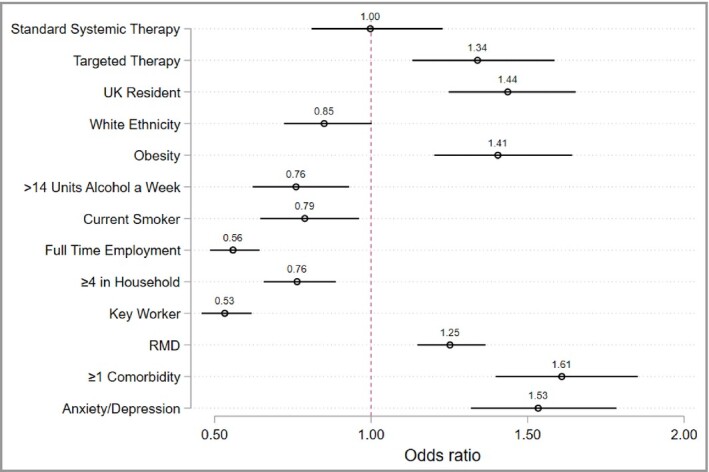
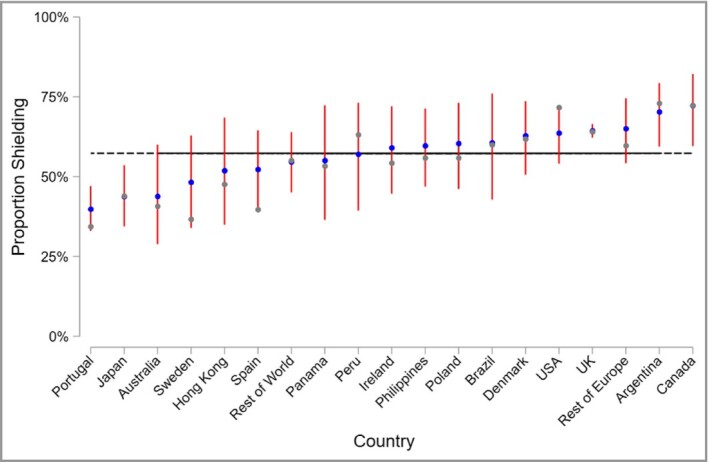
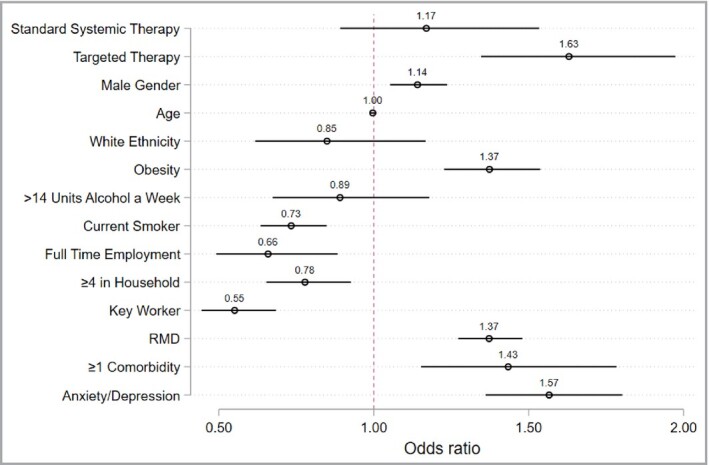
Of 3720 participants (2869 psoriasis, 851 RMDs) from 74 countries, 2262 (60·8%) reported the most stringent risk-mitigating behaviour (classified here under the umbrella term 'shielding'). A greater proportion of those receiving targeted therapies (biologics and Janus Kinase inhibitors) reported shielding compared with those receiving no systemic therapy [adjusted odds ratio (OR) 1·63, 95% confidence interval (CI) 1·35-1·97]. The association between targeted therapy and shielding was preserved when standard systemic therapy was used as the reference group (OR 1·39, 95% CI 1·23-1·56). Shielding was associated with established risk factors for severe COVID-19 [male sex (OR 1·14, 95% CI 1·05-1·24), obesity (OR 1·37, 95% CI 1·23-1·54), comorbidity burden (OR 1·43, 95% CI 1·15-1·78)], a primary indication of RMDs (OR 1·37, 95% CI 1·27-1·48) and a positive anxiety or depression screen (OR 1·57, 95% CI 1·36-1·80). Modest differences in the proportion shielding were observed across nations.
Greater risk-mitigating behaviour among people with IMIDs receiving targeted therapies may contribute to the reported lower risk of adverse COVID-19 outcomes. The behaviour variation across treatment groups, IMIDs and nations reinforces the need for clear evidence-based patient communication on risk-mitigation strategies and may help inform updated public health guidelines as the pandemic continues.
注册数据表明,接受靶向全身治疗的免疫介导的炎症性疾病(IMID)患者与未接受全身治疗的患者相比,COVID-19 不良结局的风险较低。
我们使用国际患者调查数据来探讨这样一种假设,即接受靶向治疗的患者的风险缓解行为可能至少部分解释了这一观察结果。
2020 年 5 月 4 日至 9 月 7 日期间,来自全球的银屑病患者(全球)或风湿和肌肉骨骼疾病(RMDs)患者(仅在英国)完成了在线调查。我们使用多项逻辑回归来评估治疗类型与风险缓解行为之间的关联,同时调整了临床和人口统计学特征。我们使用混合效应模型来描述国际差异。
在来自 74 个国家的 3720 名参与者(2869 名银屑病患者,851 名 RMDs)中,2262 名(60.8%)报告了最严格的风险缓解行为(在此归类为“屏蔽”)。与未接受全身治疗的患者相比,接受靶向治疗(生物制剂和 Janus 激酶抑制剂)的患者报告说采取了更多的屏蔽措施[调整后的优势比(OR)1.63,95%置信区间(CI)1.35-1.97]。当以标准全身治疗为参考组时,靶向治疗与屏蔽之间的关联仍然存在(OR 1.39,95%CI 1.23-1.56)。屏蔽与 COVID-19 严重程度的既定危险因素相关[男性(OR 1.14,95%CI 1.05-1.24),肥胖(OR 1.37,95%CI 1.23-1.54),合并症负担(OR 1.43,95%CI 1.15-1.78)]、RMDs 的主要指征(OR 1.37,95%CI 1.27-1.48)和焦虑或抑郁筛查阳性(OR 1.57,95%CI 1.36-1.80)。在各国之间观察到屏蔽比例的适度差异。
接受靶向治疗的 IMID 患者的风险缓解行为增加,可能导致报告的 COVID-19 不良结局风险降低。治疗组、IMID 和国家之间的行为差异,强调了需要对风险缓解策略进行明确的基于证据的患者沟通,并可能有助于为持续的大流行更新公共卫生指南提供信息。