Department of Neurology, Fleni, Buenos Aires, Argentina.
Department of Neurology, Hospital de Clìnicas Josè de San Martìn, Buenos Aires, Argentina.
Ann Clin Transl Neurol. 2021 Feb;8(2):406-424. doi: 10.1002/acn3.51291. Epub 2020 Dec 28.
To investigate the effects of leptin on different T-cell populations, in order to gain more insight into the link between leptin and obesity.
Three hundred and nine RRMS patients and 322 controls participated in a cross-sectional survey, to confirm whether excess weight/obesity in adolescence or early adulthood increased the risk of MS. Serum leptin levels were determined by ELISA. MBP , and MOG peptide-specific T cells lines were expanded from peripheral blood mononuclear cells. Leptin receptor expression was measured by RT-PCR and flow cytometry. Bcl-2, p-STAT3, pERK1/2, and p27 expression were assayed using ELISA, and apoptosis induction was determined by Annexin V detection. Cytokines were assessed by ELISPOT and ELISA, and regulatory T cells (Tregs) by flow cytometry.
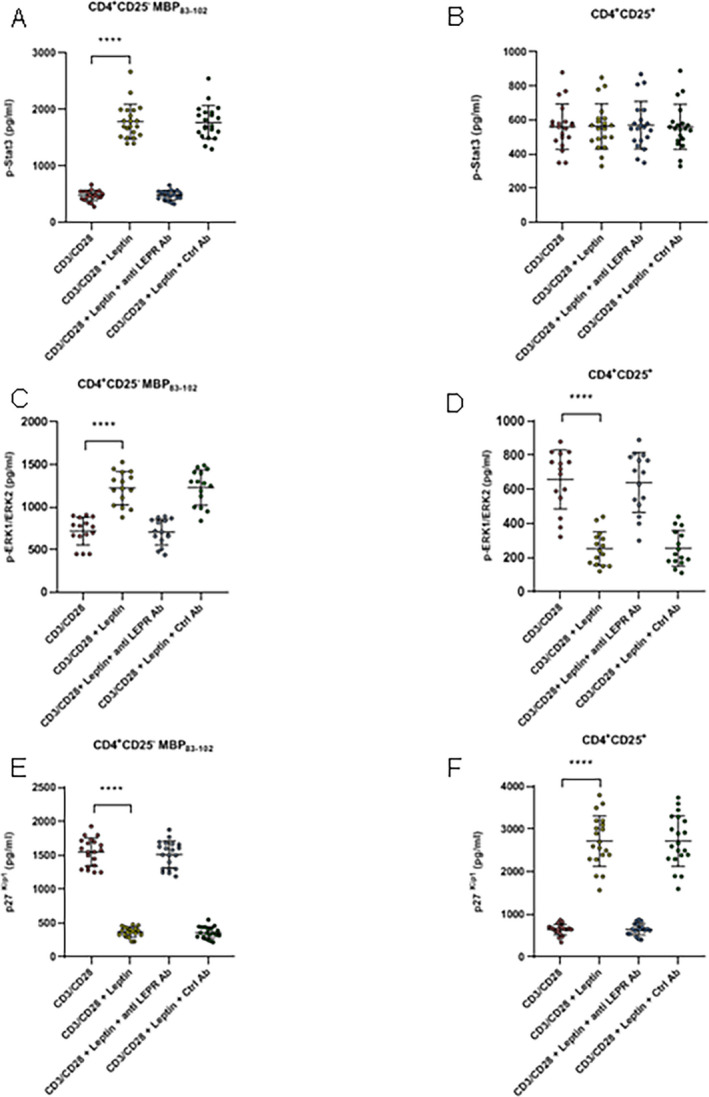
Logistic regression analysis, showed excess weight at age 15, and obesity at 20 years of age increased MS risk (OR = 2.16, P = 0.01 and OR = 3.9, P = 0.01). Leptin levels correlated with BMI in both groups. The addition of Leptin increased autoreactive T-cell proliferation, reduced apoptosis induction, and promoted proinflammatory cytokine secretion. Obese patients produced more proinflammatory cytokines compared to overweight/normal/underweight subjects. Inverse correlation was found between leptin levels and circulating Treg cells (r = -0.97, P < 0.0001). Leptin inhibited Treg proliferation. Effects of leptin on CD4 CD25 effector T cells were mediated by increased STAT3 and ERK1/2 phosphorylation, and down modulation of the cell cycle inhibitor P27 . In contrast, leptin effects on Tregs resulted from decreased phosphorylation of ERK1/2 and upregulation of p27 .
Leptin promotes autoreactive T-cell proliferation and proinflammatory cytokine secretion, but inhibits Treg-cell proliferation.
研究瘦素对不同 T 细胞群的影响,以期深入了解瘦素与肥胖之间的联系。
309 例 RRMS 患者和 322 例对照者参与了横断面调查,以确认青春期或成年早期超重/肥胖是否会增加 MS 风险。采用 ELISA 法测定血清瘦素水平。从外周血单个核细胞中扩增 MBP 和 MOG 肽特异性 T 细胞系。采用 RT-PCR 和流式细胞术测定瘦素受体表达。采用 ELISA 法测定 Bcl-2、p-STAT3、pERK1/2 和 p27 表达,用 Annexin V 检测法检测细胞凋亡诱导。采用 ELISPOT 和 ELISA 法评估细胞因子,用流式细胞术评估调节性 T 细胞(Tregs)。
Logistic 回归分析显示,15 岁时超重和 20 岁时肥胖会增加 MS 风险(OR=2.16,P=0.01 和 OR=3.9,P=0.01)。瘦素水平与两组 BMI 相关。在两组中,瘦素的添加均增加了自身反应性 T 细胞增殖,减少了凋亡诱导,并促进了促炎细胞因子的分泌。与超重/正常/消瘦患者相比,肥胖患者产生的促炎细胞因子更多。发现瘦素水平与循环 Treg 细胞呈负相关(r=-0.97,P<0.0001)。瘦素抑制 Treg 增殖。瘦素对 CD4 CD25 效应 T 细胞的作用是通过增加 STAT3 和 ERK1/2 磷酸化以及下调细胞周期抑制剂 P27 来介导的。相反,瘦素对 Tregs 的作用是通过降低 ERK1/2 磷酸化和上调 p27 来实现的。
瘦素促进自身反应性 T 细胞增殖和促炎细胞因子分泌,但抑制 Treg 细胞增殖。