Sousa João M, Appel Lieuwe, Merida Inés, Heckemann Rolf A, Costes Nicolas, Engström Mathias, Papadimitriou Stergios, Nyholm Dag, Ahlström Håkan, Hammers Alexander, Lubberink Mark
Department of Surgical Sciences, Uppsala University, Uppsala, Sweden.
Medical Imaging Centre, Uppsala University Hospital, Uppsala, Sweden.
EJNMMI Phys. 2020 Dec 28;7(1):77. doi: 10.1186/s40658-020-00347-2.
A valid photon attenuation correction (AC) method is instrumental for obtaining quantitatively correct PET images. Integrated PET/MR systems provide no direct information on attenuation, and novel methods for MR-based AC (MRAC) are still under investigation. Evaluations of various AC methods have mainly focused on static brain PET acquisitions. In this study, we determined the validity of three MRAC methods in a dynamic PET/MR study of the brain.
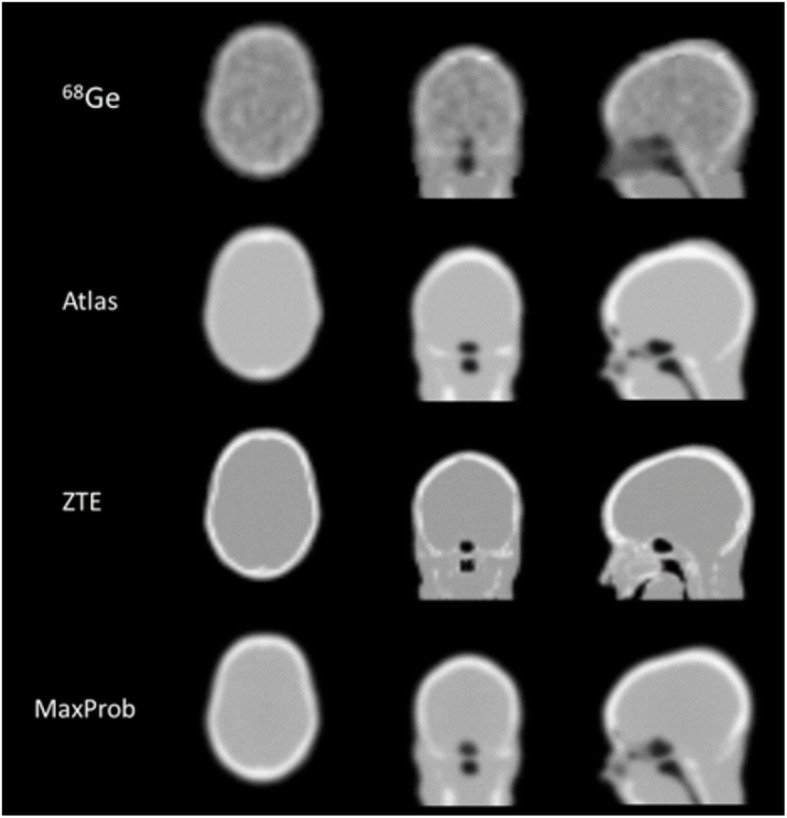
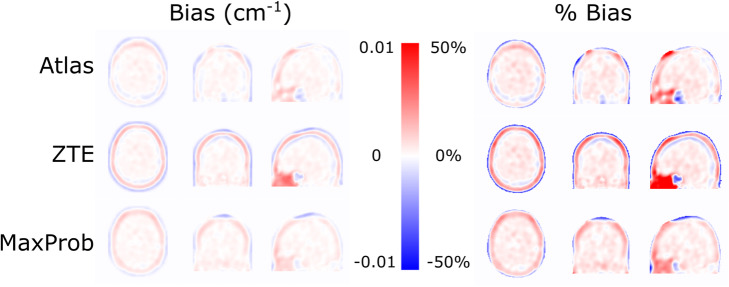
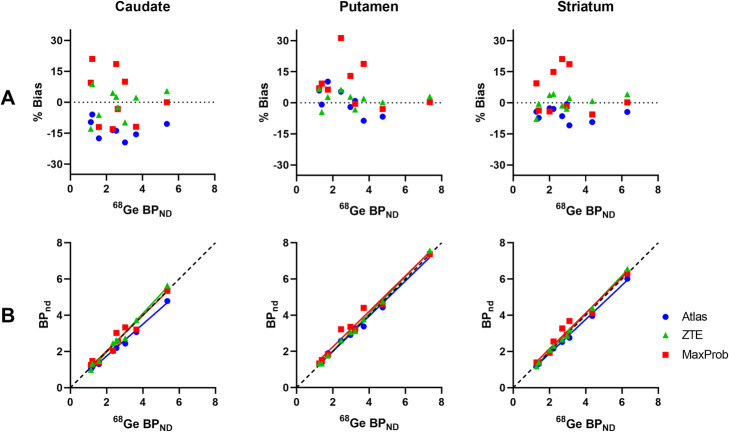
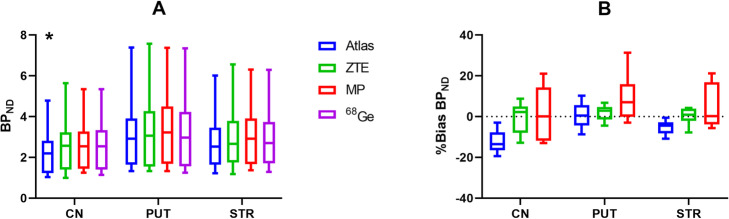
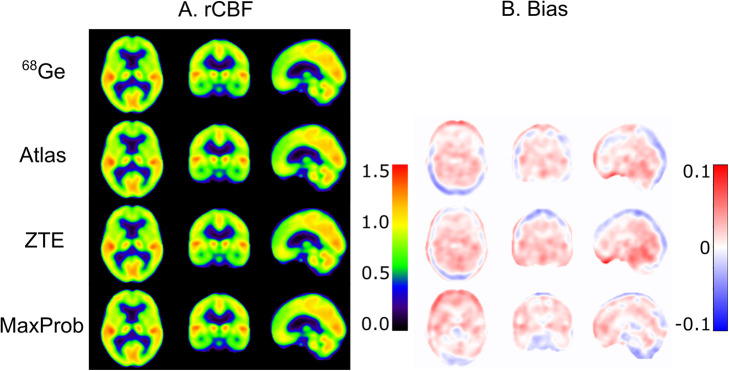
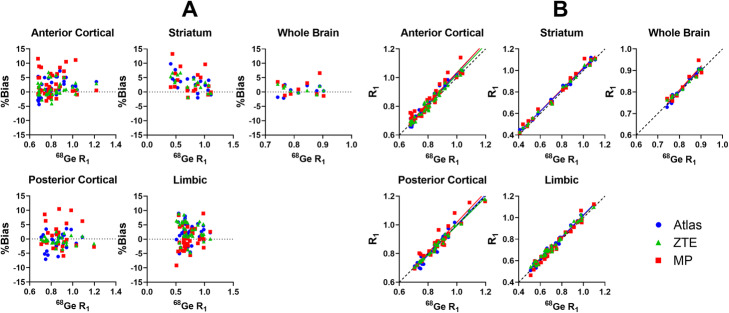
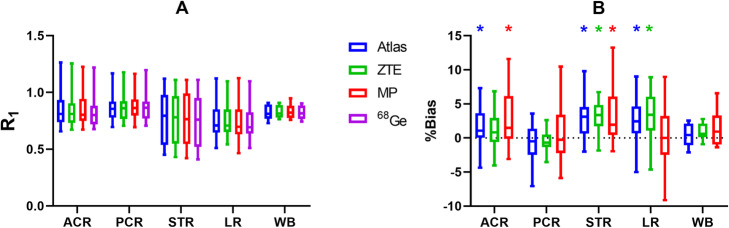
Nine participants underwent dynamic brain PET/MR scanning using the dopamine transporter radioligand [C]PE2I. Three MRAC methods were evaluated: single-atlas (Atlas), multi-atlas (MaxProb) and zero-echo-time (ZTE). The Ge-transmission data from a previous stand-alone PET scan was used as reference method. Parametric relative delivery (R) images and binding potential (BP) maps were generated using cerebellar grey matter as reference region. Evaluation was based on bias in MRAC maps, accuracy and precision of [C]PE2I BP and R estimates, and [C]PE2I time-activity curves. BP was examined for striatal regions and R in clusters of regions across the brain.
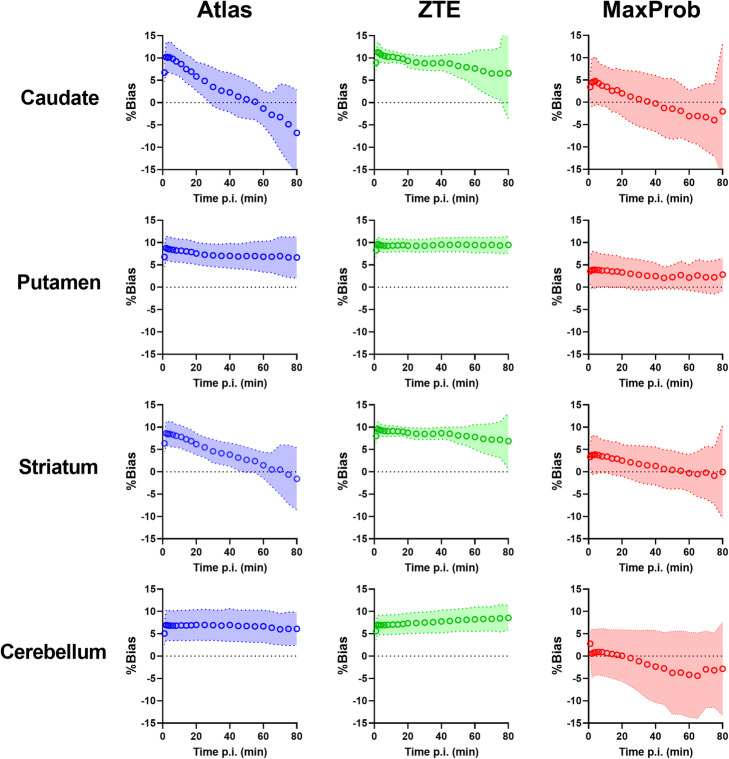
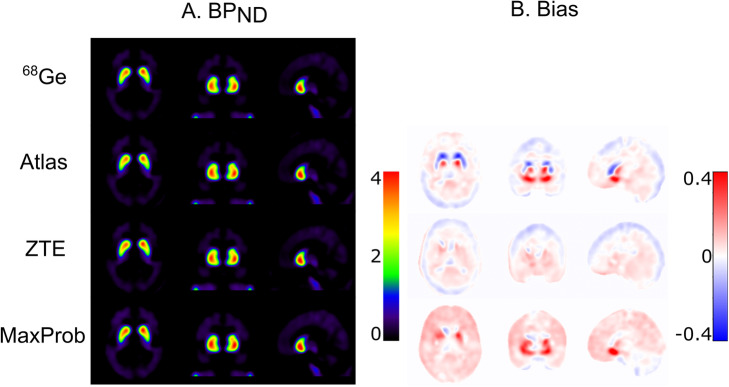
For BP, ZTE-MRAC showed the highest accuracy (bias < 2%) in striatal regions. Atlas-MRAC exhibited a significant bias in caudate nucleus (- 12%) while MaxProb-MRAC revealed a substantial, non-significant bias in the putamen (9%). R estimates had a marginal bias for all MRAC methods (- 1.0-3.2%). MaxProb-MRAC showed the largest intersubject variability for both R and BP. Standardized uptake values (SUV) of striatal regions displayed the strongest average bias for ZTE-MRAC (~ 10%), although constant over time and with the smallest intersubject variability. Atlas-MRAC had highest variation in bias over time (+10 to - 10%), followed by MaxProb-MRAC (+5 to - 5%), but MaxProb showed the lowest mean bias. For the cerebellum, MaxProb-MRAC showed the highest variability while bias was constant over time for Atlas- and ZTE-MRAC.
Both Maxprob- and ZTE-MRAC performed better than Atlas-MRAC when using a Ge transmission scan as reference method. Overall, ZTE-MRAC showed the highest precision and accuracy in outcome parameters of dynamic [C]PE2I PET analysis with use of kinetic modelling.
有效的光子衰减校正(AC)方法对于获得定量准确的PET图像至关重要。集成式PET/MR系统无法提供关于衰减的直接信息,基于MR的AC(MRAC)新方法仍在研究中。对各种AC方法的评估主要集中在静态脑PET采集上。在本研究中,我们在一项动态脑PET/MR研究中确定了三种MRAC方法的有效性。
九名参与者使用多巴胺转运体放射性配体[C]PE2I进行了动态脑PET/MR扫描。评估了三种MRAC方法:单图谱(Atlas)、多图谱(MaxProb)和零回波时间(ZTE)。将先前独立PET扫描的锗传输数据用作参考方法。使用小脑灰质作为参考区域生成参数相对递送(R)图像和结合潜能(BP)图。评估基于MRAC图中的偏差、[C]PE2I BP和R估计值的准确性和精密度以及[C]PE2I时间-活度曲线。在纹状体区域检查BP,并在全脑区域簇中检查R。
对于BP,ZTE-MRAC在纹状体区域显示出最高的准确性(偏差<2%)。Atlas-MRAC在尾状核中表现出显著偏差(-12%),而MaxProb-MRAC在壳核中显示出较大的、不显著的偏差(9%)。所有MRAC方法的R估计值都有轻微偏差(-1.0-3.2%)。MaxProb-MRAC在R和BP方面表现出最大的个体间变异性。纹状体区域的标准化摄取值(SUV)显示ZTE-MRAC的平均偏差最强(约10%),尽管随时间恒定且个体间变异性最小。Atlas-MRAC的偏差随时间变化最大(+10至-10%),其次是MaxProb-MRAC(+5至-5%),但MaxProb的平均偏差最低。对于小脑,MaxProb-MRAC表现出最高的变异性,而Atlas-和ZTE-MRAC的偏差随时间恒定。
当使用锗传输扫描作为参考方法时,Maxprob-和ZTE-MRAC的表现均优于Atlas-MRAC。总体而言,在使用动力学建模的动态[C]PE2I PET分析的结果参数中,ZTE-MRAC显示出最高的精密度和准确性。