Department of Medical Physics & Biomedical Engineering, University College London, London WC1E 6BT, UK; School of Biomedical Engineering & Imaging Sciences, King's College London, London SE1 7EH, UK.
Department of Medical Physics & Biomedical Engineering, University College London, London WC1E 6BT, UK; School of Biomedical Engineering & Imaging Sciences, King's College London, London SE1 7EH, UK.
Med Image Anal. 2021 Jul;71:102079. doi: 10.1016/j.media.2021.102079. Epub 2021 Apr 16.
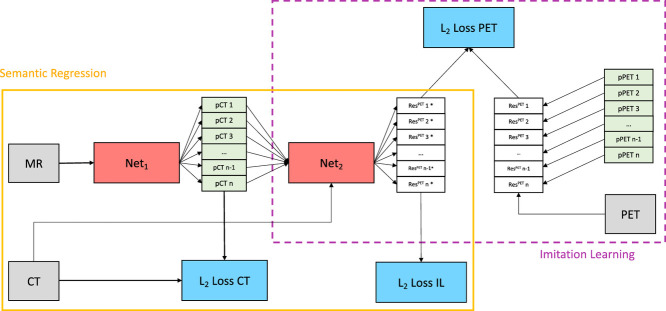
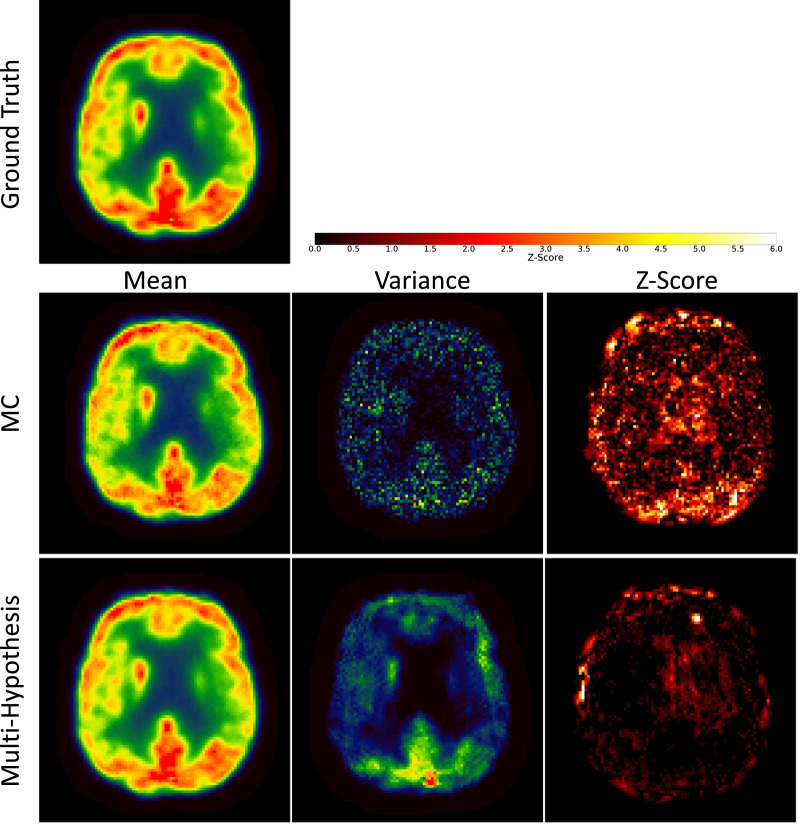
The assessment of the quality of synthesised/pseudo Computed Tomography (pCT) images is commonly measured by an intensity-wise similarity between the ground truth CT and the pCT. However, when using the pCT as an attenuation map (μ-map) for PET reconstruction in Positron Emission Tomography Magnetic Resonance Imaging (PET/MRI) minimising the error between pCT and CT neglects the main objective of predicting a pCT that when used as μ-map reconstructs a pseudo PET (pPET) which is as similar as possible to the gold standard CT-derived PET reconstruction. This observation motivated us to propose a novel multi-hypothesis deep learning framework explicitly aimed at PET reconstruction application. A convolutional neural network (CNN) synthesises pCTs by minimising a combination of the pixel-wise error between pCT and CT and a novel metric-loss that itself is defined by a CNN and aims to minimise consequent PET residuals. Training is performed on a database of twenty 3D MR/CT/PET brain image pairs. Quantitative results on a fully independent dataset of twenty-three 3D MR/CT/PET image pairs show that the network is able to synthesise more accurate pCTs. The Mean Absolute Error on the pCT (110.98 HU ± 19.22 HU) compared to a baseline CNN (172.12 HU ± 19.61 HU) and a multi-atlas propagation approach (153.40 HU ± 18.68 HU), and subsequently lead to a significant improvement in the PET reconstruction error (4.74% ± 1.52% compared to baseline 13.72% ± 2.48% and multi-atlas propagation 6.68% ± 2.06%).
合成/伪计算机断层扫描(pCT)图像质量的评估通常通过ground truth CT 和 pCT 之间的强度相似性来衡量。然而,在将 pCT 用作正电子发射断层扫描磁共振成像(PET/MRI)中的衰减图(μ-map)进行 PET 重建时,最小化 pCT 和 CT 之间的误差忽略了预测一个 pCT 的主要目标,该 pCT 用作 μ-map 重建的伪 PET(pPET)与金标准 CT 重建尽可能相似。这一观察结果促使我们提出了一种新的多假设深度学习框架,该框架明确旨在应用于 PET 重建。卷积神经网络(CNN)通过最小化 pCT 和 CT 之间的像素级误差以及新的度量损失来合成 pCT,该度量损失本身由 CNN 定义,旨在最小化随后的 PET 残差。训练是在二十个 3D MR/CT/PET 脑图像对的数据库上进行的。对二十三个 3D MR/CT/PET 图像对的完全独立数据集的定量结果表明,该网络能够合成更准确的 pCT。与基线 CNN(172.12 HU ± 19.61 HU)和多图谱传播方法(153.40 HU ± 18.68 HU)相比,pCT 的平均绝对误差为 110.98 HU ± 19.22 HU,随后在 PET 重建误差方面取得了显著改善(与基线 13.72% ± 2.48%和多图谱传播 6.68% ± 2.06%相比,分别为 4.74% ± 1.52%)。