Unit of Developmental and Educational Psychology, Institute of Psychology, Leiden University, Leiden, The Netherlands.
Cognitive Psychology Unit, Institute of Psychology, Leiden University, Leiden, The Netherlands.
Ear Hear. 2021 July/Aug;42(4):1024-1033. doi: 10.1097/AUD.0000000000000994.
For children to understand the emotional behavior of others, the first two steps involve emotion encoding and emotion interpreting, according to the Social Information Processing model. Access to daily social interactions is prerequisite to a child acquiring these skills, and barriers to communication such as hearing loss impede this access. Therefore, it could be challenging for children with hearing loss to develop these two skills. The present study aimed to understand the effect of prelingual hearing loss on children's emotion understanding, by examining how they encode and interpret nonverbal emotional cues in dynamic social situations.
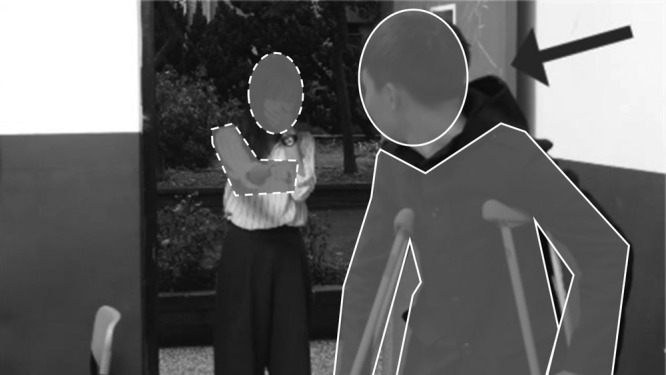
Sixty deaf or hard-of-hearing (DHH) children and 71 typically hearing (TH) children (3-10 years old, mean age 6.2 years, 54% girls) watched videos of prototypical social interactions between a target person and an interaction partner. At the end of each video, the target person did not face the camera, rendering their facial expressions out of view to participants. Afterward, participants were asked to interpret the emotion they thought the target person felt at the end of the video. As participants watched the videos, their encoding patterns were examined by an eye tracker, which measured the amount of time participants spent looking at the target person's head and body and at the interaction partner's head and body. These regions were preselected for analyses because they had been found to provide cues for interpreting people's emotions and intentions.
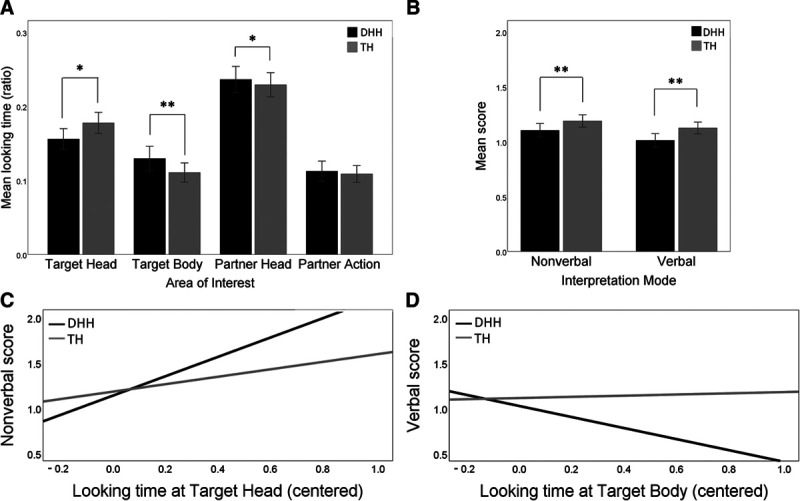
When encoding emotional cues, both the DHH and TH children spent more time looking at the head of the target person and at the head of the interaction partner than they spent looking at the body or actions of either person. Yet, compared with the TH children, the DHH children looked at the target person's head for a shorter time (b = -0.03, p = 0.030), and at the target person's body (b = 0.04, p = 0.006) and at the interaction partner's head (b = 0.03, p = 0.048) for a longer time. The DHH children were also less accurate when interpreting emotions than their TH peers (b = -0.13, p = 0.005), and their lower scores were associated with their distinctive encoding pattern.
The findings suggest that children with limited auditory access to the social environment tend to collect visually observable information to compensate for ambiguous emotional cues in social situations. These children may have developed this strategy to support their daily communication. Yet, to fully benefit from such a strategy, these children may need extra support for gaining better social-emotional knowledge.
根据社会信息处理模型,儿童要理解他人的情绪行为,首先要经历情绪编码和情绪解读这两个步骤。获得日常社交互动是儿童获得这些技能的前提,而听力损失等沟通障碍会阻碍这种互动。因此,听力损失的儿童可能很难发展这两种技能。本研究旨在通过考察儿童在动态社交情境中对非言语情绪线索的编码和解读方式,来了解学前听力损失对儿童情绪理解的影响。
60 名聋或重听(DHH)儿童和 71 名正常听力(TH)儿童(3-10 岁,平均年龄 6.2 岁,54%为女孩)观看了目标人与互动伙伴之间典型社交互动的视频。在每个视频结束时,目标人没有面对摄像机,参与者无法看到他们的面部表情。之后,参与者被要求解释他们认为视频结尾时目标人所感受到的情绪。参与者观看视频时,他们的编码模式由眼动追踪仪进行检测,该仪器测量参与者观看目标人头部和身体以及互动伙伴头部和身体的时间。这些区域被预先选中进行分析,因为它们被发现可以为解释人们的情绪和意图提供线索。
在编码情绪线索时,DHH 和 TH 儿童观看目标人头部和互动伙伴头部的时间都多于观看他们身体或动作的时间。然而,与 TH 儿童相比,DHH 儿童观看目标人头部的时间更短(b = -0.03,p = 0.030),观看目标人身体(b = 0.04,p = 0.006)和互动伙伴头部(b = 0.03,p = 0.048)的时间更长。DHH 儿童在情绪解读方面的准确性也低于其 TH 同龄人(b = -0.13,p = 0.005),他们较低的分数与他们独特的编码模式有关。
研究结果表明,听觉获取社交环境信息有限的儿童倾向于收集视觉上可观察的信息,以弥补社交情境中模糊的情绪线索。这些儿童可能已经发展出这种策略来支持他们的日常交流。然而,为了充分利用这种策略,这些儿童可能需要额外的支持来获得更好的社会情感知识。