Worster Elizabeth, Pimperton Hannah, Ralph-Lewis Amelia, Monroy Laura, Hulme Charles, MacSweeney Mairéad
Institute of Cognitive Neuroscience University College London.
Deafness, Cognition, and Language Research Centre University College London.
Lang Learn. 2018 Jun;68(Suppl Suppl 1):159-179. doi: 10.1111/lang.12264. Epub 2017 Sep 26.
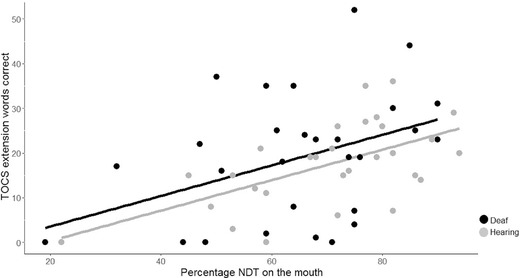
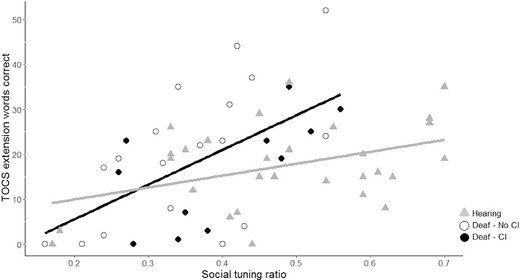
For children who are born deaf, lipreading (speechreading) is an important source of access to spoken language. We used eye tracking to investigate the strategies used by deaf ( = 33) and hearing 5-8-year-olds ( = 59) during a sentence speechreading task. The proportion of time spent looking at the mouth during speech correlated positively with speechreading accuracy. In addition, all children showed a tendency to watch the mouth during speech and watch the eyes when the model was not speaking. The extent to which the children used this communicative pattern, which we refer to as social-tuning, positively predicted their speechreading performance, with the deaf children showing a stronger relationship than the hearing children. These data suggest that better speechreading skills are seen in those children, both deaf and hearing, who are able to guide their visual attention to the appropriate part of the image and in those who have a good understanding of conversational turn-taking.
对于天生失聪的儿童来说,唇读(言语阅读)是获取口语的重要途径。我们使用眼动追踪技术,研究了33名失聪儿童和59名5至8岁听力正常儿童在句子唇读任务中所采用的策略。言语过程中注视嘴巴的时间比例与唇读准确率呈正相关。此外,所有儿童在言语过程中都倾向于注视嘴巴,在示范者不说话时则注视眼睛。儿童运用这种我们称为社交调整的交流模式的程度,正向预测了他们的唇读表现,失聪儿童的这种关系比听力正常儿童更强。这些数据表明,无论是失聪儿童还是听力正常儿童,那些能够将视觉注意力引导至图像适当部位的儿童,以及那些对对话轮流有良好理解的儿童,唇读技能更好。