Department of Veterinary Science, University of Pisa, Pisa, Italy.
Istituto Zooprofilattico Sperimentale of Sardinia, Sassari, Italy.
PLoS Negl Trop Dis. 2020 Dec 28;14(12):e0008982. doi: 10.1371/journal.pntd.0008982. eCollection 2020 Dec.
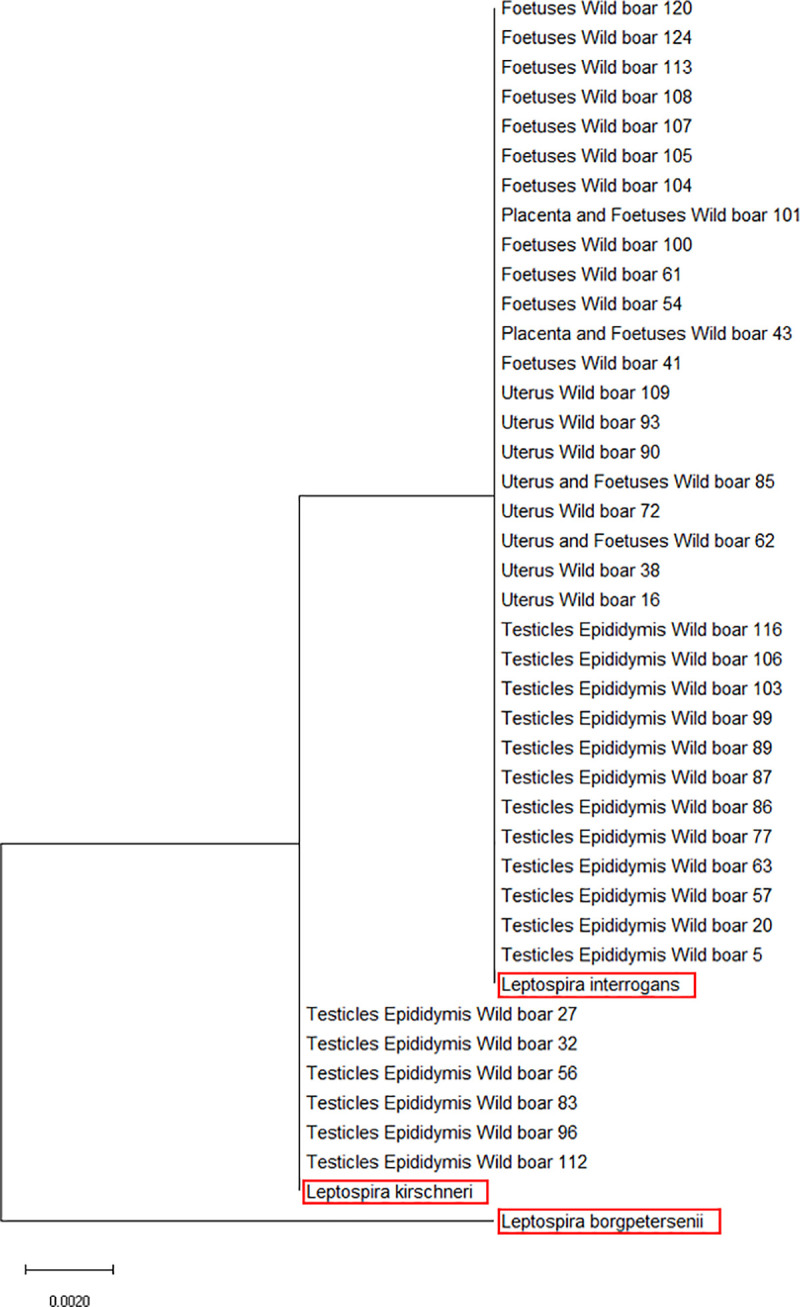
Leptospirosis is a re-emerging and globally spread zoonosis caused by pathogenic genomospecies of Leptospira. Wild boar (Sus scrofa) are an important Leptospira host and are increasing in population all over Europe. The aim of this investigation was to evaluate Leptospira spp. infection in the reproductive systems of wild boar hunted in two Italian regions: Tuscany and Sardinia. From 231 animals, reproductive system tissue samples (testicles, epididymides, uteri) as well as placentas and fetuses were collected. Bacteriological examination and Real-Time PCR were performed to detect pathogenic Leptospira (lipL32 gene). Leptospires were isolated from the testicles and epididymides of one adult and two subadult wild boar. Four isolates from the two subadult males were identified as Leptospira interrogans serogroup Australis by MLST, whereas Leptospira kirschneri serogroup Grippotyphosa was identified from the adult testicles and epididymis. Using Real-Time PCR, 70 samples were positive: 22 testicles (23.16%) and 22 epididymides (23.16%), 10 uteri (7.35%), 3 placentas (6.66%), and 13 fetuses (28.88%). Amplification of the rrs2 gene identified L. interrogans and L. kirschneri species. The results from this investigation confirmed that wild boar represent a potential source of pathogenic Leptospira spp. Isolation of Leptospira serogroups Australis and Grippotyphosa from the male reproductive system and the positive Real-Time PCR results from both male and female samples could suggest venereal transmission, as already demonstrated in pigs. Furthermore, placentas and fetuses were positive for the lipL32 target, and this finding may be related to a possible vertical transmission of pathogenic Leptospira.
钩端螺旋体病是一种由致病性钩端螺旋体基因组种引起的重新出现且在全球范围内传播的动物传染病。野猪(Sus scrofa)是重要的钩端螺旋体宿主,在整个欧洲的数量都在增加。本研究的目的是评估在意大利两个地区(托斯卡纳和撒丁岛)猎捕的野猪的生殖系统中钩端螺旋体属的感染情况。从 231 只动物中采集了生殖系统组织样本(睾丸、附睾、子宫)以及胎盘和胎儿。进行了细菌学检查和实时 PCR 以检测致病性钩端螺旋体(lipL32 基因)。从一只成年和两只亚成年野猪的睾丸和附睾中分离出钩端螺旋体。从两只亚成年雄性的四个分离株通过 MLST 鉴定为 Leptospira interrogans 血清群 Australis,而从成年睾丸和附睾中鉴定出 Leptospira kirschneri 血清群 Grippotyphosa。使用实时 PCR,70 个样本呈阳性:22 个睾丸(23.16%)和 22 个附睾(23.16%)、10 个子宫(7.35%)、3 个胎盘(6.66%)和 13 个胎儿(28.88%)。rrs2 基因的扩增鉴定出 L. interrogans 和 L. kirschneri 种。本研究的结果证实,野猪是潜在的致病性钩端螺旋体属的来源。从雄性生殖系统分离出 Leptospira 血清群 Australis 和 Grippotyphosa,以及从雄性和雌性样本中获得的实时 PCR 阳性结果表明可能存在性传播,正如在猪中已经证明的那样。此外,胎盘和胎儿对 lipL32 靶标呈阳性,这一发现可能与致病性钩端螺旋体的垂直传播有关。