Department of Clinical Laboratory, The First Affiliated Hospital of USTC, Division of Life Sciences and Medicine, University of Science and Technology of China, Hefei, Anhui, 230031, China.
Department of Clinical Laboratory, Fuyang Second People's Hospital, Fuyang Infectious Disease Clinical College, Anhui Medical University, Fuyang, 236015, China.
Virol J. 2020 Dec 28;17(1):197. doi: 10.1186/s12985-020-01467-y.
Coronavirus disease 2019 (COVID-19), caused by SARS-CoV-2, is posing a serious threat to global public health. Reverse transcriptase real-time quantitative polymerase chain reaction (qRT-PCR) is widely used as the gold standard for clinical detection of SARS-CoV-2. Due to technical limitations, the reported positive rates of qRT-PCR assay of throat swab samples vary from 30 to 60%. Therefore, the evaluation of alternative strategies to overcome the limitations of qRT-PCR is required. A previous study reported that one-step nested (OSN)-qRT-PCR revealed better suitability for detecting SARS-CoV-2. However, information on the analytical performance of OSN-qRT-PCR is insufficient.
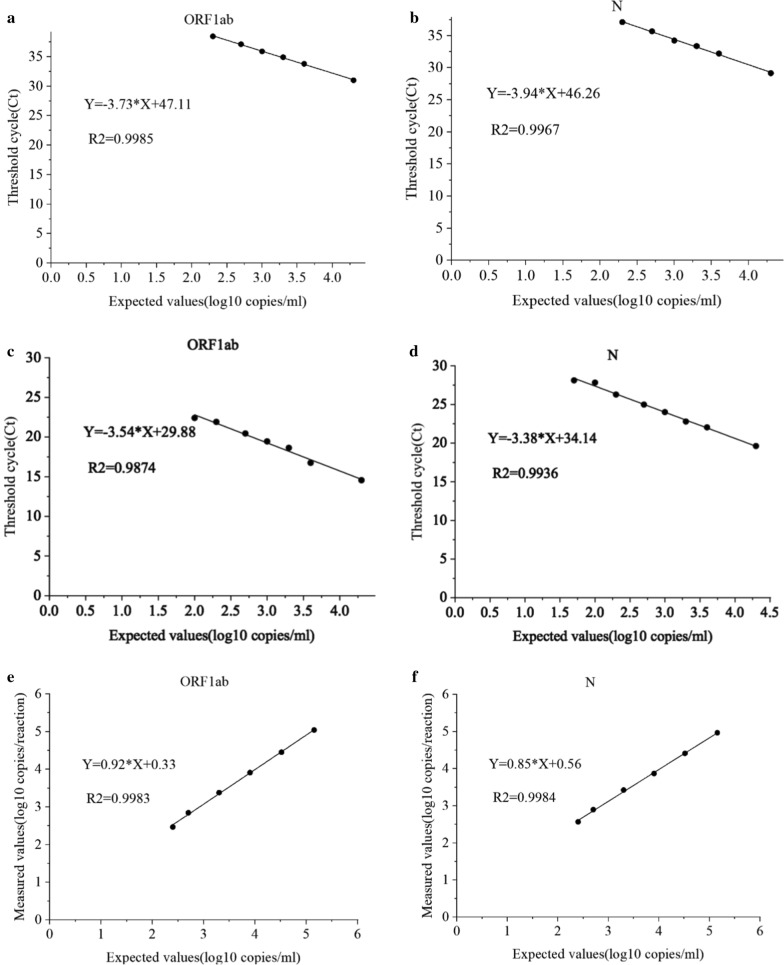
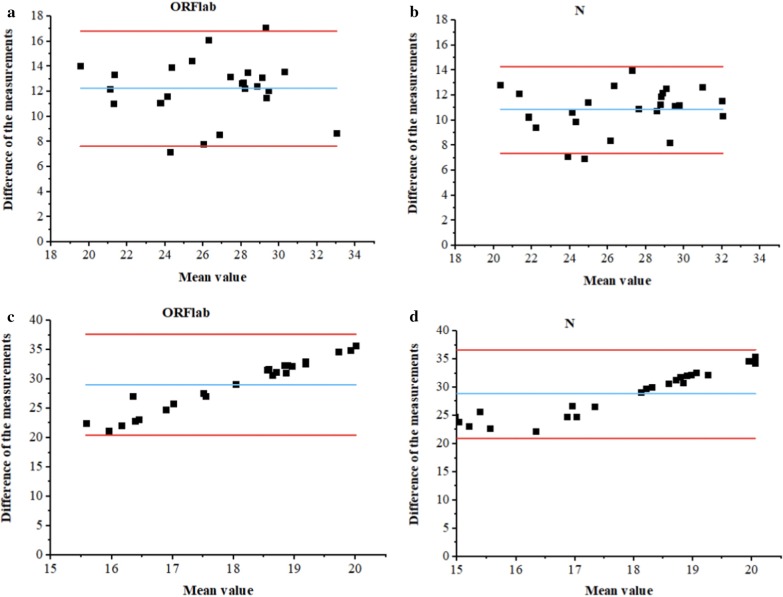
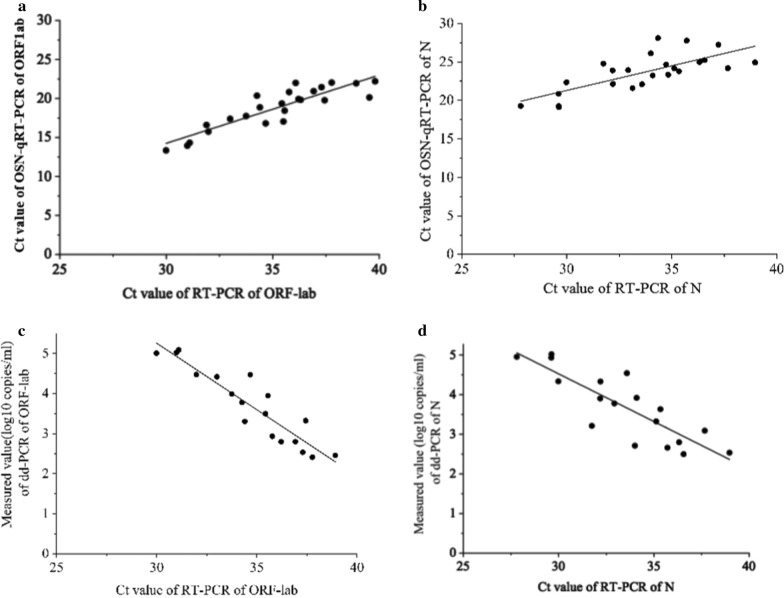
In this study, we aimed to analyze OSN-qRT-PCR by comparing it with droplet digital PCR (ddPCR) and qRT-PCR by using a dilution series of SARS-CoV-2 pseudoviral RNA and a quality assessment panel. The clinical performance of OSN-qRT-PCR was also validated and compared with ddPCR and qRT-PCR using specimens from COVID-19 patients.
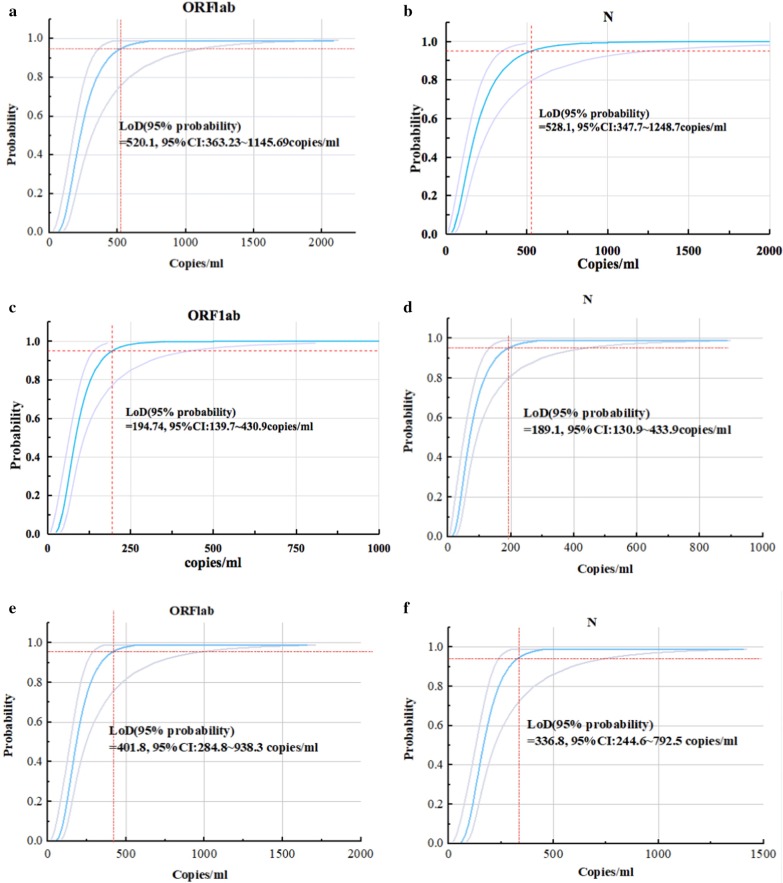
The limit of detection (copies/ml) of qRT-PCR, ddPCR, and OSN-qRT-PCR were 520.1 (95% CI: 363.23-1145.69) for ORF1ab and 528.1 (95% CI: 347.7-1248.7) for N, 401.8 (95% CI: 284.8-938.3) for ORF1ab and 336.8 (95% CI: 244.6-792.5) for N, and 194.74 (95% CI: 139.7-430.9) for ORF1ab and 189.1 (95% CI: 130.9-433.9) for N, respectively. Of the 34 clinical samples from COVID-19 patients, the positive rates of OSN-qRT-PCR, ddPCR, and qRT-PCR were 82.35% (28/34), 67.65% (23/34), and 58.82% (20/34), respectively.
In conclusion, the highly sensitive and specific OSN-qRT-PCR assay is superior to ddPCR and qRT-PCR assays, showing great potential as a technique for detection of SARS-CoV-2 in patients with low viral loads.
由 SARS-CoV-2 引起的 2019 年冠状病毒病(COVID-19)对全球公共卫生构成严重威胁。逆转录实时定量聚合酶链反应(qRT-PCR)被广泛用作 SARS-CoV-2 临床检测的金标准。由于技术限制,咽拭子样本 qRT-PCR 检测的阳性率报告差异在 30%至 60%之间。因此,需要评估替代策略以克服 qRT-PCR 的局限性。先前的一项研究表明,一步嵌套(OSN)-qRT-PCR 更适合检测 SARS-CoV-2。然而,有关 OSN-qRT-PCR 分析性能的信息不足。
在这项研究中,我们旨在通过使用 SARS-CoV-2 假病毒 RNA 稀释系列和质量评估板,将 OSN-qRT-PCR 与液滴数字 PCR(ddPCR)和 qRT-PCR 进行比较,对 OSN-qRT-PCR 进行分析。还使用 COVID-19 患者的标本验证和比较了 OSN-qRT-PCR 的临床性能,并与 ddPCR 和 qRT-PCR 进行了比较。
qRT-PCR、ddPCR 和 OSN-qRT-PCR 的检测限(拷贝/ml)分别为 ORF1ab 为 520.1(95%CI:363.23-1145.69)和 N 为 528.1(95%CI:347.7-1248.7),ORF1ab 为 401.8(95%CI:284.8-938.3)和 N 为 336.8(95%CI:244.6-792.5),ORF1ab 为 194.74(95%CI:139.7-430.9)和 N 为 189.1(95%CI:130.9-433.9)。在 34 例 COVID-19 患者的临床样本中,OSN-qRT-PCR、ddPCR 和 qRT-PCR 的阳性率分别为 82.35%(28/34)、67.65%(23/34)和 58.82%(20/34)。
总之,高灵敏度和特异性的 OSN-qRT-PCR 检测优于 ddPCR 和 qRT-PCR 检测,作为检测低病毒载量 SARS-CoV-2 的技术具有很大的潜力。