Spinoza Centre for Neuroimaging, Royal Netherlands Academy of Sciences, Meibergdreef 75, 1105 BK Amsterdam, The Netherlands;
Cognitive Psychology, Faculty of Behavioural and Movement Sciences, Vrije Universiteit, Van der Boechorststraat 7, 1081 BT Amsterdam, The Netherlands.
Proc Natl Acad Sci U S A. 2021 Jan 12;118(2). doi: 10.1073/pnas.2017032118.
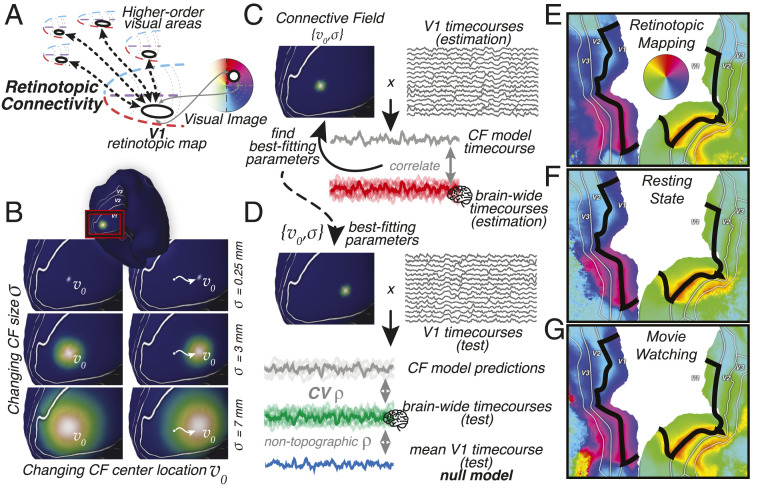
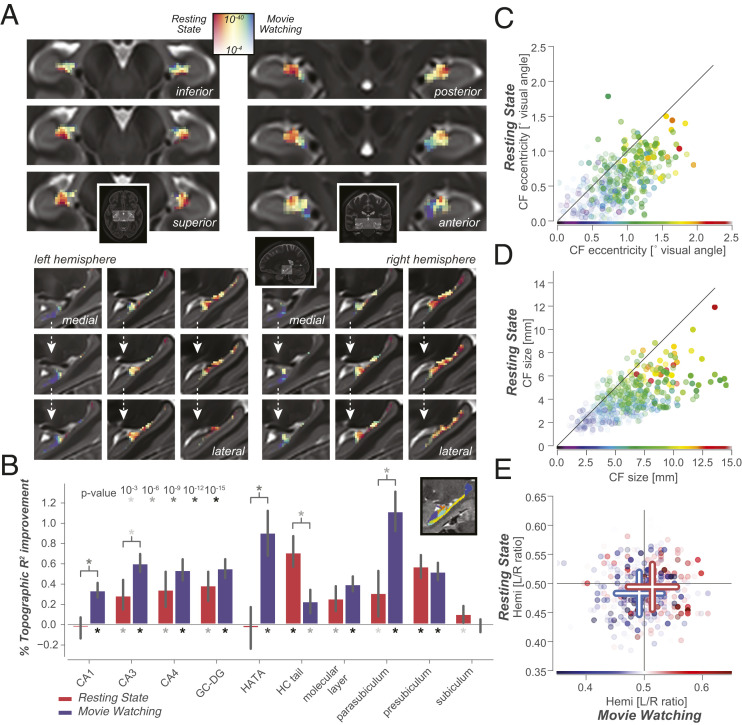
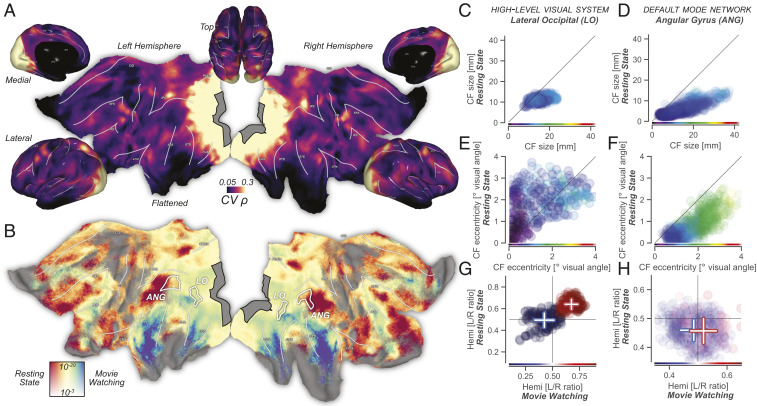
The human visual system is organized as a hierarchy of maps that share the topography of the retina. Known retinotopic maps have been identified using simple visual stimuli under strict fixation, conditions different from everyday vision which is active, dynamic, and complex. This means that it remains unknown how much of the brain is truly visually organized. Here I demonstrate widespread stable visual organization beyond the traditional visual system, in default-mode network and hippocampus. Detailed topographic connectivity with primary visual cortex during movie-watching, resting-state, and retinotopic-mapping experiments revealed that visual-spatial representations throughout the brain are warped by cognitive state. Specifically, traditionally visual regions alternate with default-mode network and hippocampus in preferentially representing the center of the visual field. This visual role of default-mode network and hippocampus would allow these regions to interface between abstract memories and concrete sensory impressions. Together, these results indicate that visual-spatial organization is a fundamental coding principle that structures the communication between distant brain regions.
人类视觉系统是一个层次化的图谱组织,这些图谱共享视网膜的拓扑结构。已识别出的、基于简单视觉刺激的、在严格注视条件下的、不同于日常视觉的、具有主动性、动态性和复杂性的经典视域图。这意味着,大脑中真正具有视觉组织的部分仍然未知。在这里,我证明了除了传统的视觉系统之外,在默认模式网络和海马体中存在广泛的稳定的视觉组织。在观看电影、静息状态和视域映射实验期间,与初级视觉皮层的详细拓扑连接揭示了大脑中的视觉空间表示受到认知状态的扭曲。具体来说,传统的视觉区域与默认模式网络和海马体交替,优先表示视野的中心。默认模式网络和海马体的这种视觉作用将允许这些区域在抽象记忆和具体感觉印象之间进行交互。总之,这些结果表明,视觉空间组织是一种基本的编码原则,它构建了大脑中远距离区域之间的通信。