Ellis Cameron T, Yates Tristan S, Arcaro Michael J, Turk-Browne Nicholas
Department of Psychology, Stanford University, Palo Alto, United States.
Department of Psychology, Columbia University, New York, United States.
Elife. 2025 Mar 6;12:RP92119. doi: 10.7554/eLife.92119.
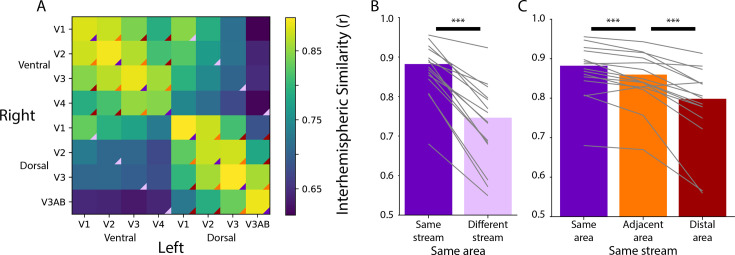
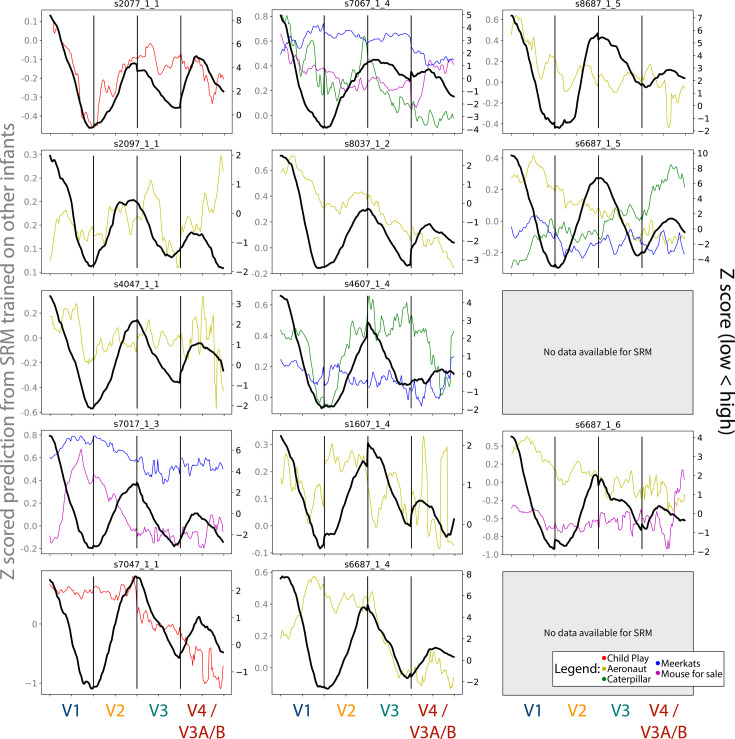
Studying infant minds with movies is a promising way to increase engagement relative to traditional tasks. However, the spatial specificity and functional significance of movie-evoked activity in infants remains unclear. Here, we investigated what movies can reveal about the organization of the infant visual system. We collected fMRI data from 15 awake infants and toddlers aged 5-23 months who attentively watched a movie. The activity evoked by the movie reflected the functional profile of visual areas. Namely, homotopic areas from the two hemispheres responded similarly to the movie, whereas distinct areas responded dissimilarly, especially across dorsal and ventral visual cortex. Moreover, visual maps that typically require time-intensive and complicated retinotopic mapping could be predicted, albeit imprecisely, from movie-evoked activity in both data-driven analyses (i.e. independent component analysis) at the individual level and by using functional alignment into a common low-dimensional embedding to generalize across participants. These results suggest that the infant visual system is already structured to process dynamic, naturalistic information and that fine-grained cortical organization can be discovered from movie data.
与传统任务相比,通过电影研究婴儿思维是提高参与度的一种有前景的方式。然而,电影诱发婴儿大脑活动的空间特异性和功能意义仍不明确。在此,我们研究了电影能揭示婴儿视觉系统组织的哪些方面。我们收集了15名年龄在5至23个月的清醒婴幼儿的功能磁共振成像(fMRI)数据,这些婴幼儿专注地观看了一部电影。电影诱发的活动反映了视觉区域的功能特征。具体而言,两个半球的同位区域对电影的反应相似,而不同区域的反应则不同,尤其是在背侧和腹侧视觉皮层之间。此外,通常需要耗时且复杂的视网膜定位映射的视觉图谱,在个体水平的数据驱动分析(即独立成分分析)中,以及通过将功能对齐到一个共同的低维嵌入以在参与者之间进行推广时,虽不精确但可以从电影诱发的活动中预测出来。这些结果表明,婴儿视觉系统已经具备处理动态、自然主义信息的结构,并且可以从电影数据中发现精细的皮层组织。