Department of Radiology and Quantitative Imaging Lab Bonn (QILaB), University Hospital Bonn, Venusberg-Campus 1, 53127, Bonn, Germany.
Department of Anesthesiology and Intensive Care Medicine, University Hospital Bonn, Venusberg-Campus 1, 53127, Bonn, Germany.
Sci Rep. 2020 Dec 28;10(1):22391. doi: 10.1038/s41598-020-79495-5.
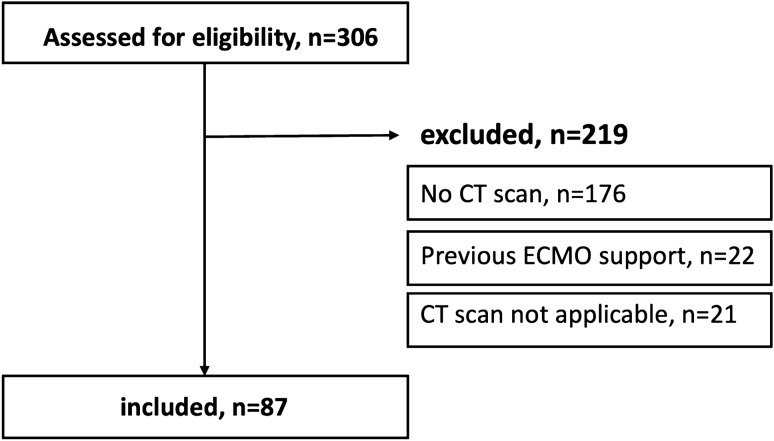
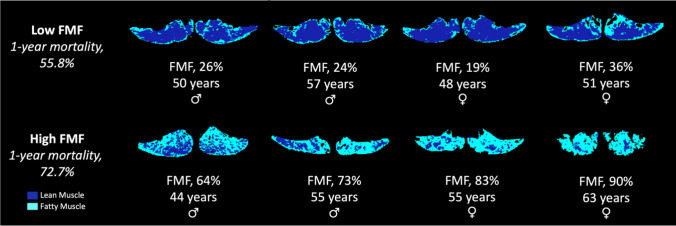
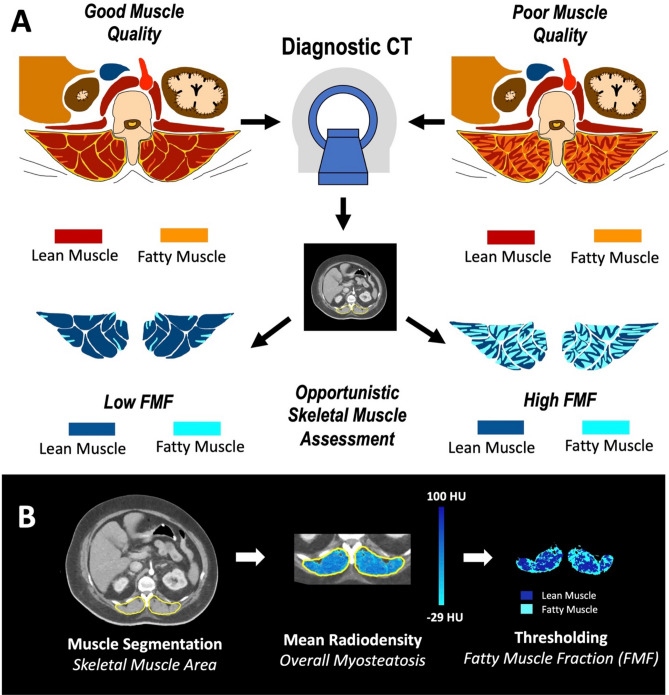
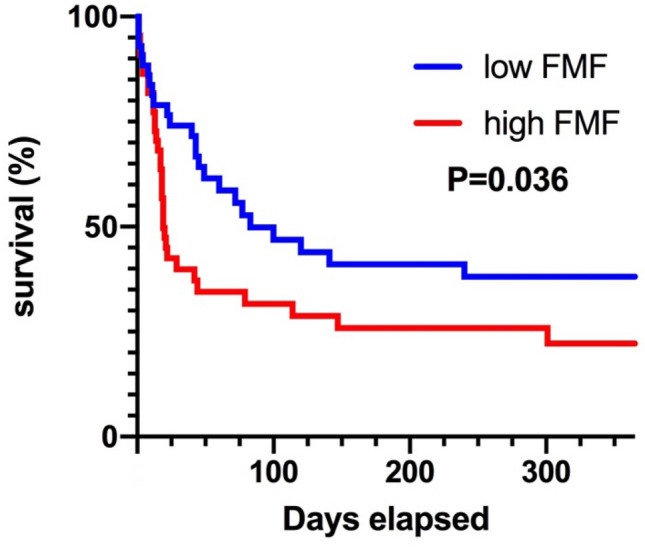
Impaired skeletal muscle quality is a major risk factor for adverse outcomes in acute respiratory failure. However, conventional methods for skeletal muscle assessment are inapplicable in the critical care setting. This study aimed to determine the prognostic value of computed tomography (CT) fatty muscle fraction (FMF) as a biomarker of muscle quality in patients undergoing extracorporeal membrane oxygenation (ECMO). To calculate FMF, paraspinal skeletal muscle area was obtained from clinical CT and separated into areas of fatty and lean muscle based on densitometric thresholds. The cohort was binarized according to median FMF. Patients with high FMF displayed significantly increased 1-year mortality (72.7% versus 55.8%, P = 0.036) on Kaplan-Meier analysis. A multivariable logistic regression model was built to test the impact of FMF on outcome. FMF was identified as a significant predictor of 1-year mortality (hazard ratio per percent FMF, 1.017 [95% confidence interval, 1.002-1.033]; P = 0.031), independent of anthropometric characteristics, Charlson Comorbidity Index, Simplified Acute Physiology Score, Respiratory Extracorporeal Membrane Oxygenation Survival Prediction Score, and duration of ECMO support. To conclude, FMF predicted 1-year mortality independently of established clinical prognosticators in ECMO patients and may have the potential to become a new muscle quality imaging biomarker, which is available from clinical CT.
骨骼肌质量受损是急性呼吸衰竭不良结局的主要危险因素。然而,传统的骨骼肌评估方法在重症监护环境中并不适用。本研究旨在确定计算机断层扫描(CT)脂肪肌肉分数(FMF)作为接受体外膜氧合(ECMO)患者肌肉质量生物标志物的预后价值。为了计算 FMF,从临床 CT 中获得脊柱旁骨骼肌面积,并根据密度计阈值将其分为脂肪和瘦肌肉区域。根据 FMF 的中位数将队列分为二进制。Kaplan-Meier 分析显示,高 FMF 患者的 1 年死亡率显著增加(72.7%比 55.8%,P=0.036)。建立多变量逻辑回归模型以测试 FMF 对结果的影响。FMF 被确定为 1 年死亡率的显著预测因子(每百分 FMF 的风险比,1.017 [95%置信区间,1.002-1.033];P=0.031),独立于人体测量特征、Charlson 合并症指数、简化急性生理学评分、呼吸体外膜氧合生存预测评分和 ECMO 支持时间。总之,FMF 可独立于 ECMO 患者的既定临床预后指标预测 1 年死亡率,并且有可能成为一种新的肌肉质量成像生物标志物,可从临床 CT 获得。