School of Medicine, University of Western Australia, 35 Stirling Highway, Crawley, WA 6009, Australia.
Telethon Kids Institute, University of Western Australia, 15 Hospital Ave, Nedlands, WA 6009, Australia.
Nutrients. 2020 Dec 24;13(1):35. doi: 10.3390/nu13010035.
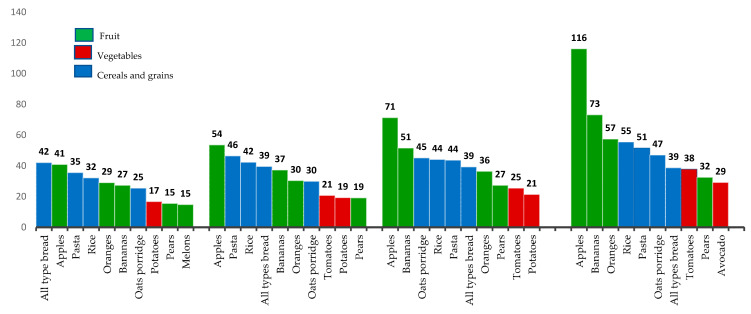
Higher dietary fiber intakes during pregnancy may have the potential health benefits of increasing gut microbiome diversity, lowering the risk of glucose intolerance and pre-eclampsia, achieving appropriate gestational weight gain, and preventing constipation. In this observational cohort study, we have assessed the dietary fiber intakes of 804 women in late pregnancy, using a semi-quantitative food frequency questionnaire (SQ-FFQ). Overall, the median (interquartile range) dietary fiber intake was 24.1 (19.0-29.7) grams per day (g/day). Only 237/804 (29.5%) women met the recommended Adequate Intake (AI) of dietary fiber during pregnancy of 28 g/day. Women consuming the highest quartile of fiber intakes (34.8 (IQR 32.1-39.5) g/day) consumed more fruit, especially apples and bananas, than women consuming the lowest quartile of fiber intakes (15.9 (IQR 14.4-17.5) g/day). These women in the highest fiber-intake quartile were older ( < 0.01), more had completed further education after secondary school ( = 0.04) and they also consumed more vegetables (67 g/day) compared to the women in the lowest fiber consumption quartile (17 g vegetables/day). Bread intakes of 39-42 g/day were consistent in quantities consumed across all four fiber-intake quartiles. Our findings suggest that antenatal education advice targeting increased fruit and vegetable consumption before and during pregnancy may be a simple strategy to achieve increased total dietary fiber intakes to reach recommended quantities.
孕期增加膳食纤维的摄入量可能具有增加肠道微生物多样性、降低葡萄糖不耐受和子痫前期风险、实现适当的妊娠体重增加以及预防便秘的潜在健康益处。在这项观察性队列研究中,我们使用半定量食物频率问卷(SQ-FFQ)评估了 804 名晚期孕妇的膳食纤维摄入量。总的来说,膳食纤维的中位数(四分位距)摄入量为 24.1(19.0-29.7)克/天(g/天)。只有 237/804(29.5%)名女性达到了孕期膳食纤维推荐摄入量(AI)28g/天。摄入膳食纤维最高四分位数(34.8(IQR 32.1-39.5)g/天)的女性比摄入膳食纤维最低四分位数(15.9(IQR 14.4-17.5)g/天)的女性摄入更多的水果,尤其是苹果和香蕉。摄入膳食纤维最高四分位数的女性年龄更大(<0.01),更多人在中学后接受了继续教育(=0.04),与摄入膳食纤维最低四分位数的女性相比,她们也摄入了更多的蔬菜(67g/天)(17g/天)。四个膳食纤维摄入量四分位数中,面包摄入量在 39-42g/天之间保持一致。我们的研究结果表明,在怀孕前和怀孕期间增加水果和蔬菜摄入量的产前教育建议可能是一种简单的策略,可以增加总膳食纤维摄入量,达到推荐量。