Kaikuntod Manusvee, Arjkumpa Orapun, Kladkempetch Doolyawat, Fukumoto Shinya, Thongkorn Kriangkrai, Boonyapakorn Chavalit, Punyapornwithaya Veerasak, Tiwananthagorn Saruda
Department of Companion Animals and Wildlife Clinic, Faculty of Veterinary Medicine, Chiang Mai University, Chiang Mai 50100, Thailand.
Phra Nakhon Si Ayutthaya Provincial Livestock Office, Thanu Subdistrict, Uthai District, Phra Nakhon Si Ayutthaya 13000, Thailand.
Animals (Basel). 2020 Dec 26;11(1):33. doi: 10.3390/ani11010033.
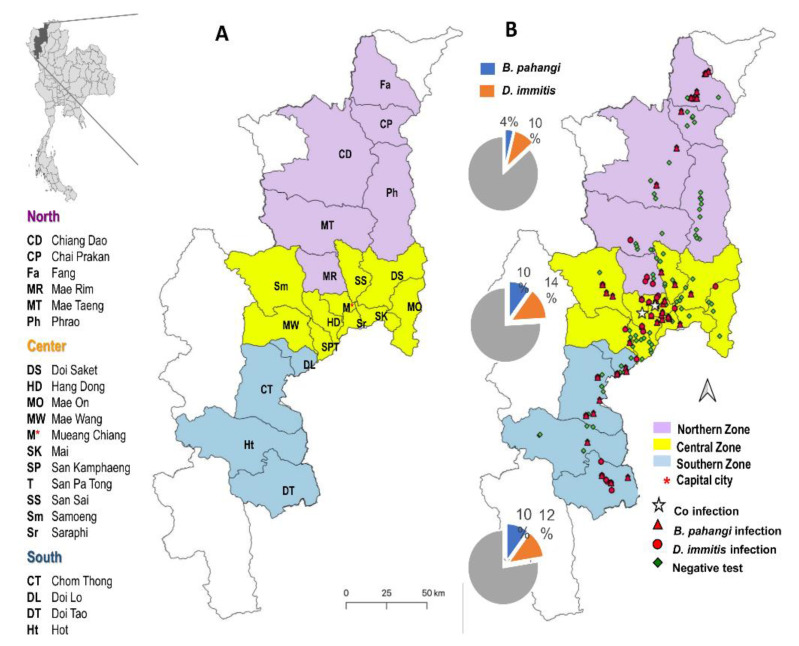
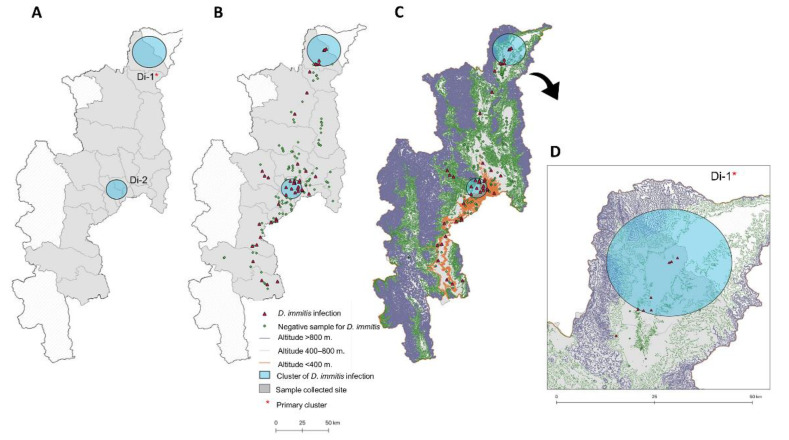
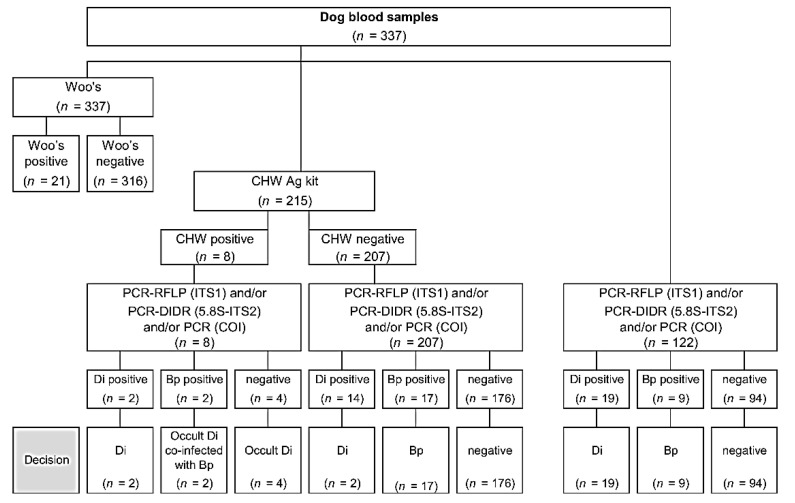
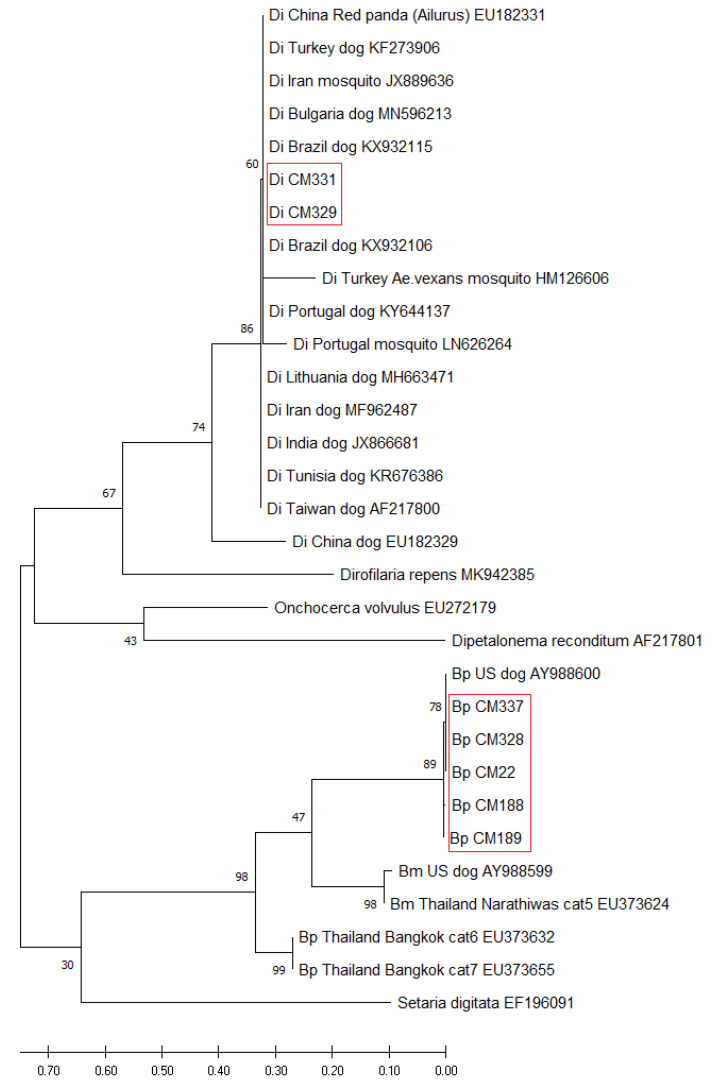
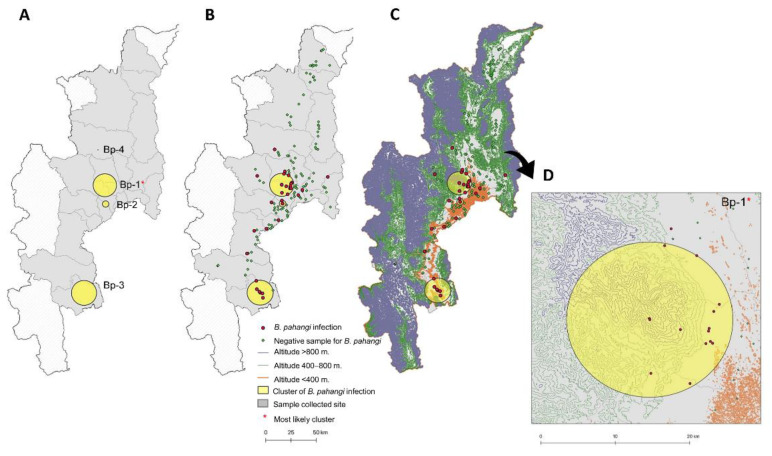
Filariasis is emerging as a public health concern in tropical and subtropical areas. Filariasis is an endemic problem commonly found in southeast Asian countries. Using the PCR-restriction fragment length polymorphism (PCR-RFLP) of the ITS1 region with I, the overall prevalence rates of (12.2% (41/337); 95% confidence interval: 9.1-16.1%) and (8.3% (28/337); 95% confidence interval: 5.8-11.8%) were determined based on 337 free-roaming community dogs from 20 districts in Northern Thailand. Microfilaremia was found in only 6.2% of dogs (21/337). Co-infection with and was observed in two dogs. Of the 215 blood samples examined using a Canine Heartworm Ag Kit, only 3.72% (eight dogs) were antigen positive. Among these eight, six dogs had occult infections. In terms of geographic distribution, we found the abundance of and in the central areas at altitudes less than 400 m to be 12.1% and 10.3%, respectively. In contrast, at higher altitudes between 400 and 800 m, a significantly higher number of compared with infected individuals were observed at 14.29% and 4.1%, respectively. In conclusion, and were the most common filarial infections found in community dogs in Northern Thailand. Dogs might be an important reservoir of in that region. Increasing awareness and concern and including proper deworming programs for community dogs should be endorsed to reduce the transmission risk. Additionally, the population dynamics of the mosquito vector of across altitudinal gradients deserved further investigation.
丝虫病正逐渐成为热带和亚热带地区的一个公共卫生问题。丝虫病是东南亚国家常见的地方病问题。利用ITS1区域的PCR-限制性片段长度多态性(PCR-RFLP)技术,对泰国北部20个地区的337只自由放养的社区犬进行检测,确定了[某种丝虫]的总体患病率为12.2%(41/337);95%置信区间:9.1-16.1%)和[另一种丝虫]的总体患病率为8.3%(28/337);95%置信区间:5.8-11.8%)。仅在6.2%的犬(21/337)中发现微丝蚴血症。在两只犬中观察到[某种丝虫]和[另一种丝虫]的合并感染。在使用犬心丝虫抗原检测试剂盒检测的215份血样中,只有3.72%(8只犬)抗原呈阳性。在这8只犬中,有6只犬有隐匿性[某种丝虫]感染。在地理分布方面,我们发现在海拔低于海拔400米的中部地区,[某种丝虫]和[另一种丝虫]的感染率分别为12.1%和10.3%。相比之下,在海拔400至800米的较高海拔地区,观察到感染[某种丝虫]的个体数量明显多于感染[另一种丝虫]的个体,分别为14.29%和4.1%。总之,[某种丝虫]和[另一种丝虫]是泰国北部社区犬中最常见的丝虫感染。犬可能是该地区[某种丝虫]的重要储存宿主。应提高认识和关注度,并包括为社区犬制定适当的驱虫计划,以降低传播风险。此外,[某种丝虫]的蚊媒在不同海拔梯度上的种群动态值得进一步研究。