Department of Public Health and Clinical Medicine, Section of Sustainable Health, The OLIN Unit, Umeå University Faculty of Medicine, Umeå, Sweden
Department of Health Science, Division of Nursing, Luleå University of Technology, Luleå, Sweden.
BMJ Open. 2020 Dec 29;10(12):e040683. doi: 10.1136/bmjopen-2020-040683.
The aim was to identify predictors of electronic cigarette (e-cigarette) use among teenagers.
A prospective population-based cohort study of schoolchildren in northern Sweden.
In 2006, a cohort study about asthma and allergic diseases among schoolchildren started within the Obstructive Lung Disease in Northern Sweden studies. The study sample (n=2185) was recruited at age 7-8 years, and participated in questionnaire surveys at age 14-15 and 19 years. The questionnaire included questions about respiratory symptoms, living conditions, upper secondary education, physical activity, diet, health-related quality of life, parental smoking and parental occupation. Questions about tobacco use were included at age 14-15 and 19 years.
E-cigarette use at age 19 years.
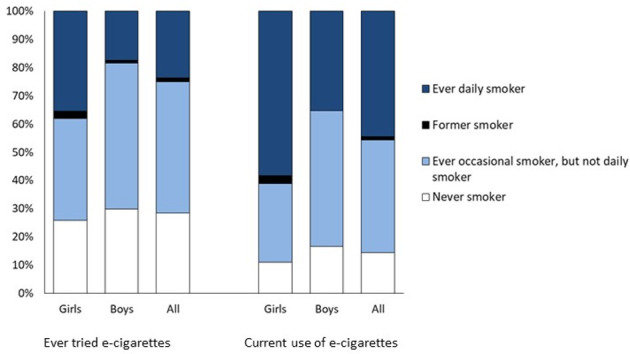
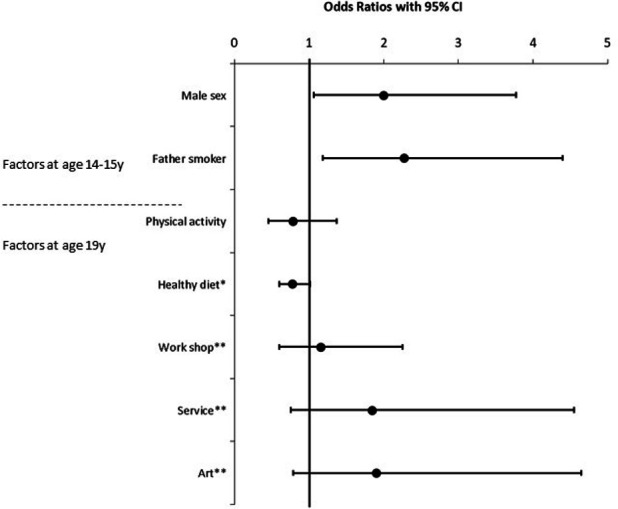
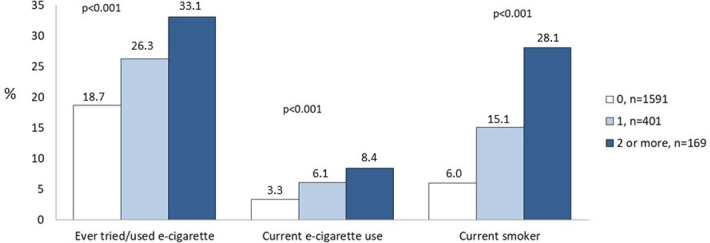
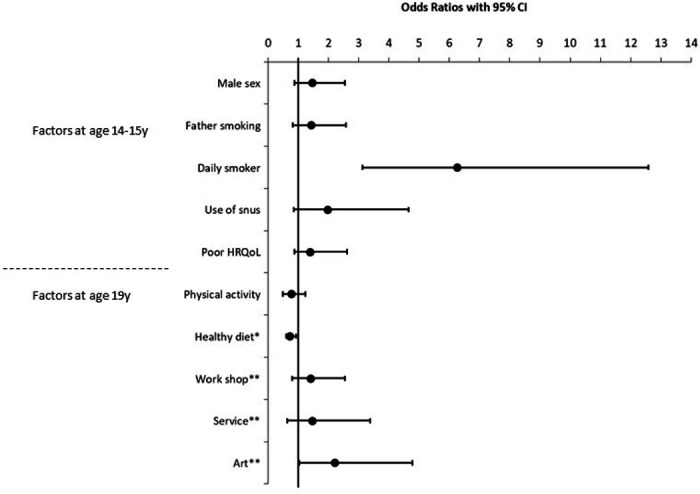
At age 19 years, 21.4% had ever tried e-cigarettes and 4.2% were current users. Among those who were daily tobacco smokers at age 14-15 years, 60.9% had tried e-cigarettes at age 19 years compared with 19.1% of never-smokers and 34.0% of occasional smokers (p<0.001). Among those who had tried e-cigarettes, 28.1% were never smokers both at age 14-15 and 19 years, and 14.4% were never smokers among the current e-cigarette users. In unadjusted analyses, e-cigarette use was associated with daily smoking, use of snus and having a smoking father at age 14-15 years, as well as with attending vocational education, physical inactivity and unhealthy diet. In adjusted analyses, current e-cigarette use was associated with daily tobacco smoking at age 14-15 years (OR 6.27; 95% CI 3.12 to 12.58), attending a vocational art programme (OR 2.22; 95% CI 1.04 to 4.77) and inversely associated with eating a healthy diet (OR 0.74; 95% CI 0.59 to 0.92).
E-cigarette use was associated with personal and parental tobacco use, as well as with physical inactivity, unhealthy diet and attending vocational upper secondary education. Importantly, almost one-third of those who had tried e-cigarettes at age 19 years had never been tobacco smokers.
确定青少年使用电子烟的预测因素。
这是一项针对瑞典北部学童的前瞻性基于人群的队列研究。
2006 年,一项针对学童哮喘和过敏性疾病的队列研究在瑞典北部阻塞性肺病研究中启动。该研究样本(n=2185)在 7-8 岁时招募,并在 14-15 岁和 19 岁时参加问卷调查。问卷包括关于呼吸道症状、生活条件、高中教育、身体活动、饮食、健康相关生活质量、父母吸烟和父母职业的问题。14-15 岁和 19 岁时询问烟草使用情况。
19 岁时使用电子烟。
19 岁时,21.4%的人曾尝试过电子烟,4.2%的人目前正在使用。在 14-15 岁时每天吸烟的人中,60.9%的人在 19 岁时尝试过电子烟,而从不吸烟者为 19.1%,偶尔吸烟者为 34.0%(p<0.001)。在尝试过电子烟的人中,28.1%的人在 14-15 岁和 19 岁时既不吸烟也不使用电子烟,而在当前电子烟使用者中,有 14.4%的人既不吸烟也不使用电子烟。在未调整的分析中,电子烟的使用与 14-15 岁时的每日吸烟、使用鼻烟以及父亲吸烟有关,与接受职业教育、身体活动不足和不健康饮食有关。在调整分析中,目前使用电子烟与 14-15 岁时的每日吸烟有关(OR 6.27;95%CI 3.12 至 12.58),与参加职业艺术课程有关(OR 2.22;95%CI 1.04 至 4.77),与健康饮食呈负相关(OR 0.74;95%CI 0.59 至 0.92)。
电子烟的使用与个人和父母的烟草使用以及身体活动不足、不健康饮食和接受职业高中教育有关。重要的是,近三分之一在 19 岁时尝试过电子烟的人从未吸烟。