Chanda Alfred, Simwinga Freddie, Kaonga Patrick, Gono-Bwalya Angela, Prashar Lavina
The University of Zambia, School of Medicine, Department of Physiological Sciences, Lusaka, Zambia.
The University of Zambia, School of Public Health, Department of Epidemiology and Biostatistics, Lusaka, Zambia.
Evid Based Complement Alternat Med. 2020 Nov 27;2020:8873180. doi: 10.1155/2020/8873180. eCollection 2020.
(F.Hoffm.) Exell and Hillc. (family: Malvalceae) is traditionally used to induce or accelerate labour in pregnant women in Chongwe, Zambia, and the plant part which is commonly used are the roots.
The aim of this study was to screen crude extracts for uterotonic activity on isolated Wistar rat uterine smooth muscles. The likely mechanism of action for the plant extract was also investigated.
Fresh leaves and roots of the plant were collected and identified by a botanist at the University of Zambia. The methanol and cold root aqueous extracts were prepared by continuous maceration while the hot aqueous root extract was extracted using the Soxhlet method. The crude extracts of the plant were screened for uterotonic activity using uterine smooth muscles isolated from estrogenised adult nongravid female Wistar rats weighing between 160 g and 200 g. The activity of the plant was also evaluated in the presence of antagonists and tocolytic agents to determine the likely mechanism of action.
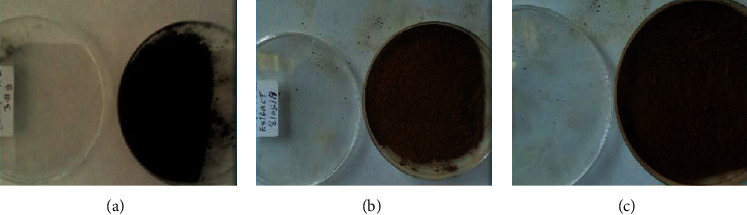
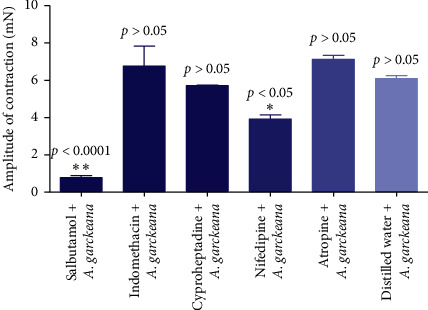
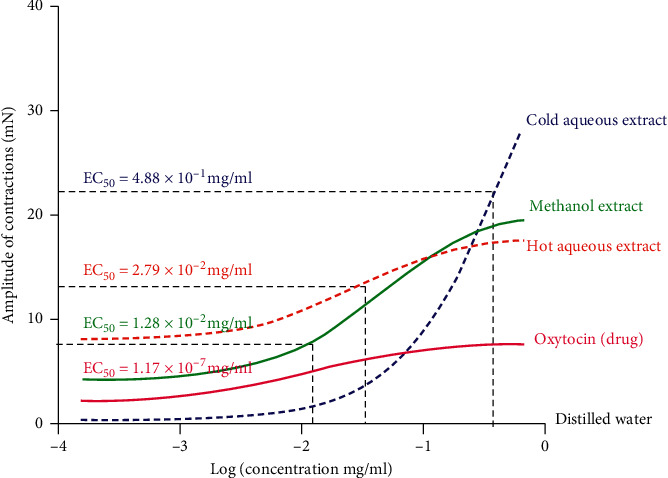
The hot aqueous root crude extract (22.26%) had the highest yield followed by the cold aqueous (11.32%) and methanol extracts (6.26%), respectively. The methanol crude root extract demonstrated the highest potency (EC = 1.28 × 10 mg/ml; 95% CI 6.418 × 10 to 2.564 × 10; =0.0001), while the cold aqueous extract was the most efficacious. Salbutamol and nifedipine significantly blocked the uterotonic activity of the extract.
This study provides scientific evidence on the uterotonic activity of with myometrial calcium mobilization as the possible mechanism of action.
(F.霍夫曼)埃克塞尔和希尔克(锦葵科)在赞比亚的琼圭,传统上被用于诱导或加速孕妇分娩,常用的植物部位是根部。
本研究旨在筛选粗提物对离体Wistar大鼠子宫平滑肌的宫缩活性。还研究了植物提取物可能的作用机制。
采集该植物的新鲜叶子和根部,由赞比亚大学的植物学家进行鉴定。甲醇提取物和冷根水提取物通过连续浸渍法制备,而热根水提取物采用索氏提取法提取。使用从体重在160克至200克之间的成年未孕雌性雌激素化Wistar大鼠分离的子宫平滑肌,筛选该植物的粗提物的宫缩活性。还在拮抗剂和宫缩抑制剂存在的情况下评估该植物的活性,以确定可能的作用机制。
热根水粗提物的产率最高(22.26%),其次是冷根水提取物(11.32%)和甲醇提取物(6.26%)。甲醇粗根提取物显示出最高的效力(EC = 1.28×10毫克/毫升;95%置信区间6.418×10至2.564×10;P = 0.0001),而冷根水提取物是最有效的。沙丁胺醇和硝苯地平显著阻断了提取物的宫缩活性。
本研究为[植物名称]的宫缩活性提供了科学证据,其作用机制可能是子宫肌层钙动员。