Sahu Pradeep Kumar, Nayak Bijoor Shivananda, Rodrigues Vincent, Umakanthan Srikanth
Centre for Medical Sciences Education, Faculty of Medical Sciences, The University of the West Indies, Saint Augustine, Trinidad and Tobago.
Department of Preclinical Sciences, Faculty of Medical Sciences, The University of the West Indies, Saint Augustine, Trinidad and Tobago.
Int J Appl Basic Med Res. 2020 Oct-Dec;10(4):270-275. doi: 10.4103/ijabmr.IJABMR_100_19. Epub 2020 Oct 7.
Stressful environment in medical school often has a negative effect on students' psychosocial well-being. An in-depth understanding of how medical students experience psychological distress and coping is necessary for the prospective students.
To estimate the prevalence of psychological distress among undergraduate medical students and its association with some demographic factors.
A cross-sectional descriptive study was conducted among 380 medical students in the University of the West Indies, Saint Augustine. The questionnaires used in this study consisted of two components - (i) the demographic information that required participants to provide their gender, age, year of study, and nationality and (ii) Depression, Anxiety, and Stress Scale-21 items to measure the levels of psychological distress among participants.
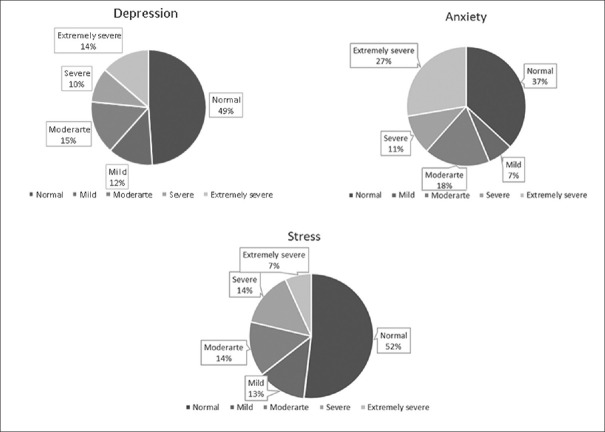
Anxiety was the most prevalent psychological distress among medical students, with 63% of them having anxiety symptoms. Depression was found to be the second most common psychological distress, with a prevalence of 51%, while 48% of the students suffered from stress. In further analysis, we found that Trinbagonian students were more depressed than the students from Caribbean Community and other nationality. Higher anxiety score was significantly associated with gender and age of the students. There was a significant association between students from different age groups and level of stress.
A considerable number of students studying medicine are suffering from psychological distress. Intervention programs to address the mental health problems of such students should be initiated.
医学院校的压力环境常常对学生的心理社会幸福感产生负面影响。对于未来的学生而言,深入了解医学生如何体验心理困扰及应对方式是很有必要的。
评估本科医学生心理困扰的患病率及其与一些人口统计学因素的关联。
在西印度群岛大学圣奥古斯丁分校对380名医学生进行了一项横断面描述性研究。本研究使用的问卷由两个部分组成——(i)人口统计学信息,要求参与者提供性别、年龄、学习年份和国籍;(ii)抑郁、焦虑和压力量表(21项),用于测量参与者的心理困扰程度。
焦虑是医学生中最普遍的心理困扰,63%的学生有焦虑症状。抑郁是第二常见的心理困扰,患病率为51%,而48%的学生有压力。在进一步分析中,我们发现特立尼达和多巴哥学生比来自加勒比共同体及其他国籍的学生更易抑郁。较高的焦虑得分与学生的性别和年龄显著相关。不同年龄组的学生与压力水平之间存在显著关联。
相当数量的医学生正遭受心理困扰。应启动干预项目来解决这类学生的心理健康问题。