Aguirre-Becerra Humberto, Pineda-Nieto Silvia Araceli, García-Trejo Juan Fernando, Guevara-González Ramón G, Feregrino-Pérez Ana Angelica, Álvarez-Mayorga Beatriz Liliana, Rivera Pastrana Dulce María
Ingeniería en Biosistemas, Facultad de Ingeniería, Campus Amazcala, Universidad Autónoma de Querétaro, Chichimequillas-Amazcala Road Km 1 S/N, Amazcala, CP: 76265, El Marqués, Querétaro, Mexico.
Facultad de Química, Universidad Autónoma de Querétaro, Cerro de las Campanas S/N. Col. Las Campanas, CP: 76010, Santiago de Querétaro, Qro, Mexico.
Heliyon. 2020 Dec 21;6(12):e05802. doi: 10.1016/j.heliyon.2020.e05802. eCollection 2020 Dec.
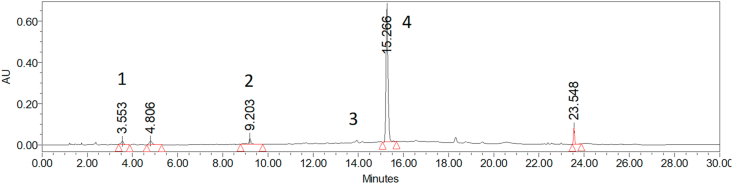
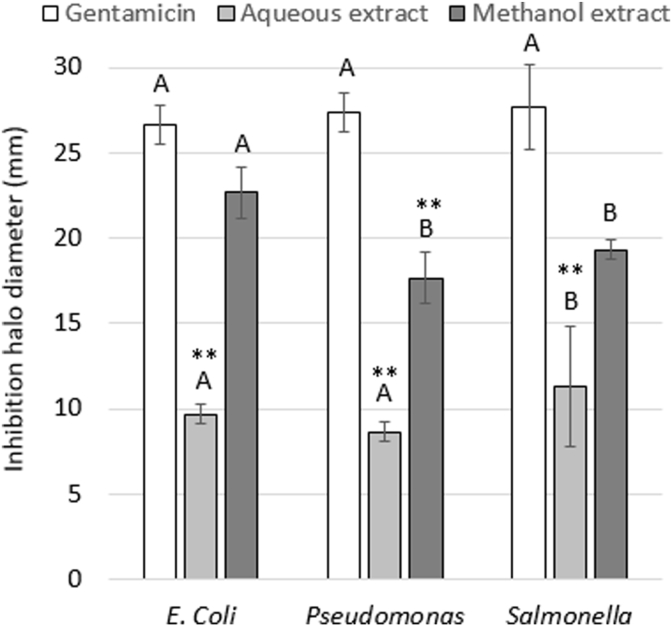
Antimicrobial resistance to antibiotics is a serious health problem worldwide, for this reason, the search for natural agents with antimicrobial power against pathogenic microorganisms is of current importance. The objective of this work was to evaluate the antioxidant capacity (ABTS+ and DPPH), antimicrobial activity, and polyphenol compounds of methanolic and aqueous extracts of flowers. The antimicrobial activity against ATCC 10876 ATCC 6633 ATCC 51299 ATCC 25922 ATCC 19115 ATCC 27853 ATCC 14028, ATCC 25923, and ATCC 25175, was determined using the Kirby Bauer technique. The results of polyphenolic compounds showed a high amount of total flavonoids in the methanolic and aqueous extracts (503.3 ± 86.5 and 245. 7 ± 27.8 mg Rutin Equivalents/g DW, respectively). Quercetin, gallic acid, caffeic acid, and rutin were identified by the HPLC-DAD technique, while in the GC-MS analysis, esters, fatty acids, organic compounds, as well as monosaccharides were identified. Higher antioxidant capacity was detected by the ABTS technique (94.9% and 62.6%) compared to DPPH values (52.5% and 52.7 %) for methanolic and aqueous extracts, respectively. The methanolic extract showed a greater inhibitory effect on gram-positive bacteria, with a predominant higher inhibition percentage on and (86% for both). In conclusion, flower extracts could be a natural antimicrobial and antioxidant alternative due to the considerable amount of polyphenolic compounds, and serve as a sustainable alternative for the isolation of active ingredients that could help in agriculture, aquaculture, livestock, pharmaceutics, and other industrial sectors, to remediate problems such as oxidative stress and antimicrobial abuse.
抗生素耐药性是全球范围内严重的健康问题,因此,寻找对病原微生物具有抗菌能力的天然药物具有重要的现实意义。本研究旨在评估花的甲醇提取物和水提取物的抗氧化能力(ABTS+和DPPH)、抗菌活性及多酚化合物。采用 Kirby Bauer 技术测定对 ATCC 10876、ATCC 6633、ATCC 51299、ATCC 25922、ATCC 19115、ATCC 27853、ATCC 14028、ATCC 25923 和 ATCC 25175 的抗菌活性。多酚化合物的结果显示,甲醇提取物和水提取物中的总黄酮含量较高(分别为 503.3±86.5 和 245.7±27.8 mg 芦丁当量/g 干重)。通过 HPLC-DAD 技术鉴定出槲皮素、没食子酸、咖啡酸和芦丁,而在 GC-MS 分析中鉴定出酯类、脂肪酸、有机化合物以及单糖。与 DPPH 值(分别为 52.5%和 52.7%)相比,ABTS 技术检测到甲醇提取物和水提取物具有更高的抗氧化能力(分别为 94.9%和 62.6%)。甲醇提取物对革兰氏阳性菌显示出更大的抑制作用,对[具体菌名 1]和[具体菌名 2]的抑制率更高(均为 86%)。总之,由于花提取物中含有大量多酚化合物,它们可能是一种天然的抗菌和抗氧化替代品,并可作为一种可持续的替代品用于分离活性成分,有助于农业、水产养殖、畜牧业、制药业和其他工业部门解决氧化应激和抗菌药物滥用等问题。