Tsikandylakis Georgios, Mortensen Kristian R L, Gromov Kirill, Troelsen Anders, Malchau Henrik, Mohaddes Maziar
Department of Orthopaedics, Sahlgrenska University Hospital, Mölndal, Sweden.
Department of Orthopaedics, Institute of Clinical Sciences, Sahlgrenska Academy, University of Gothenburg, Gothenburg, Sweden.
JB JS Open Access. 2020 Dec 15;5(4). doi: 10.2106/JBJS.OA.20.00107. eCollection 2020 Oct-Dec.
Cups are more frequently revised than stems after uncemented total hip arthroplasty, which warrants the development of cup surfaces that provide long-lasting, stable fixation. Large heads have become popular with the aim of reducing dislocation rates, but they generate greater frictional torque that may compromise cup fixation. We aimed to investigate (1) if a novel porous titanium surface provides superior cup fixation when compared with a porous plasma spray (PPS) surface and (2) if the use of the largest possible head compromises cup fixation when compared with a 32-mm head.
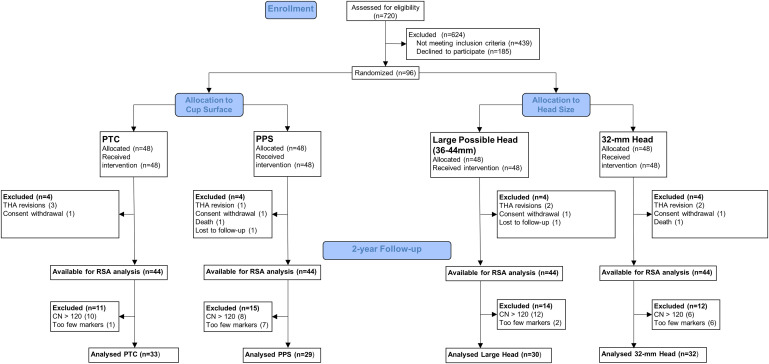
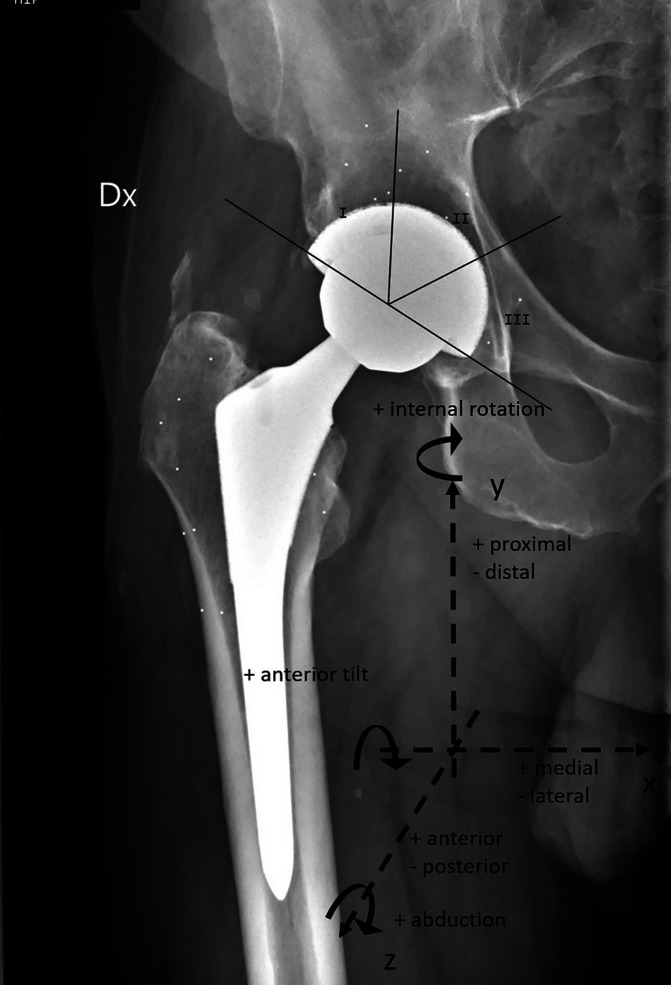
Ninety-six patients were randomized to receive either a cup with a porous titanium coating (PTC) or a cup with PPS. A second randomization was performed to either the largest possible (36 to 44-mm) or a 32-mm head in metal-on-vitamin-E-infused polyethylene bearings. Roentgen stereophotogrammetric analysis (RSA) examinations were obtained postoperatively at 3, 12, and 24 months. The primary outcome was proximal cup migration when comparing the 2 cup surfaces and also when comparing the largest possible head with the 32-mm head. The patients were followed for 2 years.
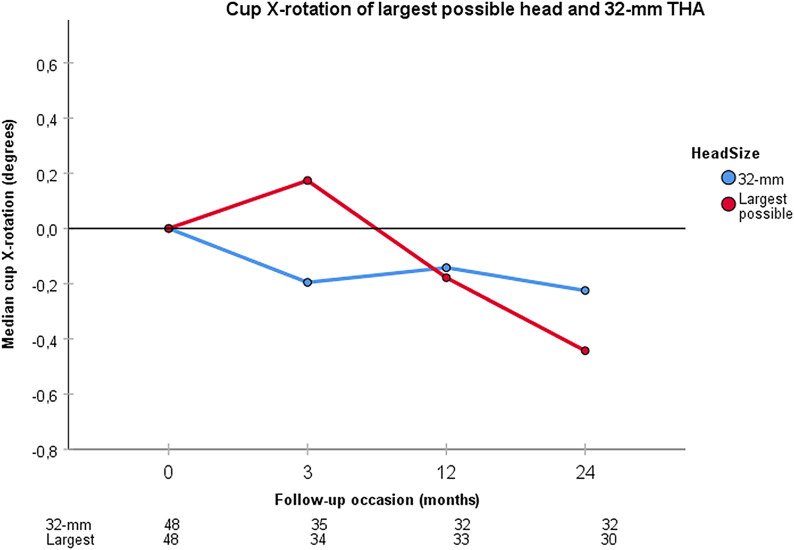
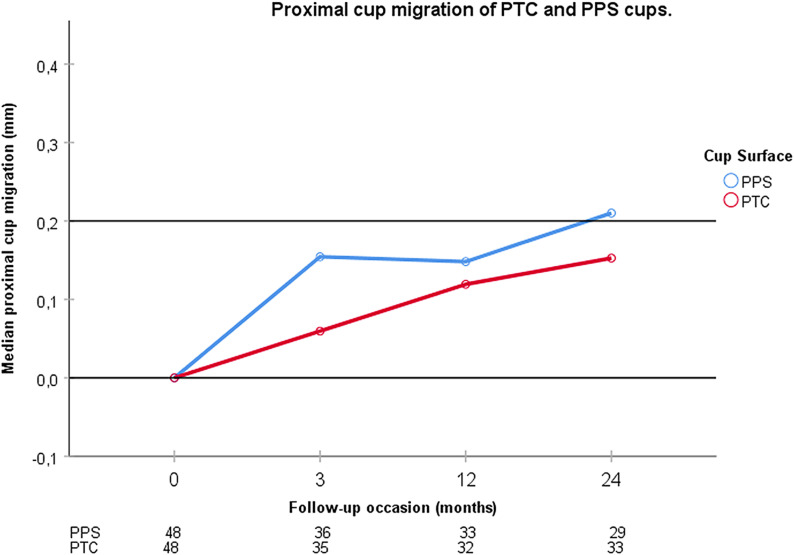
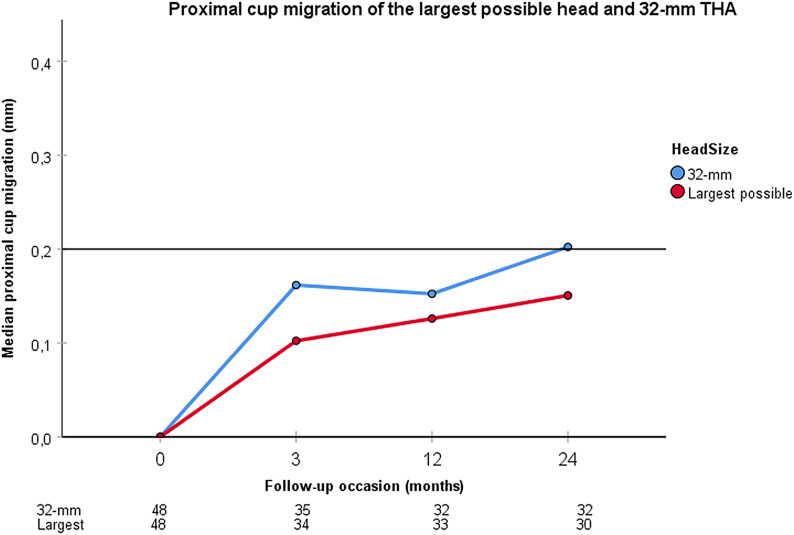
The median (and interquartile range) proximal cup migration was 0.15 mm (0.02 to 0.32 mm) for the PTC cup and 0.21 mm (0.11 to 0.34 mm) for the PPS cup. The largest possible head had a proximal cup migration of 0.15 mm (0.09 to 0.31 mm), and the 32-mm head had a proximal cup migration of 0.20 mm (0.04 to 0.35 mm). There were no significant differences between the cup surface (p = 0.378) or the head size (p = 0.693) groups.
Early cup fixation was not superior with the novel PTC cup; the use of the largest possible head (36 to 44 mm) did not compromise early cup fixation.
Therapeutic Level I. See Instructions for Authors for a complete description of levels of evidence.
在非骨水泥型全髋关节置换术后,髋臼杯的翻修频率高于股骨柄,这就需要研发出能提供持久、稳定固定的髋臼杯表面。大头假体因旨在降低脱位率而受到欢迎,但它们会产生更大的摩擦扭矩,这可能会影响髋臼杯的固定。我们旨在研究:(1)与多孔等离子喷涂(PPS)表面相比,新型多孔钛表面是否能提供更好的髋臼杯固定;(2)与32毫米的股骨头相比,使用尽可能大的股骨头是否会影响髋臼杯的固定。
96例患者被随机分为接受多孔钛涂层(PTC)髋臼杯或PPS髋臼杯。进行第二次随机分组,分为使用尽可能大的(36至44毫米)或32毫米的股骨头,应用金属对注入维生素E的聚乙烯轴承。术后3个月、12个月和24个月进行X线立体摄影测量分析(RSA)检查。主要观察指标是比较两种髋臼杯表面以及比较尽可能大的股骨头与32毫米股骨头时髋臼杯近端的移位情况。对患者进行了2年的随访。
PTC髋臼杯近端髋臼移位的中位数(及四分位间距)为0.15毫米(0.02至0.32毫米),PPS髋臼杯为0.21毫米(0.11至0.34毫米)。尽可能大的股骨头近端髋臼移位为0.15毫米(0.09至0.31毫米),32毫米的股骨头近端髋臼移位为0.20毫米(0.04至0.35毫米)。髋臼杯表面组(p = 0.378)或股骨头大小组(p = 0.693)之间无显著差异。
新型PTC髋臼杯的早期固定效果并不更好;使用尽可能大的股骨头(36至44毫米)不会影响髋臼杯的早期固定。
治疗水平I。有关证据水平的完整描述,请参阅作者指南。