Local Independent Administrative Institution, Akita Prefectural Hospital Organization, Akita, Japan.
The Japan Stroke Association, Osaka, Japan.
PLoS One. 2020 Dec 30;15(12):e0244240. doi: 10.1371/journal.pone.0244240. eCollection 2020.
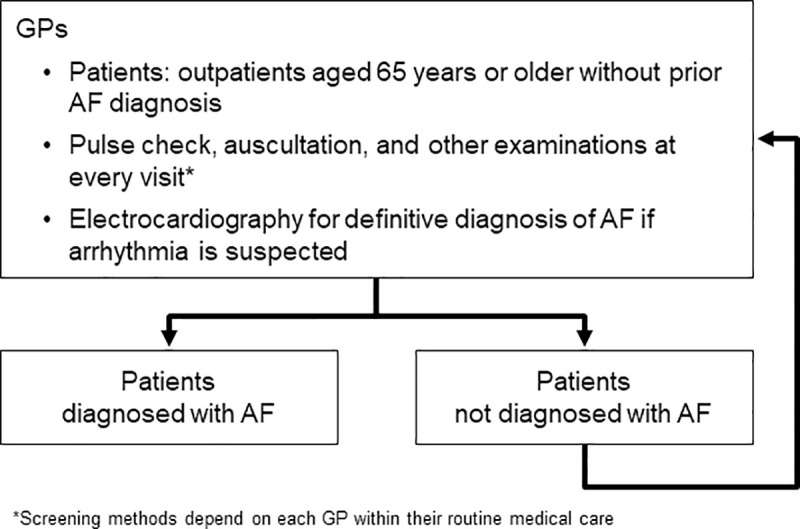
Cardio-embolic ischemic stroke caused by atrial fibrillation is more severe compared with other types of stroke, such as lacunar infarction and atherothrombotic infarction in patients without atrial fibrillation. Therefore, it is important to prevent cardio-embolic ischemic stroke by detecting atrial fibrillation early in at-risk patients and administering appropriate anticoagulation therapy. This prospective observational study aimed to evaluate the effectiveness of opportunistic atrial fibrillation screening at 12 primary clinics in Japan. The study included a 12-month pre-campaign period and a 12-month campaign period. During the campaign period, an awareness campaign was conducted to encourage physicians to be mindful of screening patients aged ≥65 years for atrial fibrillation by checking their pulses and performing subsequent electrocardiography when an irregular pulse was detected. The primary outcome was the proportion of patients with newly diagnosed atrial fibrillation. A sub-analysis focusing on first-time outpatients was performed. There were 9921 and 10,282 patients with no history of atrial fibrillation in the pre-campaign and campaign periods, respectively. In the whole population, the proportion of patients with newly diagnosed atrial fibrillation was 0.9% throughout the pre-campaign and campaign periods. In the sub-analysis limited to first-time outpatients, the detection proportion increased from 1.6% to 1.9% during the campaign period. In terms of age stratification, a large increase in detection was observed, especially among patients aged 65-74 years (detection increased from 0.9% to 1.5%) and ≥85 years (detection increased from 2.9% to 3.3%) during the campaign period. Our findings suggest the feasibility of opportunistic atrial fibrillation screening in routine primary care practice in Japan. Of note, our findings suggest that opportunistic atrial fibrillation screening targeting first-time outpatients may be of clinical value.
心房颤动引起的心源性栓塞性缺血性卒中比其他类型的卒中(如无房颤患者的腔隙性梗死和动脉粥样硬化血栓性梗死)更为严重。因此,通过早期检测高危患者的房颤并给予适当的抗凝治疗,预防心源性栓塞性缺血性卒中非常重要。本前瞻性观察性研究旨在评估在日本 12 家初级诊所进行机会性房颤筛查的效果。该研究包括 12 个月的预活动期和 12 个月的活动期。在活动期间,开展了一项宣传活动,鼓励医生在筛查年龄≥65 岁的患者时注意房颤,检查脉搏,如果发现不规则脉搏,随后进行心电图检查。主要结局是新诊断为房颤的患者比例。进行了一项重点关注首次门诊患者的亚分析。在预活动期和活动期,分别有 9921 例和 10282 例无房颤病史的患者。在整个人群中,预活动期和活动期新诊断房颤患者的比例均为 0.9%。在仅限于首次门诊患者的亚分析中,活动期的检出率从 1.6%增加到 1.9%。在年龄分层方面,检出率有较大增加,尤其是在 65-74 岁(从 0.9%增加到 1.5%)和≥85 岁(从 2.9%增加到 3.3%)的患者中。我们的研究结果表明,在日本的常规初级保健实践中,机会性房颤筛查是可行的。值得注意的是,我们的研究结果表明,针对首次门诊患者的机会性房颤筛查可能具有临床价值。