Barnes Geoffrey D, Piazza Gregory
Vascular and Cardiovascular Medicine, University of Michigan, United States.
Division of Cardiovascular Medicine, Brigham and Women's Hospital, Assistant Professor of Medicine, Harvard Medical School, United States.
Int J Cardiol Heart Vasc. 2022 Aug 1;42:101096. doi: 10.1016/j.ijcha.2022.101096. eCollection 2022 Oct.
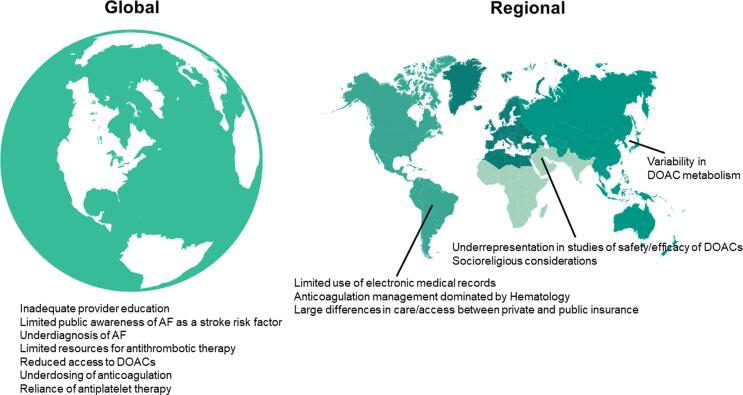
Atrial fibrillation (AF) accounts for one-quarter of the global ischemic stroke burden. Population growth and an increasing prevalence of stroke risk factors underscores the critical need to recognize and address the worldwide crisis in underutilization of antithrombotic therapy for patients with AF. Failure to address key patient, clinician, and societal gaps in AF care will result in a worldwide increase in stroke-related morbidity and mortality while overwhelming global healthcare systems. The failure to adhere to evidence-based guideline recommendations for stroke prevention in AF reflects a critical gap in implementation of best clinical practice among providers and healthcare systems. Globally, these include inadequate provider education, limited public awareness, underdiagnosis, and underutilization of treatments, including antithrombotic therapy. In specific regions, efforts are further complicated by availability of specific medications, variation in drug metabolism across racial and ethnic populations, socioreligious considerations, and lack of universally available electronic health records. Efforts are needed at both global and regional levels to address key barriers to evidence-based care for patients with AF. Investing in clinical tools and teams that improve stroke prevention for patients with AF will likely improve population health.
心房颤动(AF)占全球缺血性卒中负担的四分之一。人口增长以及卒中危险因素患病率的上升凸显了认识并解决全球范围内房颤患者抗血栓治疗未得到充分利用这一危机的迫切需求。未能解决房颤治疗中关键的患者、临床医生及社会层面的差距,将导致全球范围内与卒中相关的发病率和死亡率上升,同时使全球医疗系统不堪重负。未能遵循基于证据的房颤卒中预防指南建议,反映出医疗服务提供者和医疗系统在实施最佳临床实践方面存在重大差距。在全球范围内,这些差距包括医疗服务提供者教育不足、公众意识有限、诊断不足以及治疗(包括抗血栓治疗)未得到充分利用。在特定地区,特定药物的可及性、不同种族和族裔人群药物代谢的差异、社会宗教因素以及缺乏普遍可用的电子健康记录,使相关工作进一步复杂化。全球和地区层面都需要做出努力,以解决房颤患者循证治疗的关键障碍。投资于改善房颤患者卒中预防的临床工具和团队,可能会改善人群健康状况。