Poverty, Gender and Youth Program, Population Council, New York, New York, USA
Poverty, Gender and Youth Program, Population Council, New York, New York, USA.
BMJ Glob Health. 2020 Dec;5(12). doi: 10.1136/bmjgh-2020-003934.
Increased access to home-based medical abortion may offer women a convenient, safe and effective abortion method, reduce burdens on healthcare systems and support social distancing during the COVID-19 pandemic. Home-based medical abortion is defined as any abortion where mifepristone, misoprostol or both medications are taken at home.
A systematic review and meta-analysis of randomised controlled trials (RCTs) and non-randomised studies (NRSs) were conducted. We searched databases from inception to 10 July 2019 and 14 June 2020. Successful abortion was the main outcome of interest. Eligible studies were RCTs and NRSs studies with a concurrent comparison group comparing home versus clinic-based medical abortion. Risk ratios (RRs) and their 95% CIs were calculated. Estimates were calculated using a random-effects model. We used the Grading of Recommendations Assessment, Development and Evaluation approach to assess risk of bias by outcome and to evaluate the overall quality of the evidence.
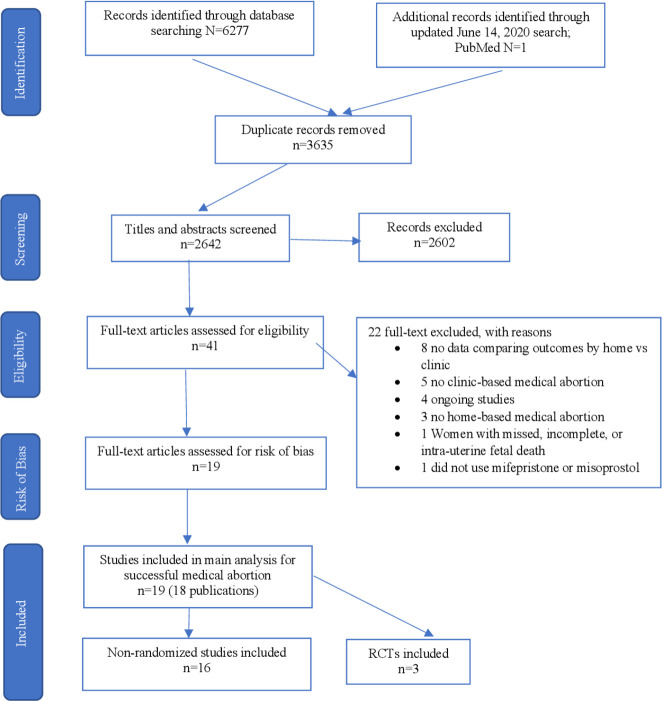
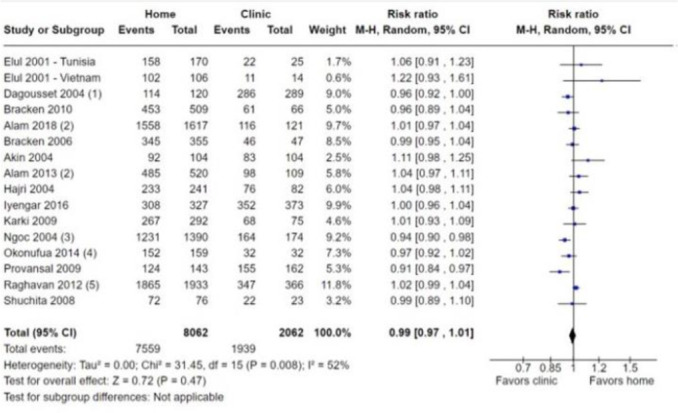
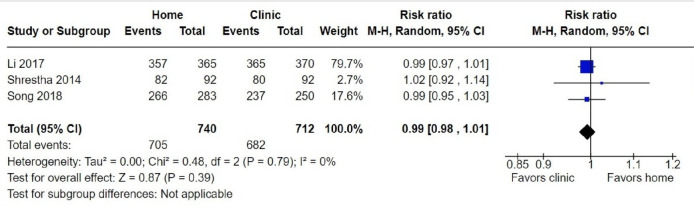
We identified 6277 potentially eligible published studies. Nineteen studies (3 RCTs and 16 NRSs) were included with 11 576 women seeking abortion up to 9 weeks gestation. Neither the RCTs nor the NRS found any difference between home-based and clinic-based administration of medical abortion in having a successful abortion (RR 0.99, 95% CI 0.98 to 1.01, I=0%; RR 0.99, 95% CI 0.97 to 1.01, I=52%, respectively). The certainty of the evidence for the 16 NRSs was downgraded from low to very low due to high risk of bias and publication bias. The certainty of the evidence for the three RCTs was downgraded from high to moderate by one level for high risk of bias.
Home-based medical abortion is effective, safe and acceptable to women. This evidence should be used to expand women's abortion options and ensure access to abortion for women during COVID-19 and beyond.
CRD42020183171.
增加家庭医疗流产的可及性可能为女性提供一种方便、安全和有效的堕胎方法,减轻医疗保健系统的负担,并在 COVID-19 大流行期间支持社会隔离。家庭医疗流产定义为任何在家中服用米非司酮、米索前列醇或两种药物的流产。
对随机对照试验(RCT)和非随机研究(NRS)进行了系统评价和荟萃分析。我们从成立到 2019 年 7 月 10 日和 2020 年 6 月 14 日搜索了数据库。主要结局是成功流产。合格的研究是 RCT 和 NRS 研究,具有同期比较组,比较家庭与诊所为基础的医疗流产。风险比(RR)及其 95%置信区间(CI)计算。使用随机效应模型计算估计值。我们使用推荐评估、制定和评估方法来评估按结局的偏倚风险,并评估证据的总体质量。
我们确定了 6277 项潜在的合格已发表研究。19 项研究(3 项 RCT 和 16 项 NRS)纳入了 11576 名寻求 9 周妊娠以下堕胎的妇女。RCT 和 NRS 都没有发现家庭与诊所之间医疗流产的成功流产率有任何差异(RR 0.99,95%CI 0.98 至 1.01,I=0%;RR 0.99,95%CI 0.97 至 1.01,I=52%)。由于偏倚风险高和发表偏倚,16 项 NRS 的证据确定性从低降至极低。由于偏倚风险高,三项 RCT 的证据确定性从高降至中。
家庭医疗流产对妇女有效、安全和可接受。这一证据应被用于扩大妇女的堕胎选择,并确保妇女在 COVID-19 期间和之后获得堕胎服务。
PROSPERO 注册号:CRD42020183171。