Department of Nutrition, University of Nevada, Reno, Nevada.
Evidence Analysis Center, Academy of Nutrition and Dietetics, Chicago, Illinois.
Clin J Am Soc Nephrol. 2020 Dec 31;16(1):107-120. doi: 10.2215/CJN.09360620.
Hyperphosphatemia is a persistent problem in individuals undergoing maintenance hemodialysis, which may contribute to vascular and bone complications. In some dialysis centers, dietitians work with patients to help them manage serum phosphate. Given the regularity of hyperphosphatemia in this population and constraints on kidney dietitian time, the authors aimed to evaluate the evidence for this practice.
DESIGN, SETTING, PARTICIPANTS, & MEASUREMENTS: There was a systematic review and meta-analysis of clinical trials. MEDLINE, Embase, CINAHL, Web of Science, Cochrane Central Register of Controlled Trials, and other databases were searched for controlled trials published from January 2000 until November 2019 in the English language. Included studies were required to examine the effect of phosphate-specific diet therapy provided by a dietitian on serum phosphate in individuals on hemodialysis. Risk of bias and certainty of evidence were assessed using the Grading of Recommendations, Assessment, Development, and Evaluations (GRADE) method.
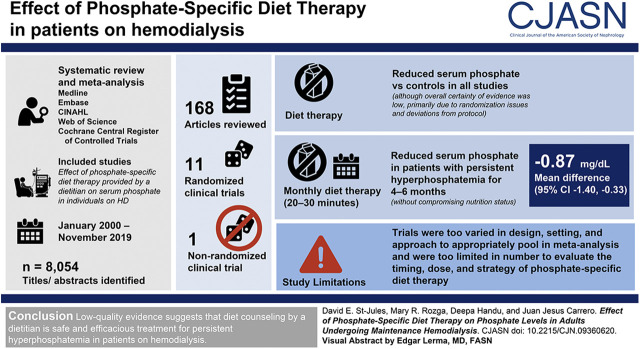
Of the 8054 titles/abstracts identified, 168 articles were reviewed, and 12 clinical trials (11 randomized, one nonrandomized) were included. Diet therapy reduced serum phosphate compared with controls in all studies, reaching statistical significance in eight studies, although overall certainty of evidence was low, primarily due to randomization issues and deviations from protocol. Monthly diet therapy (20-30 minutes) significantly lowered serum phosphate in patients with persistent hyperphosphatemia for 4-6 months, without compromising nutrition status (mean difference, -0.87 mg/dl; 95% confidence interval, -1.40 to -0.33 mg/dl), but appeared unlikely to maintain these effects if discontinued. Unfortunately, trials were too varied in design, setting, and approach to appropriately pool in meta-analysis, and were too limited in number to evaluate the timing, dose, and strategy of phosphate-specific diet therapy.
There is low-quality evidence that monthly diet therapy by a dietitian appears to be a safe and efficacious treatment for persistent hyperphosphatemia in patients on HD.
高磷血症是维持性血液透析患者持续存在的问题,可能导致血管和骨骼并发症。在一些透析中心,营养师与患者合作,帮助他们控制血清磷酸盐。鉴于该人群中高磷血症的规律性和肾脏营养师时间的限制,作者旨在评估这种做法的证据。
设计、设置、参与者和测量:对临床试验进行了系统评价和荟萃分析。在英语中,从 2000 年 1 月到 2019 年 11 月,检索了 MEDLINE、Embase、CINAHL、Web of Science、Cochrane 对照试验中心注册库和其他数据库的对照试验。纳入的研究必须检查营养师提供的特定磷酸盐饮食疗法对血液透析患者血清磷酸盐的影响。使用推荐评估、制定与评价(GRADE)方法评估偏倚风险和证据确定性。
在 8054 个标题/摘要中,有 168 篇文章进行了审查,有 12 项临床试验(11 项随机,1 项非随机)被纳入。与对照组相比,饮食疗法在所有研究中均降低了血清磷酸盐,其中 8 项研究达到统计学意义,但总体证据确定性较低,主要是由于随机化问题和偏离方案。对于持续高磷血症 4-6 个月的患者,每月进行饮食治疗(20-30 分钟)可显著降低血清磷酸盐,而不会损害营养状况(平均差异-0.87mg/dl;95%置信区间-1.40 至-0.33mg/dl),但如果停止治疗,似乎不太可能维持这些效果。不幸的是,试验在设计、设置和方法上差异太大,无法进行适当的荟萃分析,而且数量有限,无法评估特定磷酸盐饮食疗法的时间、剂量和策略。
低质量证据表明,营养师每月进行的饮食治疗似乎是血液透析患者持续性高磷血症的一种安全有效的治疗方法。