Zulfiqar Zikra, Shah Fawad Ali, Shafique Shagufta, Alattar Abdullah, Ali Tahir, Alvi Arooj Mohsin, Rashid Sajid, Li Shupeng
Department of Pharmacology, Riphah Institute of Pharmaceutical Sciences, Riphah International University, Islamabad, Pakistan.
National Center for Bioinformatics, Quaid-I-Azam University, Islamabad, Pakistan.
J Inflamm Res. 2020 Dec 24;13:1185-1205. doi: 10.2147/JIR.S284471. eCollection 2020.
Stress-associated kinases are considered major pathological mediators in several incurable neurological disorders. Importantly, among these stress kinases, the c-Jun NH2-terminal kinase (JNK) has been linked to numerous neuropathological conditions, including oxidative stress, neuroinflammation, and brain degeneration associated with brain injuries such as ischemia/reperfusion injury. In this study, we adopted a drug repurposing/reprofiling approach to explore novel JNK3 inhibitors from FDA-approved medications to supplement existing therapeutic strategies.
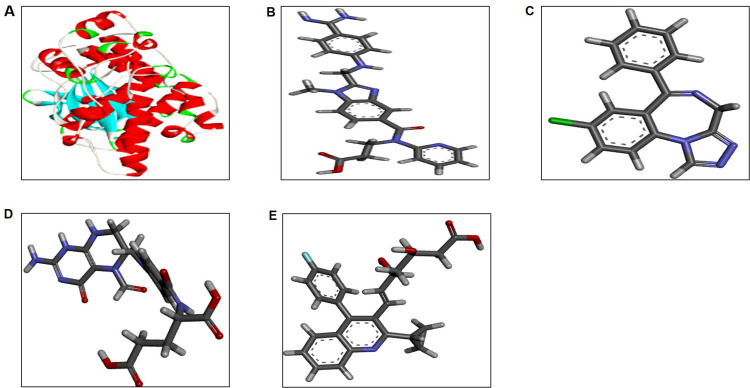
We performed in silico docking analysis and molecular dynamics simulation to screen potential candidates from the FDA approved drug library using the standard JNK inhibitor SP600125 as a reference. After the virtual screening, dabigatran, estazolam, leucovorin, and pitavastatin were further examined in ischemic stroke using an animal rodent model of focal cerebral ischemia using transient middle cerebral artery occlusion (t-MCAO). The selected drugs were probed for neuroprotective effectiveness by measuring the infarct area (%) and neurological deficits using a 28-point composite score. Biochemical assays including ELISA and immunohistochemical experiments were performed.
We obtained structural insights for dabigatran, estazolam, and pitavastatin binding to JNK3, revealing a significant contribution of the hydrophobic regions and significant residues of active site regions. To validate the docking results, the pharmacological effects of dabigatran, estazolam, leucovorin, and pitavastatin on MCAO were tested in parallel with the JNK inhibitor SP600125. After MCAO surgery, severe neurological deficits were detected in the MCAO group compared with the sham controls, which were significantly reversed by dabigatran, estazolam, and pitavastatin treatment. Aberrant morphological features and brain damage were observed in the ipsilateral cortex and striatum of the MCAO groups. The drugs restored the anti-oxidant enzyme activity and reduced the levels of oxidative stress-induced p-JNK and neuroinflammatory mediators such as NF-kB and TNF-ɑ in rats subjected to MCAO.
Our results demonstrated that the novel FDA-approved medications attenuate ischemic stroke-induced neuronal degeneration, possibly by inhibiting JNK3. Being FDA-approved safe medications, the use of these drugs can be clinically translated for ischemic stroke-associated brain degeneration and other neurodegenerative diseases associated with oxidative stress and neuroinflammation.
应激相关激酶被认为是几种无法治愈的神经系统疾病的主要病理介质。重要的是,在这些应激激酶中,c-Jun氨基末端激酶(JNK)与多种神经病理状况有关,包括氧化应激、神经炎症以及与脑损伤(如缺血/再灌注损伤)相关的脑退化。在本研究中,我们采用药物重新利用/重新分析方法,从美国食品药品监督管理局(FDA)批准的药物中探索新型JNK3抑制剂,以补充现有的治疗策略。
我们进行了计算机对接分析和分子动力学模拟,以FDA批准的药物库为基础,以标准JNK抑制剂SP600125为参考筛选潜在候选药物。虚拟筛选后,使用短暂性大脑中动脉闭塞(t-MCAO)的局灶性脑缺血动物啮齿模型,在缺血性中风中进一步检测达比加群、艾司唑仑、亚叶酸钙和匹伐他汀。通过测量梗死面积(%)和使用28分综合评分评估神经功能缺损,来探究所选药物的神经保护效果。进行了包括酶联免疫吸附测定(ELISA)和免疫组织化学实验在内的生化分析。
我们获得了达比加群、艾司唑仑和匹伐他汀与JNK3结合的结构见解,揭示了疏水区域和活性位点区域重要残基的显著作用。为验证对接结果,将达比加群、艾司唑仑、亚叶酸钙和匹伐他汀对MCAO的药理作用与JNK抑制剂SP600125进行了平行测试。MCAO手术后,与假手术对照组相比,MCAO组检测到严重的神经功能缺损,达比加群、艾司唑仑和匹伐他汀治疗可显著逆转这些缺损。在MCAO组的同侧皮质和纹状体中观察到异常的形态特征和脑损伤。这些药物恢复了抗氧化酶活性,并降低了MCAO大鼠中氧化应激诱导的p-JNK以及神经炎症介质如核因子κB(NF-κB)和肿瘤坏死因子-α(TNF-α)的水平。
我们的结果表明,这些新的FDA批准药物可能通过抑制JNK3减轻缺血性中风诱导的神经元退化。作为FDA批准的安全药物,这些药物的应用可在临床上转化用于缺血性中风相关的脑退化以及其他与氧化应激和神经炎症相关的神经退行性疾病。