Department of Neurosurgery, Radboud University Medical Center, Geert Grooteplein-Zuid 10, P.O. Box 9101, 6500 HB, Nijmegen, The Netherlands.
Acta Neurochir (Wien). 2021 Apr;163(4):1143-1151. doi: 10.1007/s00701-020-04681-3. Epub 2021 Jan 2.
The need for external cerebrospinal fluid (CSF) drains in aneurysmal subarachnoid haemorrhage (aSAH) patients is common and might lead to additional complications.
A relation between the presence of an external CSF drain and complication risk is investigated.
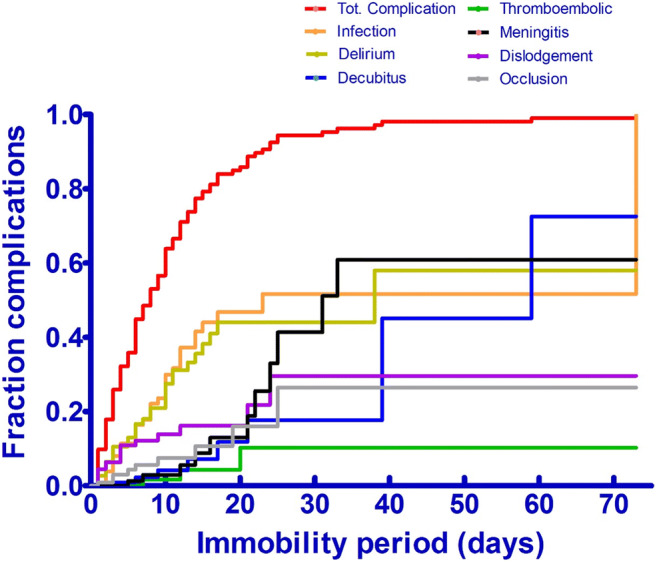
A prospective complication registry was analysed retrospectively. We included all adult aSAH patients admitted to our academic hospital between January 2016 and January 2018, treated with an external CSF drain. Demographic data, type of external drain used, the severity of the aSAH and complications, up to 30 days after drain placement, were registered. Complications were divided into (1) complications with a direct relation to the external CSF drain and (2) complications that could not be directly related to the use of an external CSF drain referred to as medical complications RESULTS: One hundred and forty drains were implanted in 100 aSAH patients. In total, 112 complications occurred in 59 patients. Thirty-six complications were drain related and 76 were medical complications. The most common complication was infection (n = 34). Drain dislodgement occurred 16 times, followed by meningitis (n = 11) and occlusion (n = 9). A Poisson model showed that the mean number of complications raised by 2.9% for each additional day of drainage (95% CI: 0.6-5.3% p = 0.01).
Complications are common in patients with aneurysmal subarachnoid haemorrhage of which 32% are drain-related. A correlation is present between drainage period and the number of complications. Therefore, reducing drainage period could be a target for further improvement of care.
在颅内动脉瘤性蛛网膜下腔出血(aSAH)患者中,通常需要使用外部脑脊液(CSF)引流,这可能会导致其他并发症。
研究外部 CSF 引流与并发症风险之间的关系。
回顾性分析一项前瞻性并发症登记。我们纳入了 2016 年 1 月至 2018 年 1 月期间我院收治的所有成人 aSAH 患者,他们均接受了外部 CSF 引流。记录了人口统计学数据、使用的外部引流类型、aSAH 的严重程度以及引流放置后 30 天内的并发症。并发症分为(1)与外部 CSF 引流直接相关的并发症和(2)不能直接归因于外部 CSF 引流使用的并发症,称为医疗并发症。
共 100 例 aSAH 患者植入了 140 根引流管,共有 59 例患者发生了 112 例并发症。36 例并发症与引流管有关,76 例为医疗并发症。最常见的并发症是感染(n = 34),引流管脱位 16 次,其次是脑膜炎(n = 11)和阻塞(n = 9)。泊松模型显示,每增加一天引流,并发症的平均数量增加 2.9%(95%CI:0.6-5.3%,p = 0.01)。
在颅内动脉瘤性蛛网膜下腔出血患者中,并发症很常见,其中 32%与引流管有关。引流时间与并发症数量之间存在相关性。因此,减少引流时间可能是进一步改善治疗的目标。