Department of Medical Education, Icahn School of Medicine at Mount Sinai, New York, USA.
Department of Otolaryngology-Head and Neck Surgery, Icahn School of Medicine at Mount Sinai, One Gustave L. Levy Place, New York, NY, 10029, USA.
J Community Health. 2021 Aug;46(4):794-802. doi: 10.1007/s10900-020-00944-3. Epub 2021 Jan 2.
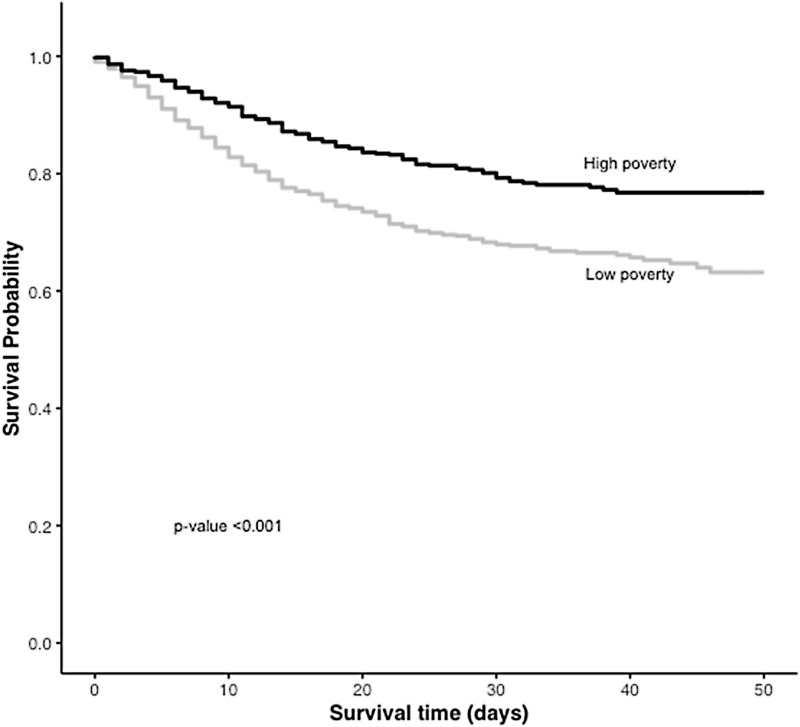
There have been limited data assessing the influence of disadvantaged socioeconomic status (SES) on the incidence and clinical outcomes of COVID-19 patients within the diverse communities of the United States. Here, we aim to investigate the association between poverty level, as an indicator of SES, and COVID-19 related clinical outcomes including hospitalization and all-cause mortality. This retrospective cohort study included 3528 patients with laboratory confirmed COVID-19 seen at a large New York City health system between March 1, 2020 and April 1, 2020. Data for neighborhood level poverty was acquired from the American Community Survey 2014-2018 and defined as the percent of residents in each ZIP code whose household income was below the federal poverty threshold (FPT): 0% to < 20% below FPT (low poverty) and > 20% below FPT (high poverty). COVID-19 positive patients who resided in high poverty areas were significantly younger, had a higher prevalence of comorbidities and were more likely to be of female gender or a racial minority when compared to individuals living in low poverty areas. Residence in a high poverty area was not associated with an increased risk of COVID-19 related hospitalization and was found to be associated with a decreased risk of in-hospital mortality. This study suggests the existence of an unequal socioeconomic gradient in the demographic and clinical presentation of COVID-19 patients including differences in age, gender and race between poverty groups. Further studies are needed to fully assess the intersectionality of SES with the COVID-19 pandemic.
在美国多元化的社区中,评估贫困的社会经济地位(SES)对 COVID-19 患者发病率和临床结局的影响的数据有限。在这里,我们旨在研究贫困水平(SES 的一个指标)与 COVID-19 相关临床结局之间的关联,包括住院和全因死亡率。
这项回顾性队列研究纳入了 2020 年 3 月 1 日至 4 月 1 日期间在纽约市一家大型医疗系统就诊的 3528 例实验室确诊 COVID-19 患者。社区贫困水平的数据来自 2014-2018 年美国社区调查,定义为每个邮政编码居民中家庭收入低于联邦贫困线(FPT)的百分比:0%至<20%低于 FPT(低贫困)和>20%低于 FPT(高贫困)。与居住在低贫困地区的患者相比,居住在高贫困地区的 COVID-19 阳性患者年龄更小,合并症发生率更高,更可能为女性或少数族裔。居住在高贫困地区与 COVID-19 相关住院风险增加无关,反而与住院死亡率降低相关。
这项研究表明,COVID-19 患者在人口统计学和临床表现方面存在不平等的社会经济梯度,包括贫困群体之间在年龄、性别和种族方面的差异。需要进一步的研究来全面评估 SES 与 COVID-19 大流行的交叉性。