Department of Pathology, University of California San Diego, La Jolla, California, USA.
Sanford Consortium for Regenerative Medicine, University of California San Diego, La Jolla, California, USA.
Reproduction. 2020 Jul;160(1):R1-R11. doi: 10.1530/REP-19-0428.
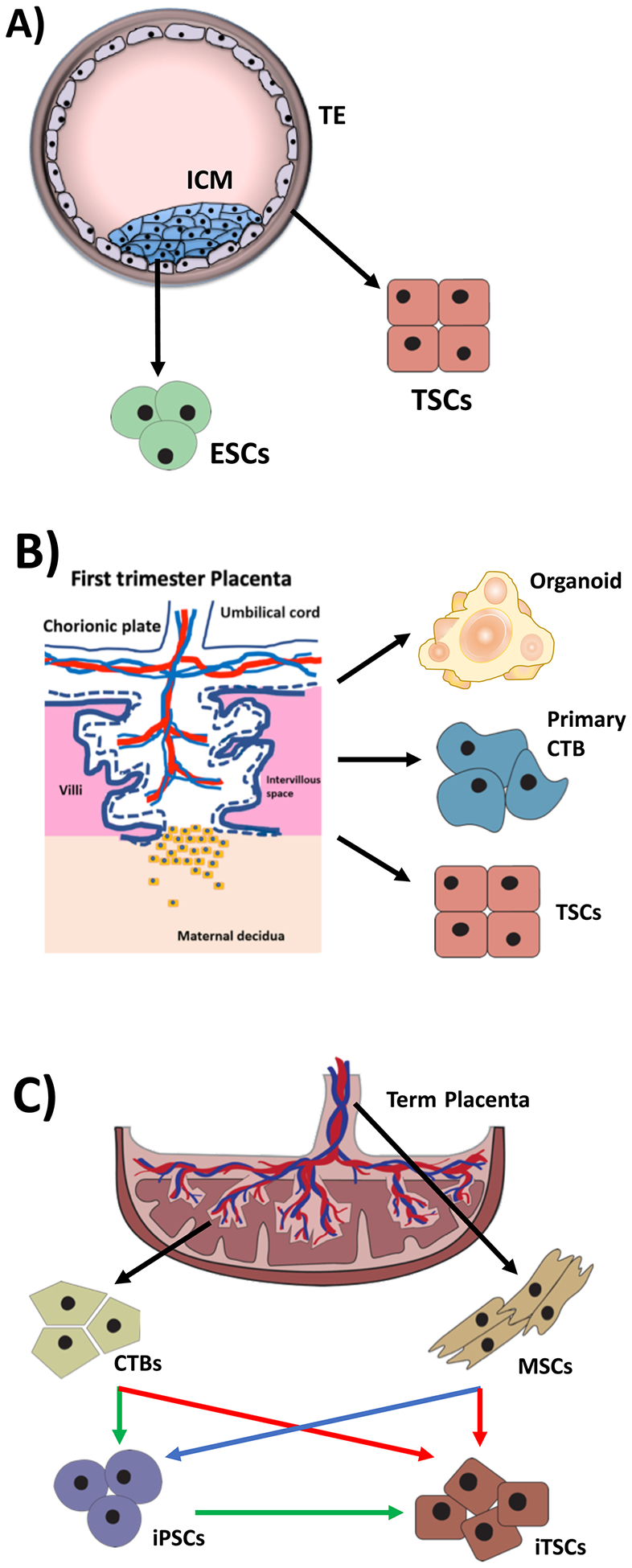
Appropriate human trophoblast lineage specification and differentiation is crucial for the establishment of normal placentation and maintenance of pregnancy. However, due to the lack of proper modeling systems, the molecular mechanisms of these processes are still largely unknown. Much of the early studies in this area have been based on animal models and tumor-derived trophoblast cell lines, both of which are suboptimal for modeling this unique human organ. Recent advances in regenerative and stem cell biology methods have led to development of novel in vitro model systems for studying human trophoblast. These include derivation of human embryonic and induced pluripotent stem cells and establishment of methods for the differentiation of these cells into trophoblast, as well as the more recent derivation of human trophoblast stem cells. In addition, advances in culture conditions, from traditional two-dimensional monolayer culture to 3D culturing systems, have led to development of trophoblast organoid and placenta-on-a-chip model, enabling us to study human trophoblast function in context of more physiologically accurate environment. In this review, we will discuss these various model systems, with a focus on human trophoblast, and their ability to help elucidate the key mechanisms underlying placental development and function. This review focuses on model systems of human trophoblast differentiation, including advantages and limitations of stem cell-based culture, trophoblast organoid, and organ-on-a-chip methods and their applications in understanding placental development and disease.
适当的人类滋养层谱系特化和分化对于正常胎盘形成和妊娠维持至关重要。然而,由于缺乏适当的建模系统,这些过程的分子机制在很大程度上仍然未知。该领域的早期研究大多基于动物模型和肿瘤衍生的滋养层细胞系,这两种模型都不适合模拟这种独特的人类器官。再生和干细胞生物学方法的最新进展导致了用于研究人类滋养层的新型体外模型系统的发展。这些包括衍生人类胚胎和诱导多能干细胞,并建立这些细胞分化为滋养层的方法,以及最近衍生人类滋养层干细胞。此外,培养条件的进步,从传统的二维单层培养到 3D 培养系统,导致了滋养层类器官和芯片上胎盘模型的发展,使我们能够在更接近生理准确的环境中研究人类滋养层的功能。在这篇综述中,我们将讨论这些不同的模型系统,重点是人类滋养层,以及它们在阐明胎盘发育和功能的关键机制方面的能力。本文综述重点介绍了人类滋养层分化的模型系统,包括基于干细胞的培养、滋养层类器官和器官芯片方法的优缺点及其在理解胎盘发育和疾病中的应用。